









What is Value Betting: A Beginner's Guide to Finding Profitable Bets
Sports betting can often feel like a game of chance, where you're hoping your team pulls off a win. But what if you could approach it like a stock market investor, consistently identifying undervalued assets and capitalizing on market inefficiencies? This is the core idea behind value betting, a mathematical strategy that shifts the focus from picking winners to finding odds that are simply incorrect. Understanding what is value betting is the first step toward transforming your approach from simple gambling to a calculated, long-term investment strategy.
At its heart, value betting isn't about having a crystal ball. It's about recognizing when a sportsbook's odds offer a higher probability of an outcome occurring than the odds suggest. By consistently placing bets only when you have this mathematical edge, you can build a profitable portfolio over time, even if you don't win every single bet. This guide will break down the entire concept, from the basic math to the tools that can help you find these opportunities automatically.
Quick Summary
- Core Concept: Value betting is the practice of placing bets on odds that are higher than the true probability of the outcome. You are betting on an 'overpriced' outcome, giving you a mathematical edge.
- Expected Value (EV): The goal is to find bets with a positive expected value (+EV). This means that, on average, you will make a profit from that bet if you were to place it an infinite number of times.
- It's a Long-Term Strategy: Value betting is not a get-rich-quick scheme. It relies on the law of large numbers, meaning you need to place many value bets over time for the profits to materialize and overcome short-term variance (losing streaks).
- Tools are Essential: Manually finding value bets is extremely time-consuming. Most successful value bettors use specialized software, known as scanners, to automatically compare odds across dozens of sportsbooks and identify profitable opportunities in real-time.
What is Value Betting? A Deeper Explanation
To truly grasp the concept, let's move past the simple definition and use an analogy. Imagine someone offers you a bet on a standard coin flip. They believe the coin is weighted and offer you odds of +150 (2.50 in decimal) for it to land on heads. You know a fair coin has a 50% chance of landing on heads.
Are these good odds.
Absolutely. The +150 odds imply a probability of only 40% (100 / (150 + 100)). Since you know the true probability is 50%, the odds are mispriced in your favor. This is a value bet.
Even if the coin lands on tails this time, you know that if you made this exact bet 100 times, your understanding of the true probability would lead to a profit in the long run.
Value betting in sports works the same way, but it's more complex because the 'true' probability of a sports outcome is never 100% certain. Instead, it's about identifying when a sportsbook's offered odds are out of line with the more accurate probability of that event happening. You are essentially exploiting a pricing error made by the bookmaker. This is the foundation of understanding value betting—it's less about predicting sports and more about identifying mathematical discrepancies in the market.



How Value Betting Works: The Math Behind the Edge
While the concept is simple, the execution relies on a bit of math. Don't worry, it's straightforward and essential for anyone serious about this strategy. The process involves three key steps: calculating implied probability, estimating the true probability, and determining the expected value (EV).
Step 1: Calculating Implied Probability
Every set of odds has an 'implied probability'—the likelihood of an outcome happening as suggested by the bookmaker's price. You need to convert the odds into a percentage to see what the sportsbook is implying.
For decimal odds, the formula is:
Implied Probability = (1 / Decimal Odds) * 100
Example: The Los Angeles Lakers are playing the Boston Celtics, and a sportsbook offers odds of 2.20 for the Lakers to win. The implied probability is (1 / 2.20) * 100 = 45.45%. The sportsbook is saying the Lakers have a 45.45% chance of winning this game.
Step 2: Estimating the True Probability
This is the most challenging part of the value betting basics. How do you determine the 'true' probability of the Lakers winning? There are a few methods:
- Your Own Model: You could build a sophisticated statistical model based on historical data, player performance, injuries, and other factors. This is what professional betting syndicates do, but it's incredibly difficult and requires advanced statistical knowledge.
- Market Consensus: A much more practical approach is to use the 'wisdom of the crowd'. You can look at the odds from the sharpest sportsbooks in the world (like Pinnacle) or odds comparison sites. These 'sharp' books are very efficient at pricing markets. If their odds suggest a 50% chance for the Lakers to win, but your local bookmaker is offering odds that imply only a 45.45% chance, you've likely found a value bet.
Step 3: The Expected Value (EV) Formula
Once you have the implied probability and your estimated true probability, you can calculate the Expected Value (EV) to see if the bet is profitable long-term. A positive EV (+EV) means you have found value.
The formula looks like this:
EV = (Profit if you Win * True Probability %) - (Stake * Implied Probability %)
Let's continue our Lakers example. You stake $100 at 2.20 odds.
- Profit if you Win: $100 * (2.20 – 1) = $120
- Stake: $100
- Your Estimated True Probability: 50% (0.50)
- Bookmaker's Implied Probability: 45.45% (0.4545)
EV = ($120 * 0.50) - ($100 * 0.4545)
EV = $60 - $45.45
EV = +$14.55
This +$14.55 EV means that for every $100 you wager on this bet, you can expect to make an average profit of $14.55 over the long run. Some bets will lose, some will win, but the average outcome is positive. This is the mathematical proof that you have an edge.
Key Benefits of a Value Betting Strategy

Adopting a value betting approach offers significant advantages that go far beyond just the potential for profit. It fundamentally changes your relationship with sports betting, turning it from a hobby based on hunches into a disciplined, analytical process.
First and foremost, the primary benefit is long-term profitability. Unlike betting based on gut feelings or team loyalty, value betting is rooted in mathematics. By consistently identifying and placing +EV bets, you are statistically guaranteed to make money over a large sample size of wagers. The law of large numbers works in your favor, smoothing out the inevitable ups and downs of short-term luck.
Second, it instills financial discipline and proper bankroll management. A core tenet of value betting is understanding variance. You will have losing streaks, even when making smart bets. This reality forces you to adopt a staking plan, such as the Kelly Criterion or a flat-staking model, where you only risk a small percentage of your total bankroll (e.g., 1-2%) on any single bet.
This prevents you from going broke during a downturn and ensures you can withstand the variance.
Finally, it provides a deeper understanding of betting markets. You start to see odds not as a prediction of who will win, but as a reflection of market supply and demand. You learn to identify which bookmakers are slow to update their lines, which markets are less efficient, and how news and public opinion can skew odds to create value opportunities. This knowledge is invaluable and elevates your betting intelligence significantly.
The Inherent Risks and Challenges: A Realistic Look
While value betting is a powerful strategy, it's crucial to approach it with a clear understanding of the potential downsides and challenges. It is not a risk-free path to guaranteed daily income, and anyone who tells you otherwise is not being honest.
The most significant challenge is variance. Even with a mathematical edge, you can experience prolonged losing streaks that can be mentally and financially taxing. It's entirely possible to place 50 consecutive +EV bets and end up with a net loss in the short term. You must have the discipline and the bankroll to ride out these downswings without abandoning your strategy.
This is often the biggest hurdle for newcomers.
Another major risk is account limitations or 'gubbing'. Sportsbooks are businesses, and they do not like consistent winners. If you are regularly beating their closing lines and extracting value, they may limit the amount you can wager or, in some cases, close your account altogether. This is a constant cat-and-mouse game for successful bettors.
To mitigate this, many value bettors spread their action across dozens of different sportsbooks.
Lastly, there is a significant time and effort commitment, especially if you try to find value manually. Constantly scanning odds across numerous bookmakers, calculating probabilities, and placing bets requires dedication. This is why most serious value bettors rely on specialized software. Even with tools, it requires time to manage your accounts, track your bets, and stay disciplined.
It's more of a part-time job than a passive investment.

Pro Tip: To reduce the risk of having your accounts limited, try to 'disguise' your value bets. Place occasional accumulator bets or small wagers on popular markets (like the Super Bowl or World Cup final) to appear more like a recreational bettor rather than a sharp, value-seeking player.
How to Find Value Bets: Methods and Tools
Now that the value betting explained section has covered the theory, how do you put it into practice? There are two primary methods for identifying these profitable opportunities: the manual, time-intensive approach and the efficient, software-driven approach.
Manual Identification: The Hard Way
Manually finding value bets involves opening dozens of browser tabs, each with a different sportsbook website. You would pick a game and meticulously compare the odds offered by each bookmaker for the same outcome. For example, for a single tennis match, you might check the odds for Player A to win at 15 different sites.
Once you find a significant outlier—one book offering much higher odds than the others—you would then compare that price to the consensus line from a sharp bookmaker like Pinnacle. If the outlier's odds represent a positive expected value compared to the sharp line, you've found a value bet. As you can imagine, this process is incredibly slow and inefficient. Odds change rapidly, and by the time you've done the comparison, the value opportunity might have disappeared.
Using Value Betting Software: The Smart Way
This is how nearly all successful value bettors operate in 2026. Value betting software, often called 'scanners' or 'odds screeners', automates the entire process. These tools constantly scan the odds from hundreds of sportsbooks in real-time.
When the software detects a discrepancy where one bookmaker's odds are significantly higher than the market average or a sharp bookmaker's line, it flags it as a potential value bet. It instantly calculates the edge or EV percentage and presents it to you on a dashboard. All you have to do is click a link that takes you directly to the betslip on the sportsbook's site, enter your stake, and place the bet. What would take hours to do manually can be done in seconds with software.
Top Tools for Finding Value Bets in 2026
Choosing the right software is critical to your success. These tools are the engine of your value betting operation, saving you time and directly identifying your profitable wagers. Here are a few of the top recommendations in the space.
RebelBetting: The All-in-One Solution
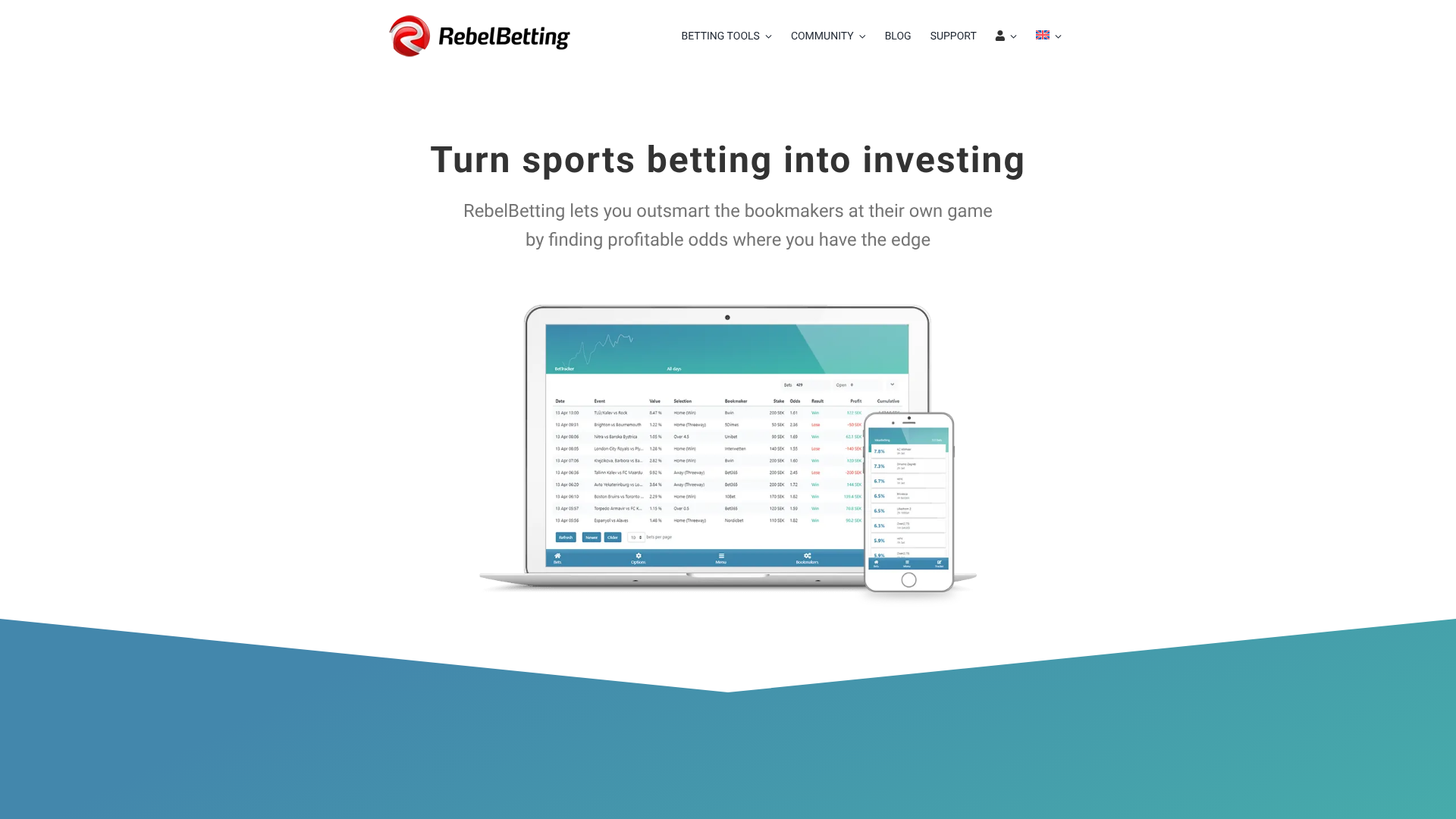
RebelBetting has been a leader in the betting tools space for over a decade, known for its reliability and user-friendly interface. Their Value Betting product is specifically designed to find +EV bets by comparing odds against the 'true' odds set by sharp bookmakers. The platform is clean, fast, and includes a built-in bet tracker to monitor your profits automatically.
It's an excellent choice for both beginners and experienced bettors who want a dedicated, powerful tool for finding value. They also offer a Sure Betting (arbitrage) product, allowing you to diversify your strategies within one ecosystem.
Pros
- Highly reliable and fast odds updates.
- User-friendly interface is great for beginners.
- Includes an integrated bet tracker and analytics.
- Offers both value betting and sure betting products.
Cons
- Subscription cost can be high for those with a small bankroll.
- Primarily focused on European and international bookmakers.
OddsJam: The Data-Driven Approach for US Bettors
For bettors located in the United States, OddsJam is an indispensable tool. The US betting market is fragmented with different sportsbooks in each state, and OddsJam excels at covering a massive range of them. Their Positive EV tool is the core of their value betting offering, presenting a constant stream of opportunities.
Beyond just value betting, OddsJam provides a suite of other tools, including arbitrage finders, low-hold converters for promotions, and a fantasy optimizer. It's a comprehensive data hub for any serious US-based sports bettor looking to find an edge.
Pros
- Extensive coverage of US sportsbooks.
- Provides a wide array of betting tools beyond just +EV.
- Excellent educational content and customer support.
- Data-rich platform for deep market analysis.
Cons
- The sheer amount of data can be overwhelming for absolute beginners.
- The subscription is one of the more expensive options on the market.
Arb Amigo: A Budget-Friendly Scanner

If you're just starting with value betting basics and are hesitant to commit to a high-priced subscription, Arb Amigo presents a compelling, budget-friendly alternative. It functions as a straightforward scanner for both arbitrage and value bets, focusing on delivering opportunities without all the bells and whistles of more expensive platforms.
While it may not have the extensive features or the slickest interface, it performs its core function well: identifying pricing discrepancies. It's a great entry point for new bettors to test the waters of value betting without a significant financial commitment.
Pros
- More affordable than many leading competitors.
- Simple, no-frills interface that is easy to navigate.
- Scans for both arbitrage and value betting opportunities.
Cons
- Fewer supported bookmakers compared to premium services.
- The speed of odds updates may be slightly slower than top-tier tools.
Pricing and Cost Considerations for Value Betting Tools
Investing in a value betting tool is a crucial step, but it's important to understand the costs involved and how they relate to your potential returns. These services operate on a subscription model, typically with monthly or annual payment options.
| Tool | Primary Focus | Target Market | Pricing Model |
|---|---|---|---|
| RebelBetting | Value Betting & Arbitrage | Global / Europe | Premium Monthly/Annual Subscription |
| OddsJam | Positive EV & Data Tools | United States | Tiered Monthly/Annual Subscription |
| Arb Amigo | Arbitrage & Value Betting | Global | Budget-Friendly Monthly/Annual Subscription |
It's essential to view the subscription fee not as an expense, but as an investment. The goal is for the profit generated from the value bets you find to significantly exceed the cost of the software. For example, if a tool costs $150 per month, you need to be confident that your betting activity will generate more than $150 in expected value each month to make it worthwhile.
Your starting bankroll plays a big role here. If you're starting with a $500 bankroll and placing 1-2% stakes ($5-$10 per bet), it will be challenging to cover a high subscription fee. Conversely, with a bankroll of $5,000 or more, the subscription cost becomes a much smaller percentage of your expected monthly profit. Always choose a tool that aligns with your bankroll and experience level.
For the most current pricing, be sure to visit each company's website directly.
Frequently Asked Questions about Value Betting
Here are answers to some of the most common questions people have when they are first learning about value betting.
Is value betting legal?
Yes, value betting is completely legal. You are simply using publicly available information (odds) to place bets at licensed and regulated sportsbooks. You are not engaging in any form of cheating, match-fixing, or illegal activity. However, while it is legal, sportsbooks are private companies and reserve the right to limit or close the accounts of customers they deem to be unprofitable for them.
What is the best sport for value betting?
There is no single 'best' sport, as value can appear in any market. However, value is often found more frequently in less popular sports or secondary markets (like player props or corners in soccer). This is because bookmakers dedicate fewer resources to setting precise lines for these events, leading to more errors. Sports with high volume and liquidity, like Tennis, Basketball, and Soccer, also present many opportunities due to the sheer number of games and markets available.
How much money do I need to start?
There's no magic number, but you should have a dedicated bankroll that you are comfortable losing. A common recommendation is to start with at least $500 to $1,000. This amount is large enough to allow you to place many small bets (e.g., $5-$20) to overcome variance, and it can help you generate enough profit to cover software subscription costs. Starting with too little (e.g., $100) makes it very difficult to withstand a losing streak.
Is value betting the same as arbitrage betting?
No, but they are related concepts that both exploit odds discrepancies. Arbitrage betting (or 'sure betting') involves placing bets on all possible outcomes of an event across different bookmakers to lock in a guaranteed, risk-free profit, regardless of the result. Value betting involves betting on only one outcome that you have identified as having a positive expected value. Value betting carries short-term risk (the bet can lose) but typically offers a higher long-term ROI than arbitrage.
How profitable is value betting in the long run?
Profitability, often measured as Return on Investment (ROI), can vary based on your skill, the number of bets you place, and the edge you achieve. A realistic long-term ROI for a diligent value bettor is typically in the range of 2% to 8%. While that may not sound like much, consider that this is a return on your total turnover. If you wager $50,000 in a month, a 4% ROI would result in a $2,000 profit.
It's a game of volume and consistent small edges.
Final Thoughts: Is Value Betting Worth It for You?
Understanding value betting is the first step on a path that can transform sports betting from a speculative pastime into a disciplined, analytical pursuit of profit. It requires a shift in mindset: you are no longer a fan cheering for a team, but an investor hunting for mispriced assets in a dynamic market. The focus moves from the thrill of a single win to the satisfaction of executing a profitable long-term strategy.
The journey is not without its challenges. It demands patience to withstand variance, discipline in bankroll management, and an acceptance that you will face account limitations. It is not a passive activity; it requires active engagement and a commitment to learning and adapting.
For those willing to put in the effort, the rewards can be substantial. By leveraging powerful tools like RebelBetting for a robust global experience or OddsJam for the US market, you can systematically turn the odds in your favor. If you are serious about making a consistent profit from sports betting, then learning and applying the principles of value betting is not just worth it—it's essential.