









Value Betting Prediction Explained: A Beginner's Guide to Finding Profitable Bets
Most people see sports betting as a game of chance, a fun way to have some skin in the game while watching their favorite team. But for a small, disciplined group, it's treated more like investing in the stock market. They aren't guessing; they're calculating. The core of this analytical approach is the value betting prediction, a method that systematically identifies wagers where the odds offered by a bookmaker are more favorable than the true probability of the outcome.
It's about finding and exploiting pricing errors in the betting market.
This guide breaks down exactly what a betting prediction value is and how you can use it to shift from being a casual gambler to a strategic bettor. We'll cover the mathematical formula behind it, the strategies used to find these opportunities, and the tools that can automate the entire process. The goal is to stop betting on who you think will win and start betting on odds that give you a mathematical edge over the long run.
What You'll Learn
- The Core Concept: A value bet exists when the probability of an outcome is greater than the probability implied by the bookmaker's odds. It's a bet with a positive expected value (+EV).
- The Math Behind It: Value betting relies on a simple formula to calculate Expected Value (EV). Understanding this formula is the first step to making data-driven betting decisions.
- Why Value Exists: Bookmakers aren't perfect. Odds shift due to market activity, new information, and differing opinions, creating temporary pricing mistakes that savvy bettors can exploit.
- Tools Are Essential: Manually finding value bets is extremely difficult and time-consuming. Specialized software is necessary to scan thousands of odds across multiple sportsbooks in real-time.
- It's a Long-Term Strategy: Value betting is not a get-rich-quick scheme. It requires patience, discipline, and a proper bankroll to withstand short-term losing streaks (variance) to achieve long-term profitability.
What is a Value Betting Prediction?
A value betting prediction is a forecast that identifies a bet where the potential payout is disproportionately high compared to the actual statistical probability of it happening. In simpler terms, you're betting on odds that you believe are incorrect in your favor. It’s the betting equivalent of finding an item on sale for $10 when you know it's actually worth $15.
To grasp this, you need to understand two types of probability: implied probability and true probability. Implied probability is what the bookmaker's odds suggest. For example, odds of +100 (or 2.00 in decimal) have an implied probability of 50%. True probability is your (or a model's) assessment of the actual likelihood of that event occurring.
A value bet exists when your calculated true probability is higher than the bookmaker's implied probability. If you believe a team has a 55% chance to win, but the odds are +100 (implying a 50% chance), you have found a value bet. You have an edge.
The Formula for Expected Value (+EV)
The concept of value is quantified using a formula for Expected Value, or EV. A positive EV (+EV) means the bet is profitable on average over the long term. A negative EV (-EV) means it's a losing bet in the long run. This is the single most important calculation in strategic sports betting.
The formula is:



Expected Value (EV) = (Probability of Winning x Profit if You Win) – (Probability of Losing x Amount You Stake)
Let's use a simple coin toss example. You bet $10 on heads. A fair coin has a 50% chance of landing on heads and a 50% chance of landing on tails.
- A bookmaker offers you odds of +110 (win $11 profit for a $10 stake). Let's calculate the EV.
- Probability of Winning = 0.50 (50%)
- Profit if You Win = $11
- Probability of Losing = 0.50 (50%)
- Amount You Stake = $10
EV = (0.50 * $11) – (0.50 * $10) = $5.50 – $5.00 = +$0.50
This bet has a positive expected value of $0.50. This doesn't mean you'll win 50 cents every time. It means that if you made this exact bet hundreds of times, you would expect to average a profit of 50 cents per bet. This is a clear value bet you should always take.
How Value Betting Predictions Actually Work
Understanding the theory is one thing, but knowing why these opportunities appear in the first place is key. Value bets don't happen by magic. They are the result of inefficiencies in the massive, complex sports betting market.
Bookmakers set their initial odds based on sophisticated statistical models. However, their primary goal isn't just to predict the outcome; it's to create a balanced book where they make a profit regardless of who wins. They do this by building a margin, or "vigorish" (vig), into their odds. This is why if you add up the implied probabilities of all outcomes in a match, it will total more than 100%.
So, where does the value come from? Odds are not static. They move based on several factors:
- Weight of Money: If a large amount of public money comes in on one side, the bookmaker will adjust the odds to encourage betting on the other side to balance their books. This can shift the line away from the true probability, creating value on the less popular side.
- New Information: An unexpected injury to a star player, a last-minute lineup change, or even changing weather conditions can dramatically alter a team's chances of winning. The market might be slow to react, creating a window of opportunity.
- Differing Bookmaker Opinions: Not all sportsbooks have the same odds. One bookmaker might have a slightly different algorithm or a slower reaction time, creating a price discrepancy you can exploit.
A value bet forecast capitalizes on these moments. It identifies when a bookmaker's line has strayed too far from the true probability of an event, giving you a profitable edge.


Identifying Value: Manual Methods vs. Automated Tools
Now for the most important question: how do you actually find these golden opportunities? There are two primary approaches: the incredibly difficult manual way and the far more efficient automated way.
The Manual Approach: Building Your Own Models
Technically, you could find value bets on your own without any software. However, this path is reserved for a tiny fraction of professional bettors who are also expert statisticians and data scientists. It involves building predictive models from scratch for a specific sport or league.
This process would look something like this:
- Data Collection: You'd need to gather vast amounts of historical data—team performance, player statistics, weather data, injury reports, and more. This data often needs to be purchased or scraped from reliable sources.
- Model Building: You would use statistical techniques like regression analysis to build a model that predicts the outcomes of future games. Your model would need to be more accurate than the bookmakers' models.
- Generating Probabilities: Your model would output a "true" probability for each outcome (e.g., Team A has a 65% chance of winning).
- Odds Comparison: You would then manually compare your model's probabilities against the live odds offered by dozens of sportsbooks to find discrepancies and calculate the EV.
As you can imagine, this is a monumental task. It requires advanced skills, significant time, and constant refinement. For 99.9% of bettors, it's simply not a realistic option.
The Automated Approach: Using Value Betting Software
This is where technology comes in. Value betting software does all the heavy lifting for you. These platforms don't necessarily predict who will win. Instead, they work by comparing odds across a huge number of different sportsbooks to find mathematical inefficiencies.
The most common method is comparing odds from "sharp" bookmakers (like Pinnacle) against "soft" bookmakers (recreational books like DraftKings or FanDuel). Sharp bookmakers have very accurate odds and low margins because they welcome professional bettors. Soft bookmakers have higher margins and are often slower to adjust their lines.
When a soft bookmaker's odds are significantly different from the sharp bookmaker's odds, a value bet is often created. The software scans thousands of markets per second to flag these opportunities in real-time. It instantly calculates the edge (or EV) for you, presenting a simple list of profitable bets to place.
Top Value Betting Prediction Tools for 2026
For anyone serious about value betting, using a dedicated tool is non-negotiable. These platforms provide the speed and data access required to succeed. Here are some of the top options available today.
1. RebelBetting
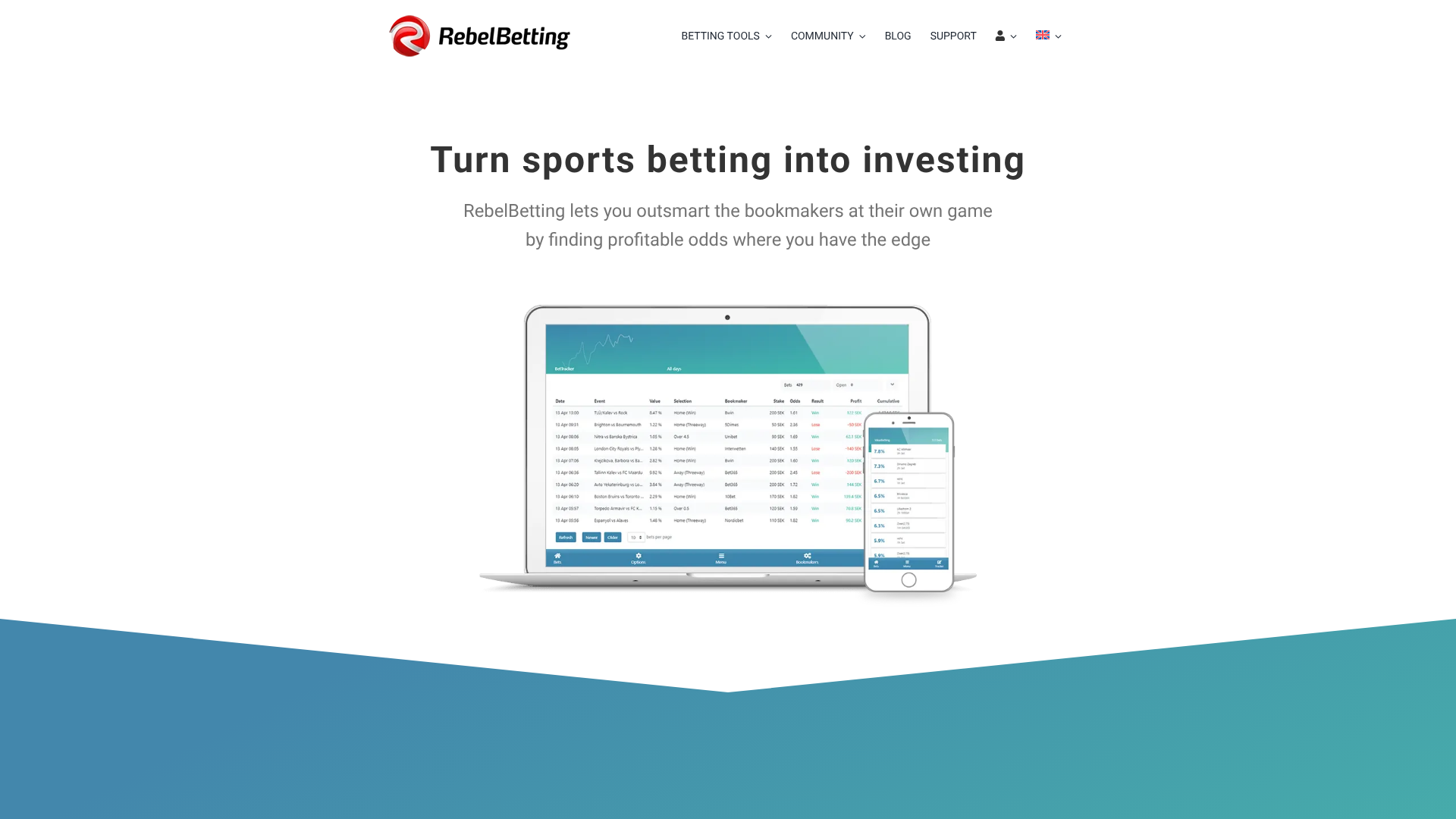
RebelBetting is one of the most established and respected names in the space, specializing in both value betting and arbitrage betting. Their platform is designed to be user-friendly for beginners while offering the power that serious bettors need.
The core of their service is a real-time scanner that identifies value bets across over 90 different bookmakers. It presents each bet with a clear "value" percentage, which represents your expected profit margin. They also include a built-in bet tracker to help you monitor your performance and manage your bankroll effectively.
Pros
- Highly Reliable: They have a long track record of providing accurate and fast data.
- User-Friendly Interface: The dashboard is clean and easy to navigate, making it simple to find and place bets.
- Comprehensive Bet Tracker: Integrated tracking helps you stay organized and analyze your long-term results.
Cons
- Subscription Cost: It's a premium service with a monthly fee, which can be a hurdle for those with a small starting bankroll.
- Focus on Major Markets: While coverage is extensive, it may not have as many obscure leagues as some other services.
2. OddsJam

OddsJam is another top-tier platform that offers a suite of betting tools, with its Positive EV tool being the main attraction for value bettors. It was founded by data scientists and mathematicians, and its technology is built for speed and accuracy.
OddsJam scans millions of odds per minute from over 100 sportsbooks to find profitable betting opportunities. The platform highlights the bet, the sportsbook offering the value, and the percentage edge you have. It also provides direct links to the sportsbook to help you place the bet quickly before the line moves.
Pros
- Incredible Speed: The odds refresh extremely quickly, which is critical for catching value bets before they disappear.
- Wide Sportsbook Coverage: They cover a massive range of sportsbooks, including many US-based options.
- Educational Resources: OddsJam provides a wealth of tutorials and guides to help users understand the concepts behind their tools.
Cons
- Can Be Overwhelming: The amount of data and tools can be intimidating for complete beginners.
- Premium Price Point: Like other high-end tools, the subscription cost reflects the quality of the data and technology.
3. Rithmm

Rithmm offers a slightly different approach. Instead of just finding market inefficiencies, Rithmm gives you the power of AI to create your own predictive models without needing to code. You can build, backtest, and use personalized models to generate your own betting predictions.
This is for the bettor who wants more control and wants to develop their own unique edge. You can select from various factors to include in your model, and the AI does the work of finding which ones are most predictive. You can then use your model's outputs to identify value in the market. It's a bridge between the fully manual and fully automated approaches.
Pros
- Customizable Models: Gives you the power to build a strategy that is unique to you.
- AI-Powered: Uses sophisticated machine learning to find predictive patterns in data.
- Great for Deeper Analysis: Perfect for bettors who love to dig into the stats and want to understand why a bet has value.
Cons
- Steeper Learning Curve: Requires more effort to set up and understand than a simple odds scanner.
- Model-Dependent: The success of your bets depends on the quality of the models you build.
Value Betting Software Comparison
| Feature | RebelBetting | OddsJam | Rithmm |
|---|---|---|---|
| Primary Method | Odds Comparison | Odds Comparison | AI Model Building |
| Best For | Beginners & Serious Bettors | US-Based Bettors, Speed | Data-Driven Bettors |
| Ease of Use | Very High | High | Medium |
| Number of Bookmakers | 90+ | 100+ | N/A |
| Key Feature | Bet Tracker, Simplicity | Real-Time Speed, US Focus | Custom AI Models |
Understanding the Costs and ROI
One of the first questions newcomers have is about the cost of these services. High-quality value betting software requires a monthly subscription. This is because the providers have significant overhead costs, including paying for fast, reliable data feeds from sportsbooks, server maintenance, and continuous software development.
While the idea of paying for betting tips might seem counterintuitive, it's important to reframe your thinking. You are not buying "picks." You are paying for access to a powerful data-processing tool that finds mathematical opportunities. The subscription fee should be considered an investment or a business expense.
Pricing for premium services typically ranges from around $100 to several hundred dollars per month, depending on the plan and features included. Most services offer different tiers, such as a basic plan for value betting and a pro plan that might include arbitrage betting as well.
Pro Tip: Before committing to a subscription, take advantage of any free trials offered. This allows you to get comfortable with the software's interface and see the quality of the opportunities it finds without any financial risk.
As for Return on Investment (ROI), a realistic long-term ROI for value betting is typically in the range of 2% to 8%. This might sound low, but it's crucial to remember this is a high-volume strategy. If you are placing dozens of bets per day, even a small, consistent edge can compound into significant profits over time. A 4% ROI on a total turnover of $25,000 in a month would yield a profit of $1,000.
The Reality of Value Betting: Pros and Cons
While value betting is a mathematically sound strategy for achieving long-term profit, it is not without its challenges. It's essential to go in with a realistic understanding of both the advantages and the hurdles you will face.
The Pros
- A Proven Mathematical Edge: Unlike most betting strategies, value betting is based on a proven mathematical principle. You are consistently placing bets with a positive expected return.
- Removes Emotion and Guesswork: Your decisions are based on data, not gut feelings or team loyalty. This disciplined approach prevents you from making common betting mistakes.
- Long-Term Profitability: While results will fluctuate day-to-day, the strategy is designed to be profitable over hundreds or thousands of bets.
The Cons
- Variance is Real: You will experience losing streaks. This is a statistical certainty known as variance. It's possible to place 20 consecutive +EV bets and lose most of them. You need the discipline and bankroll to push through these downswings.
- Requires a Sufficient Bankroll: To handle variance and place enough bets to realize your edge, you need a dedicated bankroll. Starting with too little money can lead to going broke during a normal downswing.
- Bookmaker Limitations: Soft bookmakers do not like winning players. If you consistently beat them, they may limit your stake sizes or even close your account. This is a constant cat-and-mouse game for successful bettors.
- It Requires Speed and Dedication: Value bets don't last long. The market corrects itself quickly. You need to be ready to place bets as soon as they appear, which requires time and attention.
Finding Value Bets: A How-To Video
Seeing how a tool works in practice can make the concept much clearer. This video from OddAlerts provides a great walkthrough of how software can be used to identify value opportunities in seconds.
Frequently Asked Questions (FAQ)
Here are answers to some of the most common questions people have about value betting predictions.
Is value betting legal?
Yes, value betting is completely legal. You are simply using publicly available information (the odds) to find profitable wagering opportunities. It is no different from a stock trader analyzing market data to find undervalued stocks. However, while it is legal, bookmakers are private companies and have the right to refuse your business.
Consistently winning players may face account limitations or closures, which is a risk of the strategy.
How much money do I need to start value betting?
There is no single magic number, but you need enough to withstand variance. Most experts recommend a starting bankroll of at least $1,000. A common staking strategy is to bet 1% of your total bankroll on each value bet (this is known as flat staking). With a $1,000 bankroll, this would mean placing $10 on each bet.
This approach protects you from losing a significant portion of your funds during a downswing.
Can you lose money with value betting?
Absolutely. In the short term, you can and will lose money. It is critical to understand that value betting guarantees a long-term edge, not a short-term profit. A losing week or even a losing month is entirely possible and should be expected due to variance.
The strategy only works if you stick with it over a large volume of bets (typically 1,000+). If you stop during a downswing, you will have lost money.
How quickly will I see profits?
This depends entirely on volume and luck (variance). Some users might see profits in their first week, while others might be down for their first month. The key is to focus on the process of consistently placing +EV bets, not on the short-term results. On average, your results should start to trend towards your expected ROI after you've placed several hundred bets.
Patience is non-negotiable.
What is a good ROI for value betting?
A sustainable, long-term ROI for value betting typically falls between 2% and 8%. Anything higher than 10% over a very large sample size is exceptional and rare. Newcomers might see higher initial ROIs as they take advantage of promotional offers and less efficient bookmakers, but this number tends to settle into the single digits as they place more bets and face potential account limitations.
Final Thoughts
Making the switch to a value betting prediction strategy is about fundamentally changing your perspective on sports betting. It's a move away from entertainment-based gambling and towards a disciplined, mathematical approach to finding profitable investments. It requires you to trust the math, remain disciplined during losing streaks, and put in the time to consistently find and place bets.
Manually calculating a value bet forecast is impractical for almost everyone. The modern approach relies on powerful software that can analyze the entire market in real-time. Tools like RebelBetting and OddsJam are essential for anyone serious about implementing this strategy effectively.
If you're tired of losing money based on gut feelings and want a proven, long-term method for taking on the bookmakers, exploring value betting is your next logical step. It’s not easy, and it’s not a path to instant riches, but it is one of the very few ways to actually gain a verifiable edge in the sports betting world.