









How to Use Betting Strategies for Sports: A Beginner's Guide to Winning
Most people who bet on sports lose money over the long run. They rely on gut feelings, bet on their favorite teams, and chase losses with emotional decisions. The key to shifting from a casual bettor to a profitable one is to adopt and consistently apply proven betting strategies for sports. This isn't about having a crystal ball to predict winners; it's about using a disciplined, mathematical approach to identify profitable opportunities and manage your money effectively.
This guide breaks down the fundamental and advanced tactics that separate sharp bettors from the public. You'll learn how to manage your bankroll, find value in the odds, and use powerful sports wager strategies to build a sustainable and potentially profitable hobby. It's time to stop gambling and start investing in your sports knowledge.
What You'll Learn
- Bankroll Management is Non-Negotiable: The foundation of all successful sports betting is protecting your capital. Sticking to a strict 1-2% unit size per bet is essential for surviving the inevitable losing streaks.
- Finding Value is the Goal: The secret to long-term profit isn't just picking winners, but finding bets where the odds offered are better than the true probability of an outcome. This is known as Positive Expected Value (+EV).
- Line Shopping is Free Money: Never place a bet without checking the odds at multiple sportsbooks. Small differences in lines and prices add up to significant gains over hundreds or thousands of bets.
- Discipline Trumps Emotion: Successful bettors operate like analysts, not fans. They stick to their strategy, avoid chasing losses, and never let a single win or loss affect their next decision.
- Tools Can Provide a Major Edge: Advanced strategies like arbitrage or high-volume value betting are nearly impossible to execute manually. Tools that scan the market for opportunities can automate the most difficult parts of the process.
What Are Betting Strategies for Sports? The Shift from Guessing to Winning
At its core, a sports betting strategy is a structured approach to wagering that aims for long-term profitability. It's the complete opposite of casual betting, which is often driven by emotion, team loyalty, or a simple desire for action on a big game. Instead of just trying to predict who will win, a strategic bettor focuses on identifying wagers that offer mathematical value.
Think of it this way: a casual bettor might bet on the Kansas City Chiefs because they are a popular team and have a star quarterback. A strategic bettor, however, analyzes the odds. They might determine that while the Chiefs are likely to win, the odds of -200 (implying a 66.7% win probability) don't offer value if their own data model suggests the Chiefs' true win probability is closer to 60%. They would pass on that bet, even if they think the Chiefs will win, because it's a -EV (Negative Expected Value) wager.
This fundamental shift in mindset is built on three core pillars: rigorous bankroll management to ensure you can withstand variance, a consistent method for identifying value in the betting markets, and disciplined execution to remove emotion from the equation. Adopting these principles transforms betting from a game of chance into a game of skill and analysis.
The Foundation: Essential Sports Betting Tips for Beginners
Before diving into complex models and advanced tactics, every bettor must master the fundamentals. These core principles are the bedrock of every successful strategy. Ignoring them is the fastest way to deplete your bankroll, regardless of how skilled you are at picking games.
Master Bankroll Management: The 1% Rule
Your bankroll is the total amount of money you have set aside specifically for betting, and you must be prepared to lose all of it. The single most important rule is to never bet more than 1-2% of your total bankroll on a single wager. This is often called the "1% rule" or unit-based betting.
For example, if you have a $1,000 bankroll, your standard bet size (one unit) should be $10 (1%). This might seem small and unexciting, but it's the mathematical shield that protects you from going broke during a losing streak. Even the best sports bettors in the world go through cold streaks where they lose 10 or 15 bets in a row. If you were betting 10% of your bankroll on each game, a 10-game losing streak would wipe you out completely.



With a 1% unit size, that same losing streak would only reduce your bankroll by 10%, leaving you with plenty of capital to continue betting and recover your losses when variance turns in your favor.
The Golden Rule of Betting: Always Shop for the Best Line
If you take only one piece of advice from this guide, let it be this: have accounts at multiple sportsbooks and always compare the odds before placing a bet. This practice, known as line shopping, is arguably the easiest and most effective way to increase your winnings. It's the "golden rule" because failing to do it is like willingly accepting worse payouts for the same risk.
Sportsbooks often have slightly different odds on the same game. One book might offer a point spread of -3 (-110), while another has -2.5 (-115). Securing that -2.5 is a massive advantage, as it means you win your bet if the team wins by exactly 3 points. Similarly, finding a moneyline at -140 instead of -150 means you risk less to win the same amount.
These small edges seem minor on a single bet, but over a season, they are the difference between being a break-even bettor and a profitable one.
Specialize, Don't Generalize
Sportsbooks have to set lines for thousands of events across dozens of sports. You don't. Your advantage as a bettor comes from specialization. Instead of trying to bet on the NFL, NBA, college basketball, and European soccer all at once, pick one or two sports—or even a specific niche within a sport—and become an expert.
By focusing on a smaller area, like NBA player props or WNBA totals, you can develop a deeper understanding than the generalist oddsmakers. You can learn the nuances of specific teams, player tendencies, and coaching strategies that a bookmaker with a broader focus might overlook. This information edge is where you can find consistent value that the general betting public misses.
Understand Implied Probability and Odds
Odds are simply a representation of probability. To make informed decisions, you need to understand what they mean. In American odds, a negative number (e.g., -150) shows how much you need to risk to win $100. A positive number (e.g., +200) shows how much you win for every $100 you risk.
More importantly, you can convert these odds into an implied probability—the likelihood of an outcome as suggested by the odds. For example, +200 odds have an implied probability of 33.3%. This answers a common question: "Is +200 odds bad?" The answer is no; it simply reflects an event the sportsbook thinks has a 1 in 3 chance of happening. Your job as a bettor is to determine if you believe the true probability is higher than 33.3%.
If you think the team has a 40% chance to win, then a +200 bet offers tremendous value.
Core Betting Tactics for Sports: Finding Your Edge
Once you have the fundamentals down, you can start implementing specific betting tactics for sports that professionals use to find profitable wagers. These methods move beyond basic principles and into active strategies for identifying and exploiting market inefficiencies.
Value Betting (+EV): The Professional's Approach
Positive Expected Value (+EV) betting is the cornerstone of every professional sports betting strategy. It means only placing wagers where you believe the probability of winning is greater than the implied probability offered by the sportsbook's odds. It's a simple concept but requires a disciplined approach to execute.
Imagine a coin flip. The true probability of heads is 50%. A sportsbook, however, might offer you +110 odds (47.6% implied probability) on heads. Even though the outcome is 50/50, this is a +EV bet because the payout is better than the true odds.
Over thousands of flips, you are mathematically guaranteed to make a profit by only betting on heads at +110. The challenge in sports is that unlike a coin flip, the "true" probability is unknown.
Finding +EV bets involves creating your own odds or using tools that compare lines across dozens of sportsbooks. When a sharp sportsbook (one known for accurate lines) has an outcome priced at +100 and another, slower book is still offering it at +120, that +120 line is likely a +EV bet. Tools like OddsJam are built specifically for this, constantly scanning the market to highlight these profitable discrepancies for you.

Pro Tip: Track your Closing Line Value (CLV). CLV measures whether you consistently beat the final, most efficient line before a game starts. If you bet on a team at -110 and the line closes at -125, you have positive CLV. Consistently beating the closing line is one of the strongest indicators of long-term betting success.
Fading the Public (Contrarian Betting)
Contrarian betting, or "fading the public," is a popular strategy based on betting against the team that is receiving the majority of public bets. The theory is that casual bettors tend to overvalue popular teams, star players, and recent performance, and they love betting on favorites and overs. This flood of public money can skew the betting lines, creating value on the other side.
For example, if 85% of the bets are on the Green Bay Packers to cover a -7 spread against the Detroit Lions, the sportsbooks may move the line to -7.5 or -8 to encourage betting on the Lions and balance their books. A contrarian bettor sees this inflated line and bets on the Lions +8, getting a better number than the true line simply because of public bias. This strategy requires a strong stomach, as you'll often be betting on underdog teams that look bad on paper, but it can be a highly effective long-term approach.
Chasing Steam and Following Sharp Money
This strategy is the opposite of fading the public. It involves identifying where the professional bettors, or "sharps," are placing their money and betting alongside them. A "steam move" is a sudden, drastic line change that occurs across the entire market simultaneously. This happens when a large betting syndicate or a respected sharp places a huge wager, forcing all sportsbooks to adjust their lines immediately.
By identifying these moves and placing your bet quickly, you are essentially riding the coattails of the most successful bettors in the world. The key is speed. The value in a steam move disappears within minutes, or even seconds, as the lines correct. This is another area where software is almost essential, as tools can send real-time alerts when these market-wide moves occur, giving you a chance to get in on the action before the value is gone.
Advanced Sports Wager Strategies and Tools
For bettors looking to take their game to the next level, several advanced strategies offer unique ways to find an edge. These methods often require more capital, speed, and a reliance on specialized software to be executed effectively. They represent the cutting edge of sports betting tactics.

Arbitrage Betting: The "Risk-Free" Profit Method
Arbitrage betting is a strategy that involves placing bets on all possible outcomes of an event across different sportsbooks to guarantee a small profit, regardless of the result. This is possible when sportsbooks have significant disagreements in their odds, creating a situation where the implied probabilities add up to less than 100%.
For instance, imagine a tennis match. Sportsbook A has Player 1 at +110 odds. Sportsbook B has Player 2 at -105 odds. By betting the correct amounts on both sides, you can lock in a guaranteed profit of around 1-2%.
While the returns per bet are small, they are theoretically risk-free. However, arbitrage has its challenges. These opportunities last for only a few minutes, and sportsbooks heavily frown upon it. If you're caught, your account will likely be limited or closed.
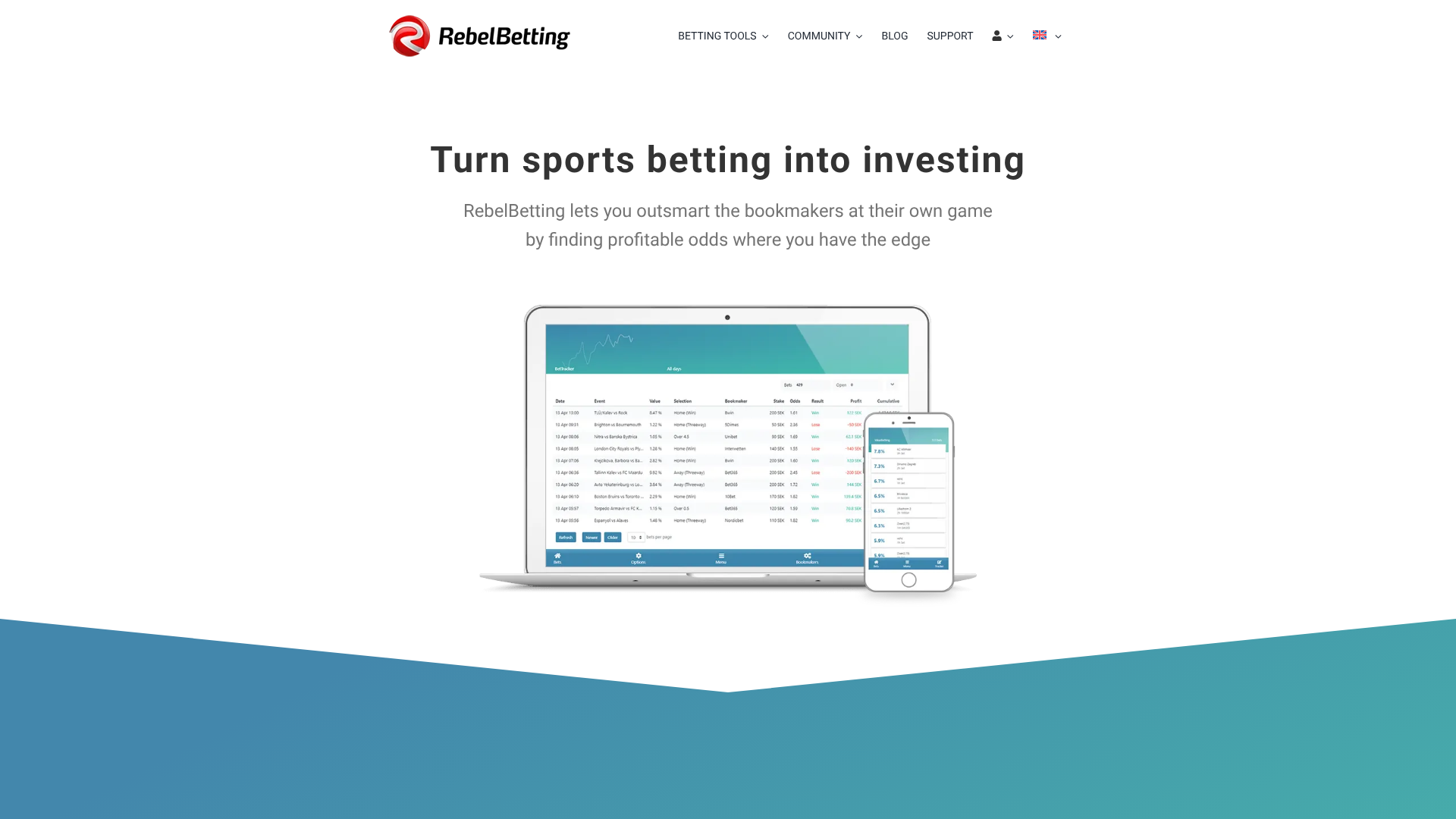
Manually finding these opportunities is nearly impossible. This is where platforms like Arb Amigo and RebelBetting become indispensable. They use powerful software to scan hundreds of sportsbooks in real-time and alert you the second an arbitrage opportunity appears, telling you exactly how much to bet on each side.
Data-Driven Prop Betting
The player proposition (prop) market is one of the fastest-growing areas in sports betting, and it's ripe with opportunities for sharp bettors. Sportsbooks put most of their effort into setting accurate game lines (spreads, moneylines, totals), which means prop lines can often be less efficient. A dedicated researcher can find a significant edge here.
This strategy involves deep statistical analysis of individual player performance, matchups, usage rates, and coaching schemes. For example, you might analyze a point guard's assist numbers against different defensive schemes or a wide receiver's target share when a team's primary receiver is injured. This level of granular research can uncover value that the broader market misses.
To do this effectively, you need access to clean, well-organized data. This is the problem that a tool like Props.Cash solves. It's a research platform that consolidates and visualizes years of player data, making it easy to spot trends, analyze matchups, and find profitable prop betting opportunities without spending hours digging through box scores.
Building Your Own Models with AI
The ultimate strategy for the most advanced bettors is to build their own predictive models. Historically, this required advanced skills in statistics and programming. You would need to gather vast amounts of data, clean it, and build algorithms to project game outcomes and compare those projections to the sportsbook lines.
Today, technology is making this more accessible. AI-powered platforms are emerging that allow bettors to create sophisticated models without writing a single line of code. You can choose which stats you think are most important, and the AI will backtest your theory and build a predictive model based on your inputs. This allows for a highly personalized and data-driven approach to betting.
A service like Rithmm is at the forefront of this space. It provides a user-friendly interface for building, testing, and deploying custom AI betting models. This gives you the power of quantitative analysis that was once reserved for only the most elite betting syndicates.
Choosing the Right Strategy & Tools for You
There is no single "best" betting strategy; the right one depends entirely on your personality, goals, bankroll, and time commitment. Choosing an approach that doesn't align with your resources or risk tolerance is a recipe for failure. Before you commit to a strategy, you need to conduct an honest self-assessment.
Assessing Your Goals, Risk Tolerance, and Time Commitment
First, what is your primary goal? Are you looking for slow, steady, low-risk growth, or are you comfortable with higher variance in pursuit of a greater long-term return? An arbitrage bettor, for example, accepts very low risk but needs a large bankroll and significant screen time to generate meaningful profit. A value bettor, on the other hand, must be comfortable with long losing streaks, knowing their edge will play out over time.
Next, consider your available time. Do you have hours each day to research player props and analyze matchups? If so, a hands-on strategy like prop betting could be perfect. If you have a full-time job and only 30 minutes a day to dedicate to betting, you'll be better served by a tool-driven approach, like using an arbitrage or +EV scanner that does the heavy lifting for you.
A Comparison of Top Sports Betting Tools
For those who choose a tool-assisted strategy, selecting the right software is crucial. Each platform is designed to serve a different type of bettor and strategy. Here’s a quick comparison of some of the leading options:
| Tool | Best For | Key Feature | Pricing Model |
|---|---|---|---|
| OddsJam | Value Betting (+EV) | Real-time scanner for +EV bets, middles, and low-hold opportunities | Subscription |
| RebelBetting | Arbitrage & Value Betting | High-speed arbitrage and value betting software with a profit guarantee | Subscription |
| Props.Cash | Player Prop Research | In-depth player statistics, research tools, and data visualization | Subscription |
| Rithmm | AI Model Building | No-code platform for creating and backtesting custom AI betting models | Subscription |
When evaluating these tools, consider their cost relative to your bankroll. A $200/month subscription might be a great investment for someone with a $10,000 bankroll, but it would be unsustainable for someone starting with $500. Most platforms offer free trials, which are a great way to see if the tool fits your workflow before committing.
The Pros and Cons of a Strategic Approach
Adopting a structured betting strategy can be incredibly rewarding, but it's not without its challenges. It's important to understand both the benefits and the potential drawbacks before you begin.
The Advantages
The most significant advantage is the potential for long-term profitability. By consistently applying a strategy with a mathematical edge, you shift the odds in your favor. You are no longer just a gambler hoping to get lucky; you are an investor exploiting market inefficiencies.
Another key benefit is the removal of emotion. A solid strategy provides a clear set of rules for what to bet, when to bet, and how much to bet. This disciplined framework prevents you from making impulsive decisions, like chasing losses after a bad beat or getting overconfident after a big win. It also leads to a deeper engagement with sports, as you learn to analyze games with a more critical and objective eye.
The Disadvantages and Risks
Strategic betting is not a get-rich-quick scheme. It requires a significant investment of time and effort. Whether you're doing your own research or learning to use sophisticated software, there is a steep learning curve. Success doesn't happen overnight.
Furthermore, there are no guarantees. Even with a perfect strategy, you will experience variance. Losing streaks are a mathematical certainty, and you must have the psychological fortitude and proper bankroll management to endure them. Finally, if you become too successful, especially with strategies like arbitrage, you run the very real risk of having your betting accounts limited or shut down by sportsbooks.
Pro Tip: Keep meticulous records of every bet you place. Track the sport, date, bet type, odds, stake, and outcome. This data is invaluable for analyzing your performance, identifying your strengths and weaknesses, and refining your strategy over time. You can't manage what you don't measure.
Frequently Asked Questions About Sports Betting Strategies
Here are answers to some of the most common questions new bettors have about developing a winning strategy.
What is the 80/20 rule in betting?
The 80/20 rule, or the Pareto Principle, can be applied to betting in a couple of ways. First, it suggests that roughly 80% of your profits will likely come from 20% of your bets or strategies. This highlights the importance of identifying and focusing on your most profitable niches. Second, it can relate to public betting percentages.
If over 80% of the public is on one side of a game, it's often a strong signal for a contrarian bettor to look at the other side, as the line may be inflated due to this lopsided action.
What is the 1% rule in gambling?
The 1% rule is a fundamental principle of bankroll management. It dictates that you should never risk more than 1% of your total bankroll on any single wager. This conservative approach ensures that you can withstand long losing streaks without depleting your capital. It's the most critical rule for ensuring longevity and surviving the natural variance inherent in sports betting.
What is the golden rule of betting?
The golden rule of sports betting is to always shop for the best line. This means having accounts at multiple sportsbooks and comparing their odds for every single bet you make. Consistently getting a slightly better point spread or a more favorable price on a moneyline is one of the easiest ways to increase your long-term profitability. It's a simple habit that separates sharp bettors from amateurs.
Is +200 odds bad?
No, +200 odds are not inherently bad or good. The number itself simply represents an implied probability of 33.3%. A bet is only "good" or "bad" in relation to its true probability. If you believe an event has a 40% chance of happening, then getting +200 odds is an excellent value bet.
If you believe the event only has a 25% chance of happening, then it's a bad bet. The odds themselves are just a price; your job is to determine if that price offers value.
What is the 100% profitable martingale strategy?
There is no such thing as a 100% profitable Martingale strategy. The Martingale system involves doubling your bet after every loss, with the idea that an eventual win will recover all previous losses plus a one-unit profit. While this sounds appealing in theory, it is catastrophically flawed in practice. It requires an infinite bankroll and no table limits, neither of which exist in the real world.
A string of losses will quickly force you to wager astronomical amounts, leading to complete financial ruin. It is one of the most dangerous betting systems and should be avoided at all costs.
What is the secret to win betting?
The "secret" is that there is no secret. Winning at sports betting is not about a hidden formula or a guaranteed system. It is the consistent application of several key principles: strict bankroll management, the discipline to only bet when you have identified positive expected value (+EV), the patience to endure losing streaks, and a commitment to continuous learning and improvement. Success is a result of a sound, long-term process, not a shortcut.
What percentage of gamblers win?
While exact figures are hard to come by, it is widely accepted in the industry that only a very small fraction of sports bettors are profitable in the long run. Most estimates place the number of consistent, long-term winners at just 1-3% of all bettors. This small group succeeds because they treat betting like a business, using disciplined strategies and analytical approaches, while the other 97-99% bet for entertainment and are prone to emotional decision-making.
Final Thoughts: Building Your Winning System
Transitioning from a casual fan to a strategic sports bettor is a journey that requires dedication, discipline, and a willingness to learn. There is no single magic formula for success. The key is to master the fundamentals of bankroll management and line shopping, and then find a strategy for identifying value that aligns with your skills, resources, and personality.
Remember that every professional bettor started where you are now. They built their success not on luck, but on a commitment to a sound process. They track their bets, analyze their performance, and constantly refine their approach. They understand that winning is a marathon, not a sprint, and they have the discipline to weather the inevitable ups and downs.
Whether you're manually researching games, using a powerful tool like OddsJam to spot +EV plays, or diving deep into player stats with Props.Cash, the most important step is to get started. Choose a strategy, stick to it with discipline, and commit to the process. That is the only proven path to long-term success in sports betting.