









Profitable Betting Strategies for Sports: A Step-by-Step Guide for Bettors
Transitioning from a casual fan who places a few bets for fun to a sharp bettor who wins consistently requires a fundamental shift in mindset. It’s not about luck, gut feelings, or loyalty to your favorite team. Success in this arena is built on a foundation of proven betting strategies for sports, discipline, and a clear understanding of how to find value in the market. This guide will walk you through the essential principles and tactics used by professionals to turn a hobby into a profitable venture.
We'll move beyond simply picking winners and into the core concepts that define successful sports wagering strategies. From the non-negotiable rule of bankroll management to advanced techniques like arbitrage and value betting, you'll learn how to approach sports betting as a calculated investment. We will also explore how modern tools can automate much of the heavy lifting, giving you an edge over the average bettor.
What You'll Learn
- Bankroll Management is Foundational: The single most important strategy is managing your money effectively. A disciplined staking plan using "units" protects you from ruin and is the bedrock of long-term success.
- Finding Value is the Goal: Profitable betting isn't about picking the most winners; it's about finding bets where the odds offered are better than the true probability of an outcome. This is known as Positive Expected Value (+EV).
- Line Shopping is Non-Negotiable: Never accept the first odds you see. Having accounts at multiple sportsbooks to compare lines is one of the easiest ways to instantly increase your profitability over time.
- Specialized Strategies Offer Unique Edges: Niche markets like player props and systematic approaches like arbitrage betting can provide significant advantages, as sportsbooks can't set perfect lines for everything.
- Modern Tools Provide a Major Advantage: Software designed to find +EV bets, arbitrage opportunities, and player prop data can automate complex processes and save you countless hours of manual research.
What Are Betting Strategies for Sports? (Beyond Just Picking Winners)
At its core, a sports betting strategy is a systematic and disciplined approach to wagering designed to mitigate risk and maximize long-term profitability. It's the crucial difference between gambling and investing. A casual bettor might place a wager on their favorite team to win the Super Bowl based on emotion and hope. A strategic bettor, however, makes decisions based on data, mathematical value, and a predefined plan.
The primary goal of any effective strategy isn't to win every single bet—that's impossible. Instead, the objective is to make decisions that have a positive expected value (+EV) over a large sample size. This means you're consistently placing wagers where the potential reward outweighs the statistical risk, according to your analysis. It’s about playing the long game.
This approach fundamentally changes how you view betting. It's no longer a series of isolated events but a continuous process of analysis and execution. It involves several key components: strict bankroll management, identifying value in the odds, specializing in specific markets, and often, using specialized tools to gain an edge. Adopting these betting tactics for sports is the first step toward treating your betting like a business rather than a lottery ticket.
The Cornerstone of All Sports Wagering Strategies: Bankroll Management
Before you even think about what team to bet on, you must master bankroll management. This is the single most important skill in sports betting, and without it, even the most brilliant handicapper will eventually go broke. Your bankroll is the total amount of money you have set aside specifically for betting—money you can comfortably afford to lose.
The Unit System: Your Key to Discipline
The most effective way to manage your bankroll is through the "unit" system. A unit is a percentage of your total bankroll, typically between 1% and 5%. For example, if your bankroll is $1,000, one unit (1%) would be $10. This becomes your standard bet size for most wagers.
- Beginners (1-2%): If you're new, stick to 1% or 2% units. A $1,000 bankroll means $10-$20 bets.
- Experienced Bettors (3-5%): If you have a proven track record of success, you might increase your unit size to 3-5%, but rarely more. A 5% bet should be reserved for wagers where you have extremely high confidence.
This system accomplishes two critical things. First, it protects you from devastating losses during an inevitable losing streak. If you lose five bets in a row, you've only lost 5% of your bankroll, not half of it. Second, it removes emotion from your staking decisions.



The size of your bet is determined by your system, not by how strongly you feel about a game.
Flat Betting vs. Percentage Staking
There are two main approaches to the unit system. Flat betting means your unit size stays the same regardless of bankroll fluctuations (e.g., your unit is always $10). Percentage-based staking means your unit size is always a percentage of your current bankroll. As your bankroll grows to $1,200, your 1% unit becomes $12.
As it shrinks to $800, your unit becomes $8.
Most professionals prefer the percentage model because it naturally compounds winnings and reduces risk during downturns. The key is consistency. Choose a system, define your unit size, and stick to it with unwavering discipline. This is the golden rule of betting.

Core Betting Tactics for Sports: Finding Your Edge
Once your bankroll management is in place, you can focus on finding profitable wagers. The following strategies are the building blocks used by sharp bettors to identify an edge over the sportsbooks.
Value Betting (Positive Expected Value, +EV)
This is the holy grail of sports betting. A bet has positive expected value (+EV) when the probability of it winning is greater than the probability implied by the sportsbook's odds. In simpler terms, you're getting a price that is a bargain relative to the actual risk.
Imagine a coin flip. The true probability of heads is 50%. If a sportsbook offered you +110 odds (implying a 47.6% probability) on heads, that would be a +EV bet. Even though you might lose the flip, making that same bet over and over again would guarantee you a profit in the long run.
The goal of a value bettor is to consistently identify these pricing errors in the market.
Finding +EV bets manually requires a deep understanding of a sport and the ability to create your own odds. However, this is where technology provides a massive shortcut. Tools like OddsJam use real-time data to scan thousands of odds across all major sportsbooks, instantly identifying +EV opportunities for you. It compares the odds at one book to the sharpest sportsbooks in the world to find discrepancies, saving you hours of work.

Line Shopping: The Easiest Way to Increase Profits
Line shopping is the practice of comparing the odds for the same bet across multiple sportsbooks. It is the single easiest and most effective strategy you can implement right now to improve your bottom line. Not all sportsbooks offer the same odds, and these small differences add up significantly over time.
Consider a standard point spread bet. Most books offer -110 odds on both sides, meaning you have to risk $110 to win $100. But what if you could find another book offering the same bet at -105. That might not seem like a big difference, but it is.
A bettor who consistently gets -105 odds only needs to win 51.2% of their bets to break even, while a bettor at -110 needs to win 52.4%. That 1.2% difference is often the margin between a winning and losing bettor.
To do this effectively, you must have accounts funded at multiple sportsbooks (ideally 5-10). Before placing any bet, you should quickly check the odds across all your available books and place the wager at the one offering the best price. This simple habit guarantees you are maximizing the return on every single winning ticket.
Fading the Public
"Fading the public" is a contrarian betting strategy that involves wagering against the team that is receiving the majority of public bets. The logic is that casual, public bettors are often influenced by media narratives, star players, and team popularity rather than data. This heavy, one-sided action can force sportsbooks to adjust their lines to mitigate their risk, creating inflated numbers on the popular side.
This inflation creates value on the other side of the bet—the less popular team or underdog. For example, if 85% of the public is betting on the Kansas City Chiefs, the sportsbook might move the line from Chiefs -6.5 to -7.5. A sharp bettor might see value in taking the underdog at +7.5, a more favorable number than the original line. This strategy is most effective in high-profile games, like primetime NFL matchups or major playoff games, where public bias is at its peak.
Advanced Betting Strategies for Sports: From Theory to Profit
With the fundamentals down, you can explore more advanced sports wagering strategies. These methods require more effort or specialized tools but can offer a more systematic and quantifiable edge.
Arbitrage Betting: The "Risk-Free" Method
Arbitrage betting, or "arbing," is a strategy that exploits price discrepancies between different sportsbooks to guarantee a small profit, regardless of the outcome. It involves placing bets on all possible outcomes of an event across multiple books.
Here’s a simple example: a tennis match between Player A and Player B.
- Sportsbook 1 offers Player A to win at +110 odds.
- Sportsbook 2 offers Player B to win at -105 odds.
By placing a calculated amount on each outcome, you can lock in a guaranteed profit. If you bet $100 on Player A at +110 (to win $110) and $105 on Player B at -105 (to win $100), your total risk is $205. No matter who wins, your payout will be $210, guaranteeing you a $5 profit.
While the concept is simple, finding these opportunities manually is nearly impossible as odds change rapidly. This is where specialized software is essential. Tools like Arb Amigo and RebelBetting are designed specifically to scan the market in real-time and alert you to arbitrage opportunities. The main downside is that sportsbooks dislike arbitrage bettors and may limit the accounts of those who practice it frequently.

Pro Tip: When executing an arbitrage bet, always place your wager on the "soft" or unusual line first. This is the odd that is most likely to change. Once that bet is confirmed, quickly place the hedge bet at the other sportsbook to lock in your profit.
Specializing in Niche Markets: Player Props
While sportsbooks are incredibly efficient at setting sharp lines for major markets like point spreads and totals, they can be more vulnerable in niche markets like player props. These are bets on an individual player's statistical performance, such as "LeBron James Over/Under 25.5 points."
There are thousands of player props available every day across various sports, and oddsmakers simply don't have the time or resources to set perfect lines for every single one. This creates opportunities for knowledgeable bettors who specialize. By focusing on a specific team, player, or even a single statistic, you can develop an informational edge over the sportsbook.
To succeed in this area, you need access to deep data. This is where a tool like Props.Cash becomes invaluable. It provides a comprehensive research platform with historical data, matchup analysis, defensive rankings, and trends, all presented in an easy-to-digest format. It allows you to quickly identify favorable matchups and statistical trends that support a particular prop bet, turning a guess into a data-driven decision.
Using AI and Predictive Modeling
One of the most modern approaches to sports betting involves using artificial intelligence and machine learning models to predict game outcomes. These models can process thousands of data points—far more than any human—to find patterns and correlations that lead to profitable betting opportunities.
This strategy removes human emotion and bias entirely from the equation. Instead of relying on a gut feeling, you rely on a model's output. While building your own predictive models requires advanced statistical knowledge, several services now offer this technology to the public.
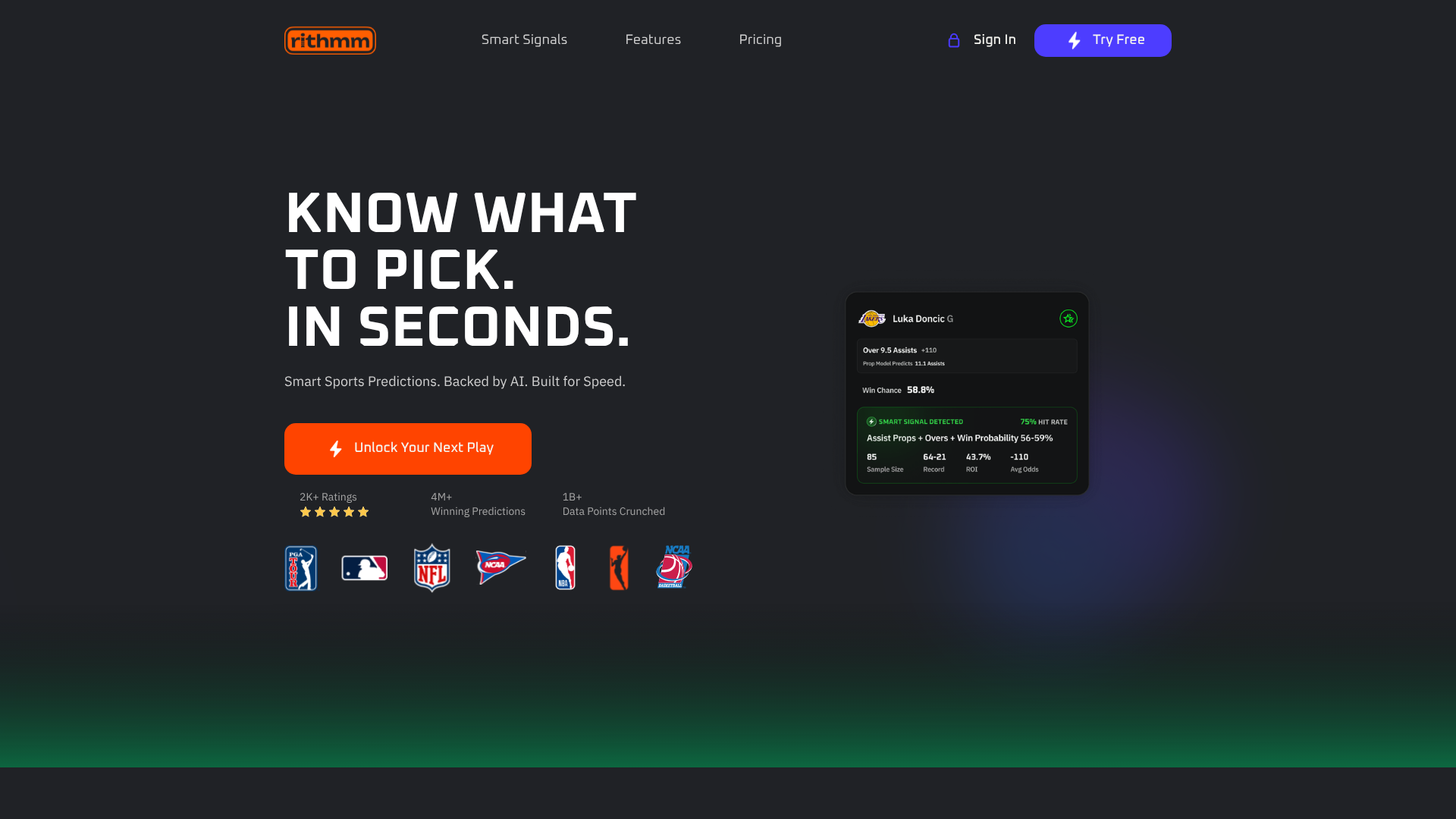
A great example is Rithmm, an AI-powered platform that allows you to build your own predictive models without any coding. You can select which stats you think are important, and the AI will generate picks based on your custom model. It's a powerful way to leverage high-level data analysis to inform your betting decisions.
How to Choose and Implement the Right Sports Betting Tips for You
With so many strategies available, choosing the right one can feel overwhelming. The best approach depends on your personal goals, risk tolerance, and the amount of time you're willing to commit. Here’s a step-by-step process to find what works for you.
- Assess Your Goals: Are you betting purely for entertainment, or is your primary goal to generate a consistent profit? If it's profit, you must be willing to bet on games you have no emotional attachment to and use a disciplined, mathematical approach.
- Evaluate Your Time Commitment: Some strategies are more time-intensive than others. Arbitrage betting requires you to be ready to place bets at a moment's notice. In-depth handicapping and player prop research can take hours each day. Conversely, using a tool for +EV betting can significantly cut down on research time.
- Determine Your Risk Tolerance: Are you comfortable with the variance of value betting, where you might endure losing streaks despite making good bets? Or do you prefer the low-risk, low-reward nature of arbitrage? Your comfort with risk will guide your choice.
- Start Small and Specialize: Don't try to master every sport and every strategy at once. Pick one sport you know well and one strategy that appeals to you. Focus on becoming an expert in that niche. Whether it's NFL player props or NBA first-quarter totals, specialization is key to developing an edge.
- Track Everything: You cannot improve what you do not measure. Keep a detailed record of every bet you place: the date, sport, teams, bet type, odds, stake size, and result. This data will reveal your strengths and weaknesses, allowing you to refine your approach and focus on what's actually working.
Top Tools to Supercharge Your Betting Tactics
Executing advanced betting strategies manually is possible, but it's incredibly time-consuming and inefficient. The modern sharp bettor uses specialized tools to automate research, find opportunities, and make faster, more informed decisions. Here are some of the top options available.
| Feature | OddsJam | RebelBetting | Props.Cash | Rithmm | Arb Amigo |
|---|---|---|---|---|---|
| Primary Use | +EV Betting, Line Shopping | Arbitrage, Value Betting | Player Prop Research | AI-Powered Picks | Arbitrage Betting |
| Best For | Bettors seeking consistent value | Serious arbitrage bettors | Data-driven prop bettors | Bettors who trust models | Beginners in arbitrage |
| Ease of Use | User-friendly interface | Steeper learning curve | Very intuitive | Simple to use | Straightforward |
| Free Trial | Yes | Yes | Yes | Yes | Yes |
1. OddsJam
OddsJam is arguably the most popular tool for value bettors in the U.S. market. Its primary function is its Positive EV screen, which constantly scans dozens of sportsbooks to find mathematically profitable betting opportunities. It also offers excellent tools for arbitrage, middling, and a fantasy optimizer.
If your goal is to implement a +EV strategy efficiently, OddsJam is an essential tool.
2. RebelBetting
RebelBetting is a long-standing and highly respected name in the industry, particularly popular in Europe but available globally. It specializes in sure betting (arbitrage) and value betting, providing a powerful software suite that identifies opportunities with impressive speed and reliability. It's geared more towards serious bettors who are looking to treat betting as a significant investment.
3. Props.Cash
For anyone serious about betting on player props, Props.Cash is a must-have. It's less of a bet-finding tool and more of a comprehensive research platform. It aggregates an incredible amount of data on player performance, matchups, and historical trends into easy-to-read charts and tables. It helps you quickly validate (or invalidate) your ideas for prop bets with hard data.
4. Rithmm
Rithmm takes a different approach by putting the power of artificial intelligence in your hands. Instead of just finding market inefficiencies, it helps you create your own predictive models to generate picks. It's perfect for the bettor who is data-savvy but doesn't have the coding skills to build their own AI from scratch. You can customize models based on stats you find important and let the AI do the work.
Pricing and Cost: Investing in Your Strategy
While fundamental strategies like bankroll management and basic line shopping are free, the most powerful and efficient methods often require an investment in tools. It's important to view these costs not as an expense, but as an investment in your betting business. A good tool should pay for itself through the value it provides.
Most of these platforms operate on a monthly subscription model. The prices can range from around $40 per month for a basic plan to several hundred dollars for professional-grade software. For example, a subscription to a value betting tool might cost $200 per month. If that tool helps you generate more than $200 in additional profit that you wouldn't have found otherwise, it's a worthwhile investment.
Before committing, take advantage of the free trials that most services offer. This allows you to test the platform, understand its features, and see if it aligns with your chosen strategy. For the most current pricing structures, it's always best to visit the websites directly, such as checking the latest plans on OddsJam or RebelBetting.
Pros and Cons of Using Systematic Betting Strategies
Adopting a structured approach to sports betting offers significant advantages, but it's important to have realistic expectations. It's not a magic formula for guaranteed riches, but rather a method for tilting the odds in your favor over the long run.
Pros
- Removes Emotion: A systematic approach forces you to make decisions based on data and logic, not on emotional biases or gut feelings. This is crucial for avoiding common mistakes like chasing losses.
- Provides Discipline: Strategies inherently come with rules for bankroll management and bet selection, providing a framework that promotes disciplined and consistent behavior.
- Increases Long-Term Profit Potential: By consistently identifying value and managing risk, you dramatically increase your chances of being profitable over a large number of bets.
- Manages Risk Effectively: The core of any good strategy is bankroll management, which is designed to protect you from going broke during inevitable losing streaks.
Cons
- Requires Patience and Discipline: These strategies are not get-rich-quick schemes. They require a long-term perspective and the discipline to stick to the plan, even when you're losing.
- Can Be Time-Consuming: Researching games, finding value, and tracking bets can take a significant amount of time, especially without the help of specialized tools.
- No Guarantees: Even the best strategy will have losing periods. Variance is a natural part of sports betting, and there is no such thing as a 100% guaranteed winner (outside of pure arbitrage).
- Cost of Tools: The most efficient tools and software come with a subscription fee, which needs to be factored into your overall profitability calculations.
Frequently Asked Questions (FAQ)
What's the best sports betting strategy?
There is no single "best" strategy, as the ideal approach depends on your goals, risk tolerance, and time commitment. However, the two foundational principles that every successful bettor must master are strict bankroll management and value betting (+EV). Without managing your money properly, no strategy can succeed long-term. And without consistently finding bets with positive expected value, you are simply gambling, not investing.
What is the 80/20 rule in betting?
The 80/20 rule, or the Pareto Principle, suggests that roughly 80% of your results will come from 20% of your efforts. In betting, this means you'll likely find that the vast majority of your profits come from a small subset of your strategies or the sports/markets you specialize in. The key takeaway is to identify that profitable 20%—whether it's betting on NFL player props or NBA first-half spreads—and focus most of your energy and bankroll there, rather than spreading yourself too thin.
What is the 1/3/2/6 strategy?
The 1-3-2-6 system is a staking plan most commonly used in casino games like Baccarat. It's a positive progression system where you increase your stake after a win. You start by betting 1 unit. If you win, you bet 3 units.
If you win again, you bet 2 units, and if you win a third time, you bet 6 units. If you lose at any stage, you revert back to a 1-unit bet. While it can be exciting, most professional sports bettors avoid such progression systems because they don't alter the underlying value of a bet and can expose your bankroll to unnecessary risk.
What is the golden rule of betting?
The undisputed golden rule of betting is effective bankroll management. Specifically, it can be broken down into two parts: 1) Never bet more money than you are willing and can comfortably afford to lose, and 2) Use a consistent staking plan, like the unit system (1-5% of your bankroll per bet). This rule ensures that you can withstand losing streaks without going broke and removes emotional decision-making from your bet sizing.
Final Thoughts: Building Your Winning Approach
Success in sports betting is not an accident. It's the result of a deliberate, disciplined, and strategic approach. By moving away from hopeful guesses and embracing the core principles of bankroll management, value betting, and line shopping, you fundamentally change your relationship with wagering. You stop being a gambler and start becoming an investor.
Remember that this is a long-term game. There will be ups and downs, but a solid strategy acts as your anchor, keeping you grounded and focused on the process rather than short-term results. Specializing in niche markets and leveraging technology can further sharpen your edge in an increasingly competitive market.
If you're serious about implementing these tactics, exploring the tools we've discussed is a logical next step. For those focused on finding mathematically profitable wagers daily, a platform like OddsJam can be an invaluable asset. If your passion lies in deep statistical research for player props, Props.Cash provides the data you need. Choose the strategy that fits your style, commit to the process, and you'll be well on your way to becoming a more profitable sports bettor.