









Betting Strategies for Football: A Step-by-Step Guide for Profit
Moving from casual weekend bets to a more structured approach is the single most important step you can take to improve your results. Implementing proven betting strategies for football transforms gambling from a game of chance into a calculated process focused on long-term profitability. It's about replacing gut feelings and team loyalties with data, discipline, and a clear plan for every wager you place.
This guide breaks down the fundamental principles and actionable techniques used by successful sports bettors. We'll cover everything from managing your money to identifying valuable odds and using specialized tools to gain an edge. Whether you're betting on the NFL or European soccer, these core concepts will provide the framework you need to bet smarter.
What You'll Learn
- Bankroll Management is Non-Negotiable: The foundation of all successful betting is protecting your capital. Staking only 1-3% of your total bankroll on any single bet is the golden rule that prevents catastrophic losses.
- Value is More Important Than Winners: The goal isn't just to pick the winning team; it's to find odds that offer a better payout than the team's true probability of winning. This concept, known as value betting, is the key to long-term success.
- Specialization Creates an Edge: You can't be an expert on every league and team. Focusing on a specific niche, like a particular league or bet type (e.g., player props), allows you to develop deeper knowledge than the sportsbooks.
- Discipline Outweighs Emotion: The most effective strategies remove emotional bias from the equation. A systematic approach prevents you from chasing losses or over-betting on your favorite team.
The Foundation: What Are Football Betting Strategies?
A football betting strategy is a structured, systematic approach to wagering on games. Instead of placing bets based on impulse or personal bias, a strategy relies on a set of rules and principles designed to identify profitable opportunities over the long run. It's the difference between randomly guessing lottery numbers and being a professional card counter in blackjack.
At its core, a strategy forces you to think critically about every bet. Why are you making this wager. Do the odds represent good value. How much should you stake.
These questions shift your mindset from a casual fan hoping for a win to a calculated investor seeking a positive return. This disciplined approach is what separates consistently profitable bettors from those who lose money season after season.
Effective football wagering strategies are built on pillars like bankroll management, statistical analysis, and understanding market odds. They help you avoid common pitfalls like chasing losses after a bad beat or betting too much on a "sure thing." Ultimately, a strategy provides a roadmap to navigate the ups and downs of sports betting, ensuring that one bad day doesn't wipe out your entire bankroll.
Core Principles Every Bettor Must Master

Before diving into specific techniques, you must understand the fundamental principles that underpin all successful betting. These aren't just suggestions; they are the non-negotiable rules that protect your capital and give you a fighting chance against the sportsbooks. Mastering these concepts is the first and most crucial step.



Bankroll Management: The Golden Rule of Betting
This is the most important concept in all of gambling. Without proper bankroll management, even the best bettor in the world will eventually go broke. The core idea is to only risk a small fraction of your total betting funds on any single wager. This ensures that a losing streak—which is inevitable—doesn't destroy your ability to continue betting.
The most common method is the "unit" system. A unit is a percentage of your total bankroll, typically between 1% and 3%. For example, if your starting bankroll is $1,000, one unit would be $10 (1%). Your standard bet size would be one unit, and you might risk up to 2-3 units on bets where you have a very high degree of confidence.
This flat-staking model removes emotion from your bet sizing and imposes critical discipline.
By sticking to this rule, you can withstand a string of 10 or even 20 consecutive losses without being wiped out. It forces you to think long-term and prevents the catastrophic mistake of betting big to try and win back recent losses, a behavior known as "chasing."
Understanding and Finding Value (Value Betting)
Value betting is the practice of placing a wager only when you believe the probability of an outcome is greater than the odds offered by the sportsbook suggest. In simple terms, you're getting a good price. Think of it like shopping: you wouldn't buy a $50 item for $100. The same logic applies to betting.
For example, imagine a coin toss. The true probability of heads is 50%. In betting odds, a 50% chance translates to +100 (or 2.00 in decimal). If a sportsbook offered you odds of +110 (a 47.6% implied probability) on heads, that would be a "value bet." Over an infinite number of coin flips, betting on heads at +110 would be profitable.
Finding value in football requires you to create your own assessment of a game's probabilities and compare them to the market odds. This can be done through statistical modeling, deep qualitative analysis, or a combination of both. The key is to consistently find spots where the bookmaker's odds are mispriced relative to your own analysis.
The Power of Line Shopping
Not all sportsbooks offer the same odds on the same game. One book might have the Green Bay Packers at -7, while another has them at -6.5. One might offer a moneyline price of -140, while another has it at -130. These small differences have a massive impact on your long-term profitability.
Line shopping is the simple act of checking multiple sportsbooks to ensure you get the best possible price for every bet you make. Securing an extra half-point on a point spread or getting a better price on a moneyline directly increases your potential return and can turn a long-term losing record into a winning one. It's one of the easiest and most effective football betting tips you can implement immediately.
Manually checking dozens of sites is tedious. This is where technology becomes essential. Tools like OddsJam are designed specifically for this purpose. They scan hundreds of sportsbooks in real-time and highlight the best available odds for any given bet, saving you time and ensuring you never accept a bad price.

Specialization: Become an Expert in a Niche
Trying to bet on every game in every league is a recipe for disaster. Sportsbooks have teams of experts and sophisticated algorithms setting lines for everything from the NFL to the Japanese J-League. You cannot possibly have more information than they do across such a broad range of markets.
Your advantage comes from specialization. By focusing on a specific niche, you can develop a deeper level of expertise than the general market. This could mean concentrating on one or two leagues you follow closely, like the English Premier League or the Big Ten in college football. You could also specialize in a specific bet type, such as player props or corner kicks in soccer.
When you specialize, you learn the nuances of the teams, players, and coaching tendencies. You can spot situational factors the market might overlook, such as a team's performance in cold weather or a key player's subtle injury. This focused knowledge is where you can find your edge and identify value that others miss.
Pro Tip: When specializing in player props, look for discrepancies between a player's recent performance and their season averages. A player on a hot streak might still have their prop line set closer to their average, creating a value opportunity.
Top Betting Strategies for Football Explained
Once you've mastered the core principles, you can begin applying specific, actionable strategies. These techniques range from mathematically guaranteed profit models to data-intensive approaches that require deep analysis. Each has its own risk profile and time commitment.
Arbitrage Betting (Surebetting)
Arbitrage betting, or "surebetting," is a mathematical strategy that guarantees a small profit by exploiting price discrepancies between different sportsbooks. It involves placing bets on all possible outcomes of an event across multiple bookies, ensuring that your winnings are greater than your total stake, regardless of who wins.
For example, let's say Sportsbook A has the Kansas City Chiefs at +110 and Sportsbook B has the Tampa Bay Buccaneers at -105. By placing a specific amount on each outcome, you can lock in a risk-free profit of around 1-2%. The profit margins are small, but they are guaranteed when executed correctly.
The main challenges of arbitrage are finding these opportunities and placing the bets before the odds change. This is nearly impossible to do manually. Services like RebelBetting and Arb Amigo are built to find these surebets for you, scanning the market constantly and alerting you to profitable opportunities.
Matched Betting
Matched betting is similar to arbitrage but focuses on leveraging the free bets and promotions offered by sportsbooks. It's a popular technique, especially in markets like the UK where promotions are plentiful. The goal is to cover all outcomes of an event to unlock a free bet with minimal risk, then use that free bet to guarantee a profit.
The process typically involves two steps. First, you place a "qualifying bet" on a team to win with one sportsbook. At the same time, you place a "lay bet" (a bet that the team will not win) on a betting exchange like Betfair. This cancels out your risk and qualifies you for the free bet.
Second, you repeat the process with the free bet stake, locking in a profit equal to about 80% of the free bet's value.
While highly effective, matched betting requires access to a betting exchange and a steady stream of promotional offers from bookmakers. It's a low-risk way to build a bankroll, particularly for beginners.
In-Play (Live) Wagering Strategies
Live betting, or in-play wagering, opens up a new world of strategic possibilities. Odds change rapidly based on the action on the field, creating opportunities that didn't exist before kickoff. Successful live betting requires quick thinking and a good feel for the game's momentum.
One popular soccer betting technique is to bet on a strong favorite if they concede an early goal. Their live odds will become much more attractive, yet they still have plenty of time to come back and win the match. Another strategy is to bet on "Over" the total goals when a game becomes stretched and end-to-end late in the second half.
For live betting, it's crucial to be watching the game. Statistics alone don't capture the flow and momentum of a match. You can often spot when a team is about to score or when a defense is looking vulnerable before the market fully adjusts.
Data-Driven Prop Betting
Player and team proposition (prop) bets are one of the fastest-growing markets in sports betting. Instead of betting on the game's outcome, you're wagering on a specific statistical achievement, like a quarterback's passing yards, a receiver's total receptions, or a striker's shots on target.
This is an area where deep statistical research can provide a significant edge. Sportsbooks may not have the resources to set perfectly sharp lines for hundreds of individual player props in every game. By analyzing player usage, recent form, and opponent matchups, you can often find mispriced lines.
This is where specialized tools shine. A platform like Props.Cash provides detailed dashboards with historical data, trends, and matchup analysis for thousands of players. It allows you to quickly research if a player has consistently gone over or under their prop line in similar situations, turning a time-consuming research process into a few clicks.
How to Choose and Implement Your Football Wagering Strategy
Selecting the right strategy depends on your personality, goals, and the resources you have available. There is no one-size-fits-all solution. A successful approach for one person might be a poor fit for another. The key is to find a method that aligns with your risk tolerance and the amount of time you can dedicate.
Assess Your Goals and Risk Tolerance
First, be honest with yourself about what you want to achieve. Are you looking for a low-risk, slow-and-steady method to build a bankroll? If so, strategies like matched betting or arbitrage might be perfect for you. These methods offer small, consistent returns with very little risk.
On the other hand, if you enjoy the analytical challenge and are comfortable with more volatility, a value betting approach might be a better fit. This strategy offers higher potential returns but also comes with the certainty of losing streaks. Your ability to handle the psychological pressure of these downswings is crucial. Your bankroll size also plays a role; some strategies require more capital to be effective.
Start Small and Track Everything
Regardless of which strategy you choose, start with small stakes. Use the unit system and risk only 1% of your bankroll while you're learning. This allows you to make mistakes and refine your process without it being a costly lesson. There is no substitute for experience, and starting small gives you the runway to gain it.
From your very first bet, track everything in a spreadsheet. Record the date, teams, bet type, stake, odds, sportsbook, and the result. You should also include a column for notes on why you made the bet. This data is invaluable.
Over time, it will reveal your strengths and weaknesses, helping you identify which strategies are working and which you should abandon.
Leveraging Technology and Tools
In today's betting landscape, technology is a massive advantage. Manually finding value, comparing odds, or researching stats is incredibly time-consuming. Using the right tools can automate these processes, allowing you to make more informed decisions in less time.
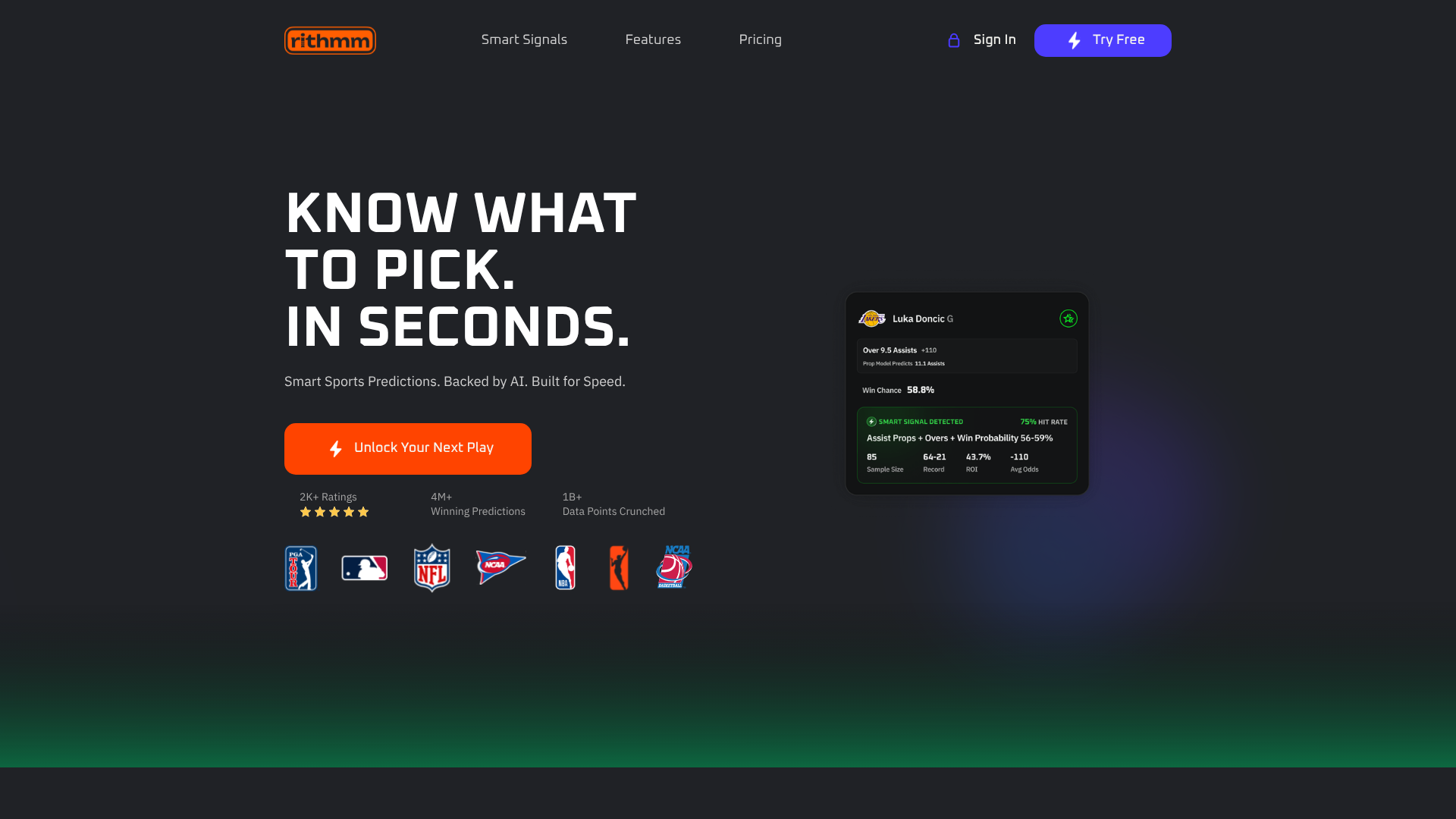
If you're a data-driven bettor but lack the time or expertise to build your own models, an AI-powered platform like Rithmm can be a powerful ally. It allows you to build and backtest custom betting models using AI, providing data-backed picks without the heavy lifting. Think of these tools not as a replacement for your own judgment, but as a highly efficient research assistant that can process vast amounts of data on your behalf.
The Cost of Strategic Betting: Tools and Services
While fundamental strategies like bankroll management are free to implement, many advanced techniques are significantly enhanced by paid tools and services. These platforms can be a worthwhile investment if you're serious about betting, as they provide an edge that is difficult to achieve manually. The cost varies widely, so it's important to find a tool that fits your budget and strategic needs.
Most of these services operate on a monthly or annual subscription model. The price often depends on the features included, such as the number of sportsbooks covered, the speed of the data, or the depth of the analytical tools. Here’s a brief comparison of some of the tools mentioned:
| Tool | Best For | Pricing Model | Key Feature |
|---|---|---|---|
| OddsJam | Line Shopping & Positive EV | Subscription | Real-time odds comparison across 200+ sportsbooks |
| RebelBetting | Arbitrage & Value Betting | Subscription | Dedicated surebet and value bet finding software |
| Props.Cash | Player Prop Research | Subscription | Detailed player stat dashboards and trend analysis |
| Rithmm | AI-Driven Picks | Subscription | Customizable AI models for generating betting picks |
It's important to view these costs as an investment in your betting process. A tool that consistently helps you find better odds or identify profitable bets can easily pay for itself over time. Many services offer free trials or lower-priced introductory tiers, allowing you to test their effectiveness before committing to a full subscription. Always visit the official websites for the most current pricing information.
Pros and Cons of Adopting a Formal Betting Strategy
Committing to a formal strategy is a significant change from casual betting. It requires discipline and effort, but the potential rewards are substantial. Understanding both the benefits and the drawbacks can help you decide if this approach is right for you.
The Advantages
- Removes Emotion: A strategy provides a logical framework that overrides emotional impulses. You'll no longer be tempted to bet on your favorite team against your better judgment or chase losses after a frustrating result.
- Enforces Discipline: Core principles like bankroll management are built into every good strategy. This structure protects you from making reckless decisions that could deplete your funds.
- Increases Profit Potential: By focusing on value and using a systematic approach, you dramatically increase your chances of being profitable over the long term. You're making calculated investments instead of random guesses.
- Provides a Clear Framework: A strategy tells you what to bet, when to bet, and how much to bet. This clarity reduces uncertainty and helps you build a consistent, repeatable process.
The Potential Downsides
- Requires Time and Effort: Successful strategic betting is not passive. It requires ongoing research, data analysis, and record-keeping. It's a hobby that demands commitment.
- Complexity for Beginners: Some advanced soccer betting techniques, like the Kelly Criterion or building statistical models, can have a steep learning curve.
- Losing Streaks Are Inevitable: No strategy wins 100% of the time. You will experience downswings, and it takes mental fortitude to stick to your process during these periods.
- Risk of Account Limitations: Sportsbooks do not like consistent winners. Strategies like arbitrage, in particular, can lead to your accounts being limited or closed if you're too successful.
Pro Tip: To reduce the risk of account limitations, try to "blend in." Place some smaller, recreational-style bets (like parlays) alongside your sharp, strategic wagers. This can make your account look less like that of a professional.
Frequently Asked Questions About Football Betting
Here are answers to some of the most common questions new and experienced bettors have about football betting strategies.
What is the most successful betting strategy in football?
There is no single "most successful" strategy that works for everyone. However, the underlying principle of nearly all professional betting is value betting. The ability to consistently identify odds that are more favorable than the true probability of an outcome is the universal key to long-term profit. Strategies like arbitrage are risk-free in theory, but value betting offers higher potential returns for those willing to do the analytical work.
What is the golden rule of betting?
The undisputed golden rule of betting is strict bankroll management. This means never risking a significant portion of your betting funds on a single event. By using a unit system and staking only 1-3% of your bankroll per bet, you protect yourself from going broke during inevitable losing streaks and remove emotion from your staking decisions.
What is the smartest way to bet on football?
The smartest way to bet on football is to combine several key elements: specialization in a niche you know well, diligent data analysis to inform your decisions, consistent line shopping to get the best price, and unwavering discipline in your bankroll management. It's about treating it like a serious investment, removing emotional bias, and focusing on making +EV (positive expected value) decisions repeatedly.
How to successfully live bet?
Successful live betting requires a combination of pre-game preparation and in-game observation. Before the match, you should have an idea of how you expect the game to play out. During the game, you must be actively watching to identify shifts in momentum, tactical changes, or key events (like an injury) that the market may be slow to react to. Acting quickly on these observations is critical, as live odds change in seconds.
Are +200 odds good?
Whether +200 odds are "good" has nothing to do with the number itself and everything to do with value. Odds of +200 imply a probability of 33.3%. If you believe the true probability of that outcome is anything higher than 33.3% (e.g., 40%), then +200 represents excellent value. If you believe the true probability is lower (e.g., 25%), it's a poor value bet, despite the attractive payout.
What is the 1% rule in gambling?
The 1% rule is a conservative form of bankroll management. It dictates that you should never stake more than 1% of your total bankroll on a single bet. For a bettor with a $1,000 bankroll, this would mean a standard bet size of $10. This highly cautious approach is excellent for beginners as it minimizes risk and allows for a long learning curve without the danger of going broke.
Final Thoughts: Playing the Long Game
Success in sports betting is not about one lucky parlay or a single big win. It's the result of a disciplined, long-term approach built on proven betting strategies for football. By mastering bankroll management, consistently hunting for value, and removing emotion from your decision-making, you shift the odds in your favor.
Remember that profitability is measured over seasons, not weekends. There will be losing days and frustrating weeks, but a solid strategy provides the resilience to weather those storms and stay focused on the end goal. It transforms betting from a hopeful gamble into a calculated endeavor.
If you're ready to elevate your process and gain a technological edge, consider how tools can support your strategy. Platforms like OddsJam for automated line shopping or Rithmm for AI-driven analysis can be powerful assets in your toolkit, saving you time and uncovering opportunities you might otherwise miss. The path to smarter betting starts with the decision to adopt a strategy and stick to it.