









11 Best Sports Betting Strategies to Win More Consistently (2026)
Winning at sports betting consistently feels impossible for most people. You might hit a nice parlay one weekend, only to give it all back and more the next. The reality is that long-term success isn't about luck or gut feelings; it's about discipline and math. Adopting some of the best sports betting strategies is what separates casual bettors from those who treat it as a serious investment.
These methods are designed to find a mathematical edge over the sportsbooks, turning a game of chance into a game of skill over time.
This guide breaks down the most effective approaches, from foundational principles that every bettor must follow to advanced techniques used by professionals. We'll explore everything from value betting and arbitrage to proper bankroll management. By understanding and applying these winning betting methods, you can shift your focus from hoping for a win to creating a system that generates consistent returns.
What You'll Learn
- Bankroll Management is Non-Negotiable: The most critical strategy for long-term survival and success is managing your money properly, typically by risking only 1-3% of your total bankroll per bet.
- Mathematical Edges are Real: Strategies like Value Betting (+EV) and Arbitrage Betting are not about predicting games but about exploiting inefficiencies in the odds to guarantee a mathematical advantage.
- Specialization Creates Opportunity: Focusing on niche sports or specific bet types (like player props) allows you to develop deeper knowledge than the sportsbooks, creating a significant edge.
- Tools are Essential for Serious Bettors: Manually finding the best odds or arbitrage opportunities is nearly impossible. Using software to scan sportsbooks in real-time is a key component of modern, successful betting.
What Are Sports Betting Strategies (And Why You Need Them)
At its core, a sports betting strategy is a structured approach to placing wagers, designed to achieve long-term profitability. It's the opposite of betting based on emotion, team loyalty, or a random hunch. Instead of just picking who you think will win, you use a system based on mathematics, data analysis, and disciplined execution.
Think of it like investing in the stock market. A successful investor doesn't just buy stocks they like; they have a strategy. They might focus on value investing, growth stocks, or dividend income. Similarly, a strategic sports bettor uses methods like value betting or arbitrage to identify profitable opportunities, regardless of which team is playing.
The primary benefit of using these top betting strategies is that they remove emotion from the equation. Emotion is the number one reason bettors lose money. Chasing losses after a bad beat or betting too much on your favorite team are common pitfalls that a solid strategy helps you avoid. It provides a clear set of rules for how much to bet, when to bet, and what to bet on, ensuring your decisions are logical and calculated.
The Foundation: 3 Non-Negotiable Rules for Every Bettor

Before diving into specific advanced strategies, you must master three foundational principles. Without these, even the most sophisticated methods will fail. These are the bedrock of all successful sports betting.



1. Bankroll Management: The Golden Rule
This is the single most important concept in sports betting. Your bankroll is the total amount of money you have set aside specifically for betting, and you should only use funds you are comfortable losing. The golden rule is to only risk a small fraction of your bankroll on any single wager, typically between 1% and 3%.
For example, if you have a $1,000 bankroll, a 1% unit size would be $10. This means every bet you place is for $10. This approach protects you from going broke during an inevitable losing streak. Even the best professional bettors have downswings, but proper bankroll management ensures they can withstand them and stay in the game long enough for their edge to play out.
Chasing losses by increasing your bet size after a loss is the fastest way to drain your account. A disciplined staking plan is the ultimate defense against emotional decision-making.
2. Line Shopping: Never Settle for Bad Odds
Line shopping is the practice of comparing the odds for the same bet across multiple sportsbooks to ensure you get the best possible price. Different sportsbooks will have slightly different odds on the same game, and these small differences add up to a massive impact on your profitability over time.
Imagine you want to bet on the Kansas City Chiefs at -110 odds. Another sportsbook might offer the exact same bet at -105. While it seems like a small difference, consistently getting better odds means you have to win less often to be profitable. Having accounts at five or more different sportsbooks is standard practice for any serious bettor.
This process is fundamental to many advanced strategies, including arbitrage and value betting. It ensures you are always maximizing your potential return on every single wager you place.
3. Track Your Bets: Data-Driven Decisions
You can't improve what you don't measure. Meticulously tracking every bet you make is crucial for understanding your performance. A simple spreadsheet can work, or you can use dedicated bet-tracking apps.
Your tracker should include key information like the date, sport, teams, bet type (moneyline, spread, etc.), sportsbook, odds, stake size, and the result (win/loss/push). Over time, this data will reveal your strengths and weaknesses. You might discover you're highly profitable betting on NBA player props but lose money on NFL moneylines. This insight allows you to focus your efforts on what works and cut out what doesn't, refining your approach into a winning betting method.
Top 11 Best Sports Betting Strategies to Use in 2026
With the foundational rules in place, you can start implementing more advanced strategies. These methods are used by professional bettors to gain a consistent edge over the house.
1. Value Betting (Positive Expected Value)

Value betting, also known as Positive Expected Value (+EV) betting, is widely considered the most sustainable strategy for long-term profit. The core idea is to find bets where the odds offered by a sportsbook are better than the true probability of that outcome occurring. In simple terms, you're getting a price that's a bargain.
For example, imagine a coin flip. The true probability of heads is 50%. If a sportsbook offered you +110 odds (implying a 47.6% probability) on heads, that would be a +EV bet. Even though you might lose the flip, placing that bet over and over again would be profitable in the long run because the payout is greater than the risk warrants.
Finding these +EV opportunities requires identifying the "true" line, which is often determined by the consensus odds of the sharpest sportsbooks in the world. Manually comparing dozens of sportsbooks to find these value gaps is incredibly time-consuming. This is why many serious bettors use tools like OddsJam, which automatically scans thousands of odds in real-time to highlight +EV bets for you.
Pros
- The most mathematically sound strategy for long-term profit.
- Can be applied to any sport or market.
Cons
- Requires patience, as it involves variance and losing streaks.
- Can be difficult to find +EV bets without specialized software.
2. Arbitrage Betting (Sure Bets)

Arbitrage betting is a strategy that guarantees a risk-free profit by placing bets on all possible outcomes of an event across different sportsbooks. This is possible when sportsbooks have a significant disagreement in their odds, creating an opportunity where the combined odds guarantee a profit regardless of who wins.
For instance, imagine a tennis match. Sportsbook A might have Player 1 to win at +110 odds. Sportsbook B might have Player 2 to win at -105 odds. By placing a specific amount on each player at these respective sportsbooks, you can lock in a small, guaranteed profit—perhaps 1-3% of your total stake—no matter which player wins the match.
These opportunities are rare and disappear within minutes, making them almost impossible to find and execute manually. Successful arbitrage bettors rely on specialized software that scans the market constantly. Tools like Arb Amigo and RebelBetting are designed specifically for this purpose, alerting users to arbitrage opportunities as soon as they appear.
Pros
- Guarantees a risk-free profit when executed correctly.
- Doesn't require any knowledge of the sports you're betting on.
Cons
- Opportunities are rare and last for a very short time.
- Sportsbooks may limit or close accounts of successful arbitrage bettors.
- Requires accounts and funds at many different sportsbooks.
3. Matched Betting (Bonus Hunting)
Matched betting is a low-risk strategy that focuses on converting the free bets and promotions offered by sportsbooks into real cash. It's similar to arbitrage but uses promotional offers as the source of the edge. The process involves placing a qualifying bet to receive a free bet, and then using that free bet to guarantee a profit.
You typically place a bet on one outcome using the free bet at one sportsbook, and then place a bet on the opposite outcome with your own money at another sportsbook (or a betting exchange). By calculating the stakes correctly, you can ensure that you make a profit regardless of the result, typically locking in 70-85% of the free bet's value as cash.
This is one of the most popular sports betting tips for beginners looking to build a bankroll with minimal risk. While it's not a long-term strategy for high rollers (as promotions eventually dry up), it's an excellent way to start.
4. Specializing in Niche Markets (Become an Expert)
Sportsbooks are very good at setting accurate lines for major markets like NFL point spreads or NBA moneylines. However, they can't be experts on everything. They are more vulnerable in less popular, or "niche," markets. This is where you can gain an edge through specialization.
Instead of betting on everything, focus on one specific area. This could be a smaller conference in college basketball, a lower-tier soccer league, or specific player prop markets. By dedicating your research to one area, you can develop a deeper understanding than the oddsmakers, who have to cover thousands of events.
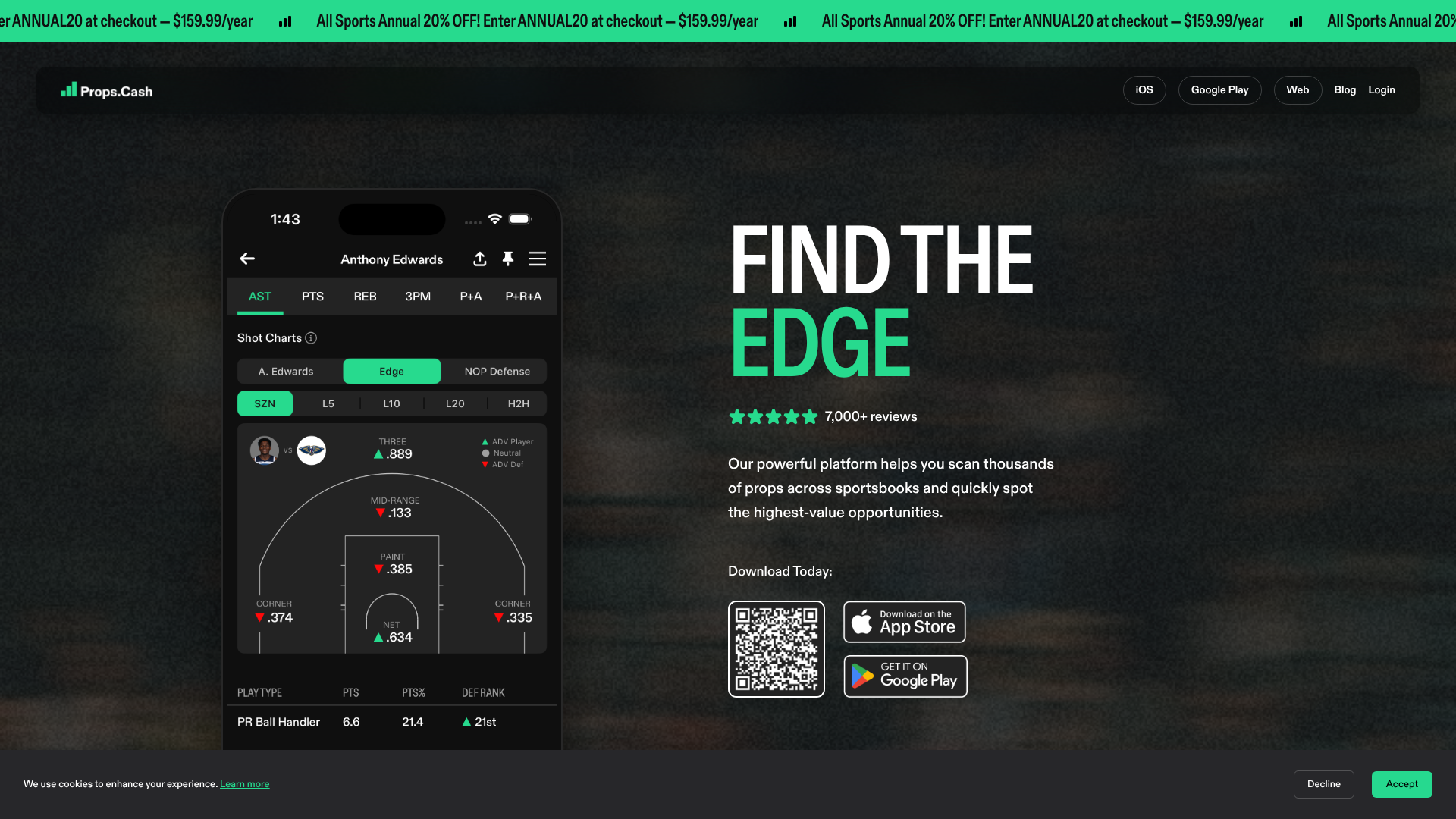
For example, if you focus on NBA player props, you can analyze individual matchups, player usage rates, and defensive schemes in more detail than a generalist oddsmaker can. Tools like Props.Cash are invaluable for this, providing detailed historical data and research tools specifically for player props, helping you find an edge the market might have missed.
5. Fading the Public
"Fading the public" is a contrarian strategy that involves betting against the team that is receiving the majority of public bets. The theory is that the general betting public is often biased, betting with their hearts (on popular teams, star players) rather than their heads. Sportsbooks know this and will often shade their lines to account for this one-sided action, creating value on the other side.
When a huge percentage of bets (say, over 75%) are on one side of a game, the line will move to make that side less attractive and the other side more attractive. By betting against the popular team, you are often getting a better number than the true line. This is a classic winning betting method that has stood the test of time.
Pro Tip: This strategy works best in high-profile games, like Monday Night Football or the NBA Finals, where public bias is at its peak. Look for games where the line moves due to public money, not sharp money.
6. Hedging Your Bets
Hedging is a strategy used to reduce risk and lock in a profit. It involves placing a bet on the opposite side of your original wager. This is most commonly done with futures bets or parlays.
For example, let's say you placed a $100 bet on the Buffalo Bills to win the Super Bowl at +900 odds before the season started. If they make it to the Super Bowl, your ticket could win you $900. To hedge, you could place a bet on their opponent to win the Super Bowl. By calculating the stake correctly, you can guarantee yourself a profit regardless of who wins the final game, eliminating the risk of walking away with nothing.
7. The Zig-Zag Theory (for Playoff Series)
This is a specific strategy for betting on playoff series in sports like the NBA and NHL. The theory applies to a best-of-seven series and focuses on betting on the team that just lost the previous game, especially when they are playing at home.
Teams, particularly home teams, often play with a greater sense of urgency after a loss in a playoff series and are statistically more likely to win the following game. The public often overreacts to the most recent result, creating value on the team that just lost. This is a situational strategy that has proven to be profitable over the years.
8. Using AI and Predictive Models

A more modern approach involves using artificial intelligence and data modeling to predict game outcomes. This strategy moves beyond traditional handicapping and uses algorithms to analyze vast amounts of data to find predictive patterns that the human eye might miss.
Building your own models requires significant statistical knowledge and programming skills. However, several platforms now offer AI-powered tools to the public. Services like Rithmm allow users to build and customize their own analytical models without needing to code. You can select which stats you find most important, and the AI will generate predictions and identify potentially valuable bets based on your custom model.
9. The Kelly Criterion (Advanced Bankroll Management)
The Kelly Criterion is a mathematical formula used to determine the optimal size of a bet. It's a more advanced form of bankroll management that calculates the bet size based on the perceived edge (the value) of the bet. The formula suggests betting a larger amount on bets where you have a bigger edge and a smaller amount when the edge is smaller.
While it's mathematically optimal, the full Kelly Criterion can be very aggressive and lead to high volatility. Many professional bettors use a "fractional Kelly" approach, such as half-Kelly or quarter-Kelly, where they bet a fraction of the amount the formula suggests. This reduces risk while still sizing bets based on the size of the edge.
10. Middling Bets
Middling is an advanced betting strategy that involves placing bets on both sides of a game at different lines, hoping the final score lands in the "middle" between the two numbers, allowing you to win both bets. This opportunity arises when a point spread moves after you've placed your initial bet.
For example, you bet on the Green Bay Packers -3. Later in the week, the line moves to Packers -5. You could then bet on their opponent at +5. If the Packers win by exactly 4 points, you win both your -3 bet and your +5 bet.
Even if the result doesn't land in the middle, you've often secured a low-risk position where your maximum loss is very small.
11. Flat Betting
This is the simplest and one of the most effective bankroll management strategies, especially for beginners. Flat betting means you bet the same amount, or "unit," on every single game, regardless of your confidence level or the odds. This typically corresponds to 1% of your bankroll.
This approach enforces discipline and prevents you from making emotional mistakes like betting more because you have a "good feeling" about a game. It protects your bankroll from significant losses and allows your long-term edge to materialize without the high volatility of other staking plans.
How to Choose the Right Betting Strategy for You
With so many options, selecting the right strategy depends on your personal goals, risk tolerance, and time commitment. There is no single "best" option for everyone; the ideal choice is the one that aligns with your circumstances.
Assess Your Goals
Are you betting for fun and a little extra income, or are you trying to generate a serious, consistent return? If your goal is low-risk profit, strategies like Arbitrage or Matched Betting are perfect. If you're aiming for the highest possible long-term growth and can handle the variance, Value Betting is the superior choice.
Consider Your Time Commitment
Some strategies are more time-intensive than others. Value betting and arbitrage often require you to be ready to place bets as soon as opportunities appear, which can be demanding. On the other hand, a strategy based on specializing in a niche market might involve more upfront research on weekends, with less in-the-moment action required.
Evaluate Your Risk Tolerance
How comfortable are you with losing streaks? Value betting, while profitable long-term, will have periods of significant downswings. If you prefer guaranteed, steady returns, even if they are smaller, arbitrage is a better fit. Understanding your psychological response to risk is crucial for sticking with a strategy long enough for it to work.

Strategy Comparison Table
| Strategy | Risk Level | Time Required | Best For… |
|---|---|---|---|
| Value Betting | Medium-High | Medium | Maximizing long-term profit |
| Arbitrage Betting | Very Low | High | Guaranteed, risk-free returns |
| Matched Betting | Very Low | Medium | Beginners building a bankroll |
| Specialization | Medium | High (Research) | Bettors with deep sports knowledge |
| Flat Betting | Low | Low | All bettors, especially beginners |
Potential Costs: Do You Need to Pay for Tools?
A common question is whether it's necessary to pay for software and tools. The simple answer is: for strategies like arbitrage and +EV betting, yes. The market moves too quickly, and the amount of data is too vast to analyze manually. The edge in these strategies comes from processing information faster than the sportsbooks can adjust.
Tools like OddsJam, Arb Amigo, and RebelBetting operate on a subscription model. While this is an upfront cost, these services are designed to pay for themselves. A single arbitrage bet or a few +EV wagers can often cover the monthly cost of the subscription. Think of it as an investment required to execute a professional-grade strategy.
For other strategies, like specialization, you might invest in data-focused tools like Props.Cash to speed up your research. While you can do handicapping for free, paid tools give you access to organized data that saves you dozens of hours. For the latest subscription costs, it's always best to visit the providers' websites directly.
Pros and Cons of Using Systematic Betting Strategies
Adopting a systematic approach to betting comes with significant advantages, but it's also important to understand the potential drawbacks. It's not a magic bullet, and it requires a shift in mindset from a casual fan to a calculated investor.
The Advantages
- Removes Emotion: A clear system prevents impulsive decisions based on bias or chasing losses.
- Long-Term Profitability: These strategies are based on mathematical principles designed to be profitable over thousands of bets.
- Discipline and Structure: A systematic approach provides a framework that promotes responsible gambling habits.
- Identifiable Edge: Unlike guessing, these methods provide a clear, quantifiable reason for placing each bet.
The Disadvantages
- Requires Patience: Profit is not immediate. You must be able to withstand losing streaks without abandoning the strategy.
- Can Be Time-Consuming: Research, line shopping, and executing bets require a consistent time investment.
- Risk of Account Limitations: Sportsbooks do not like consistent winners. Successful bettors, especially those using arbitrage, may have their accounts limited or closed.
- Can Feel Mechanical: For some, a purely mathematical approach can take some of the fun out of watching sports.
Frequently Asked Questions
What is the most successful betting strategy?
For long-term profitability, Value Betting (or +EV betting) is widely considered the most successful and sustainable strategy. It's the method used by the majority of professional sports bettors. While arbitrage guarantees a profit on each transaction, opportunities are limited, and accounts are quickly restricted. Value betting has higher variance but offers the greatest potential for long-term growth.
What is the 80/20 rule in betting?
The 80/20 rule, or the Pareto Principle, can be applied to betting in several ways. Most commonly, it suggests that roughly 80% of your profits will come from 20% of your bets. This highlights the importance of identifying your most profitable areas (e.g., a specific sport or bet type) and focusing your energy there, rather than trying to be an expert in everything.
Is the Martingale strategy profitable?
No, the Martingale strategy is extremely dangerous and not a profitable long-term strategy. This method involves doubling your bet after every loss, with the idea that an eventual win will recover all previous losses plus a small profit. The problem is that a losing streak can quickly force you to wager enormous sums of money, either hitting the sportsbook's table limit or wiping out your entire bankroll. It should be avoided at all costs.
What is the most profitable betting strategy?
This depends on your definition of "profitable." Arbitrage betting is the most profitable in terms of being risk-free; you are guaranteed to make money on every set of bets. However, the profit margins are small (1-5%), and it's difficult to scale due to account limitations. Value betting offers the highest potential for profit growth over the long run, but it comes with risk and variance.
Final Thoughts
Transitioning from a casual bettor to a strategic one requires a fundamental shift in perspective. The best sports betting strategies are not get-rich-quick schemes; they are disciplined, mathematical approaches designed for sustained success. The core principles of strict bankroll management, diligent line shopping, and tracking your results are non-negotiable for anyone serious about winning.
Whether you choose to pursue the mathematical certainty of arbitrage or the long-term growth of value betting, the key is to find a system that aligns with your goals and stick with it. Consistency and discipline will always outperform luck in the long run.
If you're ready to explore a more advanced, data-driven approach, consider exploring a tool that fits your chosen strategy. For those interested in finding a mathematical edge through value, a platform like OddsJam can be an excellent starting point. For a risk-free approach, checking out an arbitrage tool like Arb Amigo might be the right next step.