









5 Best Arbitrage Betting Sites for Profitable Bettors (2026 Review)
In the world of sports betting, the idea of a guaranteed, risk-free profit often sounds too good to be true. However, a mathematical strategy known as arbitrage betting makes this possible. By leveraging differences in odds across various sportsbooks, you can place bets on all possible outcomes of an event and lock in a profit regardless of who wins. Finding the right tools is crucial, and this guide explores the best arbitrage betting sites to help you succeed.
Arbitrage betting isn't about luck or insider knowledge; it's about speed, precision, and using the right information. The top arbitrage betting platforms are designed to do the heavy lifting for you, scanning hundreds of bookmakers in real-time to find these fleeting opportunities. Whether you're a seasoned bettor looking for a new edge or a newcomer intrigued by low-risk strategies, understanding these tools is your first step toward profitable arbing.
What You'll Learn
- Guaranteed Profit Strategy: Arbitrage betting, or "arbing," is a method that ensures a profit by placing proportional bets on every possible outcome of an event across different betting sites.
- Software is Essential: The best arbitrage betting sites use high-speed scanners to find opportunities instantly. Manually finding arbs is nearly impossible due to how quickly odds change.
- Key Platform Features: When choosing a service, prioritize speed, the number of sportsbooks covered, an intuitive interface, and an integrated calculator for determining stakes.
- Manageable Risks: While the strategy itself is low-risk, potential downsides include having your betting accounts limited or closed by bookmakers and the risk of making execution errors.
- Discipline is Crucial: Successful arbing requires careful bankroll management, acting quickly on alerts, and using strategies to avoid detection by sportsbooks.
What Exactly is Arbitrage Betting?
Arbitrage betting, often called "arbing" or creating "surebets," is a strategy that capitalizes on discrepancies in odds offered by different bookmakers for the same sporting event. When bookmakers disagree on the probability of an outcome, a window of opportunity opens. By placing calculated bets on all possible outcomes, you can guarantee a small but consistent profit, no matter which team or player wins.
Think of it like retail arbitrage. If you could buy a product from Store A for $10 and simultaneously sell it at Store B for $12, you'd make a guaranteed $2 profit. Arbitrage betting applies the same principle to sports odds. You're not gambling on an outcome; you're exploiting a temporary inefficiency in the market before it corrects itself.
For example, imagine a tennis match between Player A and Player B.
- Bookmaker 1 offers odds of +110 (2.10) for Player A to win.
- Bookmaker 2 offers odds of -105 (1.95) for Player B to win.
This scenario creates an arbitrage opportunity. By placing a specific amount on each outcome, you can ensure a profit. If you bet $100 on Player A at Bookmaker 1 and $104.76 on Player B at Bookmaker 2, your total stake is $204.76. If Player A wins, you get back $210.
If Player B wins, you get back $210. Either way, you've made a guaranteed profit of $5.24, which is about a 2.56% return on your investment. These opportunities last for only minutes or even seconds, which is why specialized software is essential.
Key Features of Top Arbitrage Betting Platforms
Not all arbitrage betting websites are created equal. The difference between a profitable tool and a frustrating one often comes down to a few critical features. When evaluating which platform is right for you, focus on these core components that directly impact your ability to find and place successful arbs.



Speed of Alerts
In arbitrage betting, speed is everything. Profitable odds discrepancies can disappear in less than a minute as bookmakers adjust their lines to match the market. The best platforms deliver real-time or near-real-time alerts, giving you the maximum possible time to verify the odds, calculate your stakes, and place both bets before the opportunity vanishes. A service with a delay of even 30 seconds can render most of its alerts useless.
Market and Bookmaker Coverage
The more sportsbooks and markets a platform scans, the more arbitrage opportunities it will find. A top-tier service covers dozens, if not hundreds, of bookmakers across the globe, including both major players and smaller, regional sites. This breadth is crucial because arbs often occur between a sharp bookmaker (like Pinnacle) and a softer, recreational bookmaker. Comprehensive coverage of sports, from major leagues like the NFL and NBA to niche markets, also increases your chances of finding profitable bets.
Accuracy and Reliability
An arbitrage alert is worthless if it's incorrect. Inaccurate alerts, or "false positives," can be caused by outdated odds, incorrect market listings, or software errors. Placing a bet based on a false positive can lead to significant losses. The most reliable arbitrage betting websites have sophisticated systems to verify odds and filter out errors, ensuring the opportunities you see are legitimate.
Look for platforms with a strong reputation for accuracy.
Integrated Tools and Filters
A great arbitrage finder does more than just show you the odds. It should include an integrated arbitrage calculator that instantly tells you how much to stake on each outcome to guarantee an equal profit. Furthermore, powerful filtering options are essential. You should be able to filter opportunities by profit percentage, specific sportsbooks, sports, and markets.
This allows you to focus only on the arbs that fit your strategy and bankroll, saving you valuable time.
How to Identify Arbitrage Opportunities Manually

Before the advent of sophisticated software, arbitrage betting was a painstaking manual process. Understanding this process highlights why modern tools are so indispensable. While not practical for consistent profit, trying to find an arb manually is an excellent way to learn the underlying mechanics of the strategy.
Here’s how you would do it:
-
Open Multiple Sportsbook Accounts: First, you need active and funded accounts at several different online sportsbooks. The more accounts you have, the more odds you can compare simultaneously.
-
Pick an Event and Market: Choose a specific event, like an upcoming NBA game. Focus on a simple two-way market, such as the moneyline (who will win) or the point spread. Comparing odds across dozens of markets for hundreds of games is what makes this so difficult.
-
Compare the Odds: With multiple browser tabs open, you would look at the odds for the same market at each sportsbook. For example, you'd check the moneyline odds for the Los Angeles Lakers vs. the Boston Celtics at DraftKings, FanDuel, BetMGM, and Caesars, looking for a pricing discrepancy.
-
Do the Math: The core of arbitrage is a simple mathematical formula. To check if an opportunity exists, you convert the odds for each outcome into a percentage, add them together, and see if the total is less than 100%. The formula for American odds is a bit more complex, but the principle for decimal odds is:
(1 / Decimal Odds A) + (1 / Decimal Odds B) < 1. If the result is less than 1, you have a profitable arb.
As you can imagine, by the time you've done the comparison and the math, the odds have likely already changed. This is why the best betting sites for arbitrage rely on automated software that performs these calculations across thousands of markets every second.
Top 5 Arbitrage Betting Sites Reviewed
Choosing the right software is the single most important decision you'll make in your arbitrage betting journey. These platforms are the engines that find profitable opportunities. Here are five of the best arbitrage betting sites, each with its own strengths and ideal user.
1. OddsJam

OddsJam has quickly become a dominant force in the betting tools space, particularly for bettors in the United States and Canada. Its platform is built around speed and comprehensive coverage of North American sportsbooks, making it an excellent choice for anyone focused on US-based betting markets. The interface is clean, modern, and provides a wealth of data beyond just arbitrage.
The Arbitrage Tool presents opportunities in a clear, easy-to-read format, showing the profit percentage, the sportsbooks involved, and the specific event. OddsJam's primary strength is its real-time data feed, which is crucial for catching arbs before they disappear. It also offers tools for positive expected value (+EV) betting and a fantasy optimizer, providing a full suite of products for serious bettors.
Pros
- Excellent US Sportsbook Coverage: Scans nearly every legal sportsbook in the United States, which is a major advantage for American arbers.
- Extremely Fast: The odds refresh in real-time, giving you a competitive edge in catching fresh arbs.
- All-in-One Platform: Includes a variety of other valuable betting tools beyond just arbitrage.
Cons
- Subscription Cost: The premium features come with a relatively high price tag, which might be a barrier for those with a small bankroll.
- Can Be Overwhelming: The sheer amount of data and tools can be intimidating for complete beginners.
2. RebelBetting
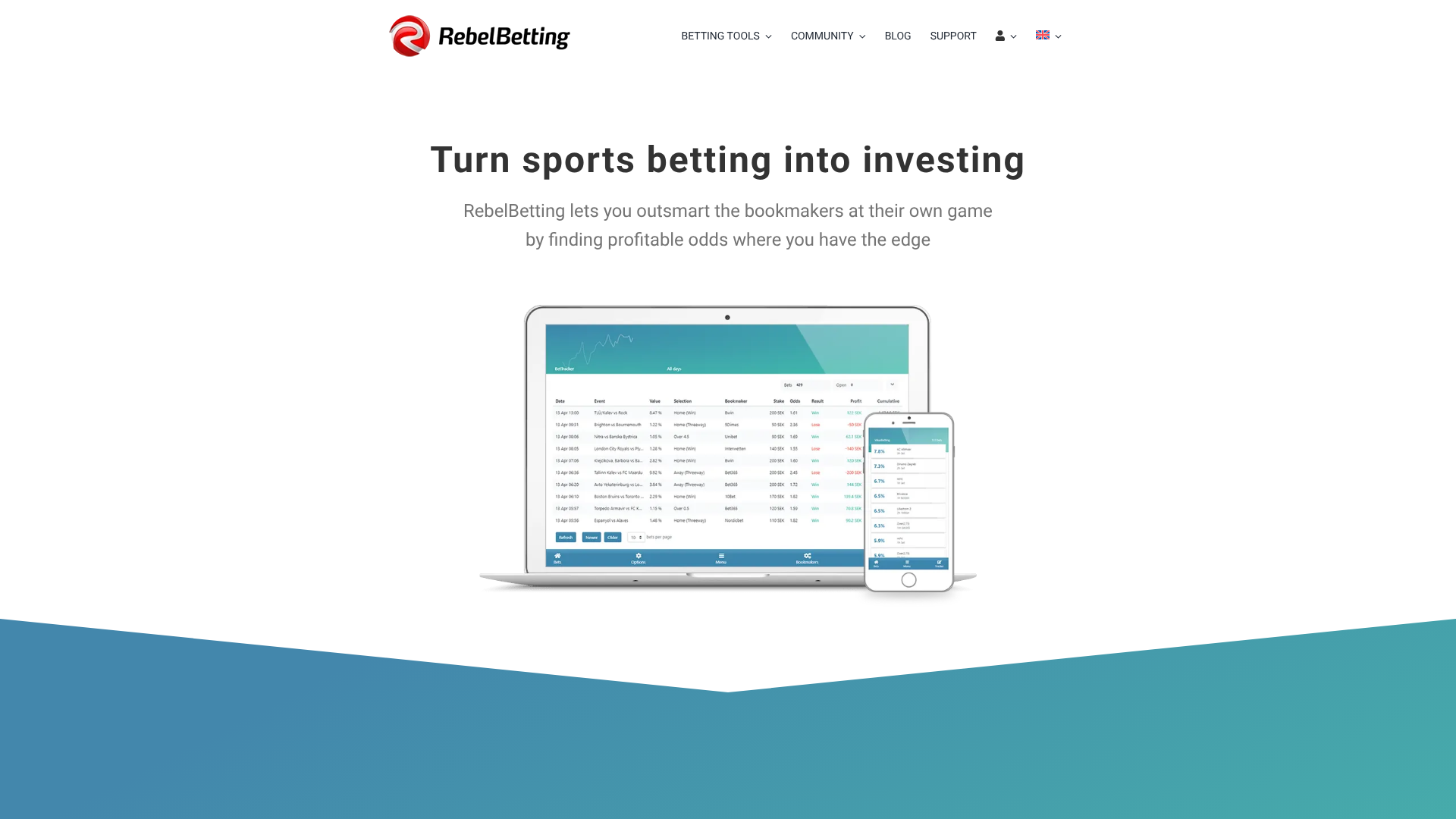
RebelBetting is a veteran in the arbitrage space, having been founded in 2006. Based in Sweden, it has a stellar reputation for reliability, accuracy, and excellent customer support. The platform primarily focuses on its Sure Betting and Value Betting products, which are polished and designed for both beginners and professionals.
Their software is known for its stability and user-friendly design. It includes features like a built-in browser that takes you directly to the bet slip at the bookmaker, streamlining the betting process. RebelBetting also offers a profit guarantee, promising that you'll make a profit in your first month or get your next month free, which shows confidence in their product.
Pros
- Highly Reliable and Reputable: A long-standing history of providing accurate and profitable alerts.
- User-Friendly Interface: The software is clean and easy to navigate, making it great for newcomers.
- Profit Guarantee: Offers a safety net for new users who are worried about the subscription cost.
Cons
- European Focus: While it covers some US books, its primary strength is in European and global bookmakers.
- Desktop Software: Traditionally a downloadable desktop application, which may be less convenient for some than a web-based platform.
3. Arb Amigo

Arb Amigo positions itself as an accessible and effective tool for those looking to get into arbitrage betting without a massive initial investment. It offers a straightforward platform that focuses on the core function of finding and presenting surebets clearly and efficiently. It's a great middle-ground option for those who want a dedicated arbitrage tool that is both powerful and easy to use.
The platform provides alerts for both pre-match and in-play arbs, giving users flexibility in their approach. Its interface is designed for quick navigation, allowing you to filter by sport, market, or bookmaker with ease. Arb Amigo is a solid choice for bettors who want a no-frills, effective arbitrage scanner.
Pros
- Good Value for Money: Often priced more competitively than some of the top-tier competitors.
- Simple and Focused: The platform is dedicated to arbitrage, making it less cluttered and easier to learn.
- Covers a Solid Range of Bookmakers: Provides good coverage of both European and international betting sites.
Cons
- Fewer Bells and Whistles: Lacks some of the advanced features and integrated tools found in more expensive platforms.
- Smaller User Base: May not have the same level of community support or extensive tutorials as larger services.
4. BetBurger
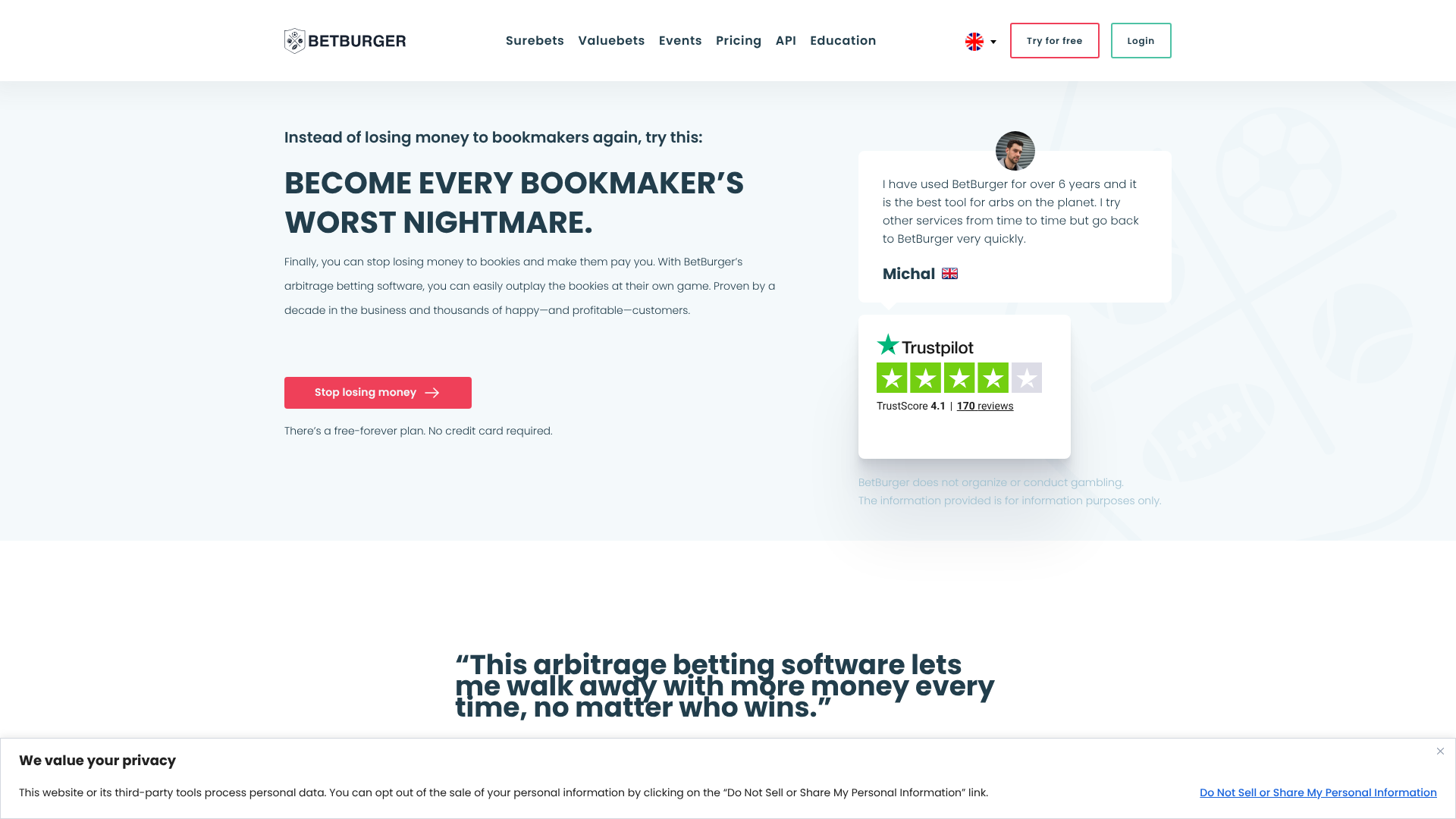
BetBurger is a powerhouse in the arbitrage world, known for its incredible speed and massive bookmaker coverage. It scans over 200 bookmakers, providing a huge volume of both pre-match and live arbitrage opportunities. This platform is generally considered a professional-grade tool for serious arbers who are willing to invest in a premium service.
The level of customization is a major selling point. Users can create complex filters to narrow down alerts to their exact specifications. However, this power comes with a steep learning curve and a high price tag. BetBurger is best suited for experienced users who can take full advantage of its advanced features to maximize their profits.
Pros
- Unmatched Bookmaker Coverage: Scans an enormous number of global bookmakers, leading to more opportunities.
- Excellent for Live Arbing: Its speed makes it one of the best tools for finding profitable in-play arbs.
- Highly Customizable: Advanced filtering allows for a tailored arbitrage hunting experience.
Cons
- Very Expensive: It is one of the priciest arbitrage services on the market.
- Complex Interface: The platform can be overwhelming and difficult for beginners to master.
5. Oddspedia
Oddspedia is widely known as a comprehensive odds comparison site, but it also offers a free surebet tool. This makes it the perfect entry point for anyone who is curious about arbitrage betting but not yet ready to commit to a monthly subscription. The tool scans a decent number of bookmakers and presents arbitrage opportunities in a simple list.
While it's a fantastic resource for learning, it comes with the limitations expected of a free service. The alerts are slower than paid platforms, meaning many of the best opportunities will be gone by the time you see them. Nonetheless, for getting a feel for the process and understanding how arbs work in a real-world context, Oddspedia's free tool is an invaluable resource.
Pros
- Completely Free: There is no cost to use their surebet finder.
- Great for Learning: An excellent way to practice finding and placing arbs without any financial risk on the software side.
- Decent Bookmaker Coverage: For a free tool, it scans a respectable number of betting sites.
Cons
- Slower Refresh Rate: Odds are not updated as quickly as on paid services, so many arbs will have vanished.
- Fewer Opportunities: You will find significantly fewer arbs compared to a premium platform.
Arbitrage Betting Platforms: A Quick Comparison
| Feature | OddsJam | RebelBetting | Arb Amigo | BetBurger | Oddspedia |
|---|---|---|---|---|---|
| Primary Focus | US & Canada | Europe & Global | Global | Professional Arbers | Beginners |
| Speed | Excellent | Very Good | Good | Excellent | Slow |
| Bookmaker Coverage | Very Good (US) | Very Good (EU) | Good | Excellent | Fair |
| Ease of Use | Good | Excellent | Very Good | Moderate | Excellent |
| Free Option | No (Trial) | No (Trial) | No | No | Yes |
| Best For | US-based bettors | Reliable, all-around arbing | Budget-conscious users | High-volume professionals | Learning the basics |
The Pros and Cons of Arbitrage Betting

Arbitrage betting is an attractive strategy because of its mathematical certainty, but it's not a magic bullet for printing money. It requires skill, discipline, and an awareness of the potential risks involved. Understanding both the advantages and disadvantages is essential before you commit your time and capital.
The Advantages
- Guaranteed Profit: This is the biggest draw. When an arbitrage bet is executed correctly, you are guaranteed to make a profit. The outcome of the game becomes irrelevant; your return is locked in.
- Low Financial Risk: Unlike traditional betting where you can lose your entire stake, the risk in arbing is primarily operational (e.g., making a mistake), not financial. The strategy itself is designed to eliminate the risk of losing.
- It's a Strategy, Not Gambling: Successful arbing relies on mathematics, speed, and efficiency, not luck or sports knowledge. This systematic approach appeals to those who prefer calculated strategies over speculative wagers.
The Disadvantages
- Account Limitations or Closure: This is the single biggest threat to an arbitrage bettor. Sportsbooks are businesses that profit from bettors' losses. They do not like customers who consistently win, and their terms of service give them the right to limit your stake sizes or close your account if they suspect you of arbitrage. This is often called being "gubbed" or "limited."
- Execution Risk: The fast-paced nature of arbing introduces the risk of errors. The most common is failing to place the second bet before the odds change, leaving you with a single, exposed bet. You could also make a typo when entering your stake or bet on the wrong market.
- Requires Significant Capital: To make meaningful profits, you need a substantial bankroll. This capital must also be spread across numerous sportsbook accounts, as you never know where an opportunity will arise. Having funds tied up in one account can mean missing a profitable arb on another.
- Time Commitment: Even with advanced software, arbitrage betting is not a passive activity. It requires you to be at your computer, ready to act instantly when an alert appears. It can be a time-intensive process, especially when you're starting out.
Strategies for Successful Arbitrage Betting
Simply having access to an arbitrage finder isn't enough to guarantee success. You need to employ smart strategies to maximize your profits while minimizing the risk of having your accounts limited. Think of it as playing a cat-and-mouse game with the bookmakers.
Pro Tip: Always have a separate browser profile (like a dedicated Chrome profile) for your betting activities. This helps keep your logins, bookmarks, and history organized and separate from your personal browsing, allowing you to work more efficiently when an arb appears.
Act Fast, But Not Recklessly
Speed is critical, but accuracy is more important. When an alert pops up, your first action should be to open the relevant sportsbooks and verify that the odds are still available and match the alert. Only after confirming both sides of the bet should you begin placing your wagers. Rushing and placing a bet on unverified odds is a recipe for disaster.
Round Your Stakes to Avoid Detection
Arbitrage calculators will often tell you to bet very specific, unrounded amounts like $97.43. Placing bets like this is a massive red flag for bookmakers, as it signals you're using a calculator. Always round your stakes to the nearest whole dollar or a common betting amount like $25, $50, or $100. This makes your activity look more like that of a regular, recreational bettor.
Place Some "Mug Bets"
To prolong the life of your accounts, you need to disguise your arbing activity. One of the best ways to do this is by placing occasional "mug bets." These are regular, non-arbitrage bets on popular events, like the moneyline of a major NFL game or a multi-leg parlay. These low-stake, recreational-style bets help you blend in and make your account look less suspicious to a bookmaker's risk management team.
Start with Low-Profit Arbs
When you're new, it's tempting to chase the high-percentage arbs (5% or more). However, these are often the quickest to disappear and are sometimes the result of obvious errors by a bookmaker, which can lead to voided bets. Start by focusing on arbs in the 1-3% profit range. They are more common, less likely to be canceled, and provide excellent practice for perfecting your workflow.
Understanding Odds and Market Movements
To excel at arbitrage betting, it helps to understand why these opportunities occur. They are not random glitches; they are the result of natural market dynamics and the operational differences between hundreds of competing sportsbooks. Understanding this context gives you a deeper appreciation for the strategy.
Every set of odds implies a certain probability for an outcome. For example, odds of +100 (2.00 in decimal) imply a 50% chance of that outcome occurring. Bookmakers add a margin, or "vig," to their odds to ensure they make a profit over the long run. This is why if you add up the implied probabilities for all outcomes of an event at a single bookmaker, the total will be over 100% (e.g., 104-105%).
An arbitrage opportunity is created when the implied probabilities from two different bookmakers for all outcomes of an event add up to less than 100%. This happens for several reasons:
- Difference of Opinion: Bookmakers may have different data models or oddsmakers, leading them to set slightly different opening lines.
- Varying Betting Volume: One bookmaker might receive a large amount of money on one side of a bet, forcing them to adjust their odds to balance their books. Another bookmaker may not have received the same action and will be slower to react.
- Promotional Odds: Sometimes, a bookmaker will offer enhanced or boosted odds on an event to attract customers. These promotions can often create one side of a profitable arb.
These windows of opportunity are almost always temporary. The market is efficient, and as money flows in to exploit the discrepancy, bookmakers will quickly adjust their lines, causing the arb to disappear. This is the race against time that arbitrage bettors and their software are constantly running.
Is Arbitrage Betting Legal?
This is one of the most common questions from newcomers, and the answer is simple and direct: Yes, arbitrage betting is completely legal. There are no federal or state laws in the United States, or in most other countries, that prohibit you from placing bets at different legal sportsbooks to take advantage of price differences.
You are simply a savvy consumer finding the best price for a product, just as you would when shopping for a car or a plane ticket. You are not hacking systems, colluding, or engaging in any form of illegal activity. You are using publicly available information (the odds) to make informed financial decisions.
However, there is a crucial distinction between being legal and being allowed. While it is not against the law, arbitrage betting is almost always against the terms of service of the sportsbooks. Bookmakers are private companies, and they have the right to refuse service to customers they deem unprofitable. If they identify your account as one that is systematically taking value from their lines, they will take action.
This action is not legal prosecution; it is a business decision to limit your stakes or close your account. This is the primary risk you manage as an arber, not any sort of legal trouble.
Best Practices for Managing a Betting Bankroll
A disciplined approach to bankroll management is what separates successful arbers from those who fail. Your capital is your most important tool, and how you manage it will directly impact your profitability and longevity in this field. It's not just about having money; it's about having it in the right places at the right time.
Spread Your Funds Across Multiple Books
You cannot be a successful arber with money in just one or two sportsbook accounts. Arbitrage opportunities are unpredictable and can appear between any two bookmakers at any time. To capitalize on them, you need to have funds ready to go. A good starting point is to have a bankroll distributed across at least 5-10 different sportsbooks.
This ensures you're prepared to act no matter where an opportunity arises.
Track Everything Meticulously
Treat your arbitrage betting like a business. Use a spreadsheet to track every single bet you place. Record the date, event, sportsbooks used, stakes, odds, and the final profit or loss. This data is invaluable for understanding your true return on investment (ROI), identifying which bookmakers are most profitable for you, and spotting any recurring mistakes in your execution.
Develop a Reinvestment and Withdrawal Plan
Decide on a strategy for your profits. A common approach is to reinvest all profits in the beginning to grow your bankroll exponentially. Once your bankroll reaches a certain target, you might switch to withdrawing a percentage of your profits each month while leaving the rest to continue growing your capital base. Having a clear plan prevents you from haphazardly withdrawing funds and stunting your growth.
Start with Realistic Capital
While you can technically start with a few hundred dollars, a more realistic starting bankroll for making a noticeable return is between $1,000 and $2,500. This amount is large enough to be spread across several bookmakers and allows you to place stakes that generate meaningful dollar returns on 1-3% arbs. Starting with too little capital can be frustrating, as your profits will be very small.
FAQ: Answering Your Top Arbitrage Questions
Here are answers to some of the most frequently asked questions about arbitrage betting.
Is arbitrage betting really profitable?
Yes, it is profitable, but it's not a get-rich-quick scheme. Profitability depends on several factors: the size of your bankroll, the quality of your arbitrage software, the amount of time you dedicate, and your discipline. It requires consistent effort to find and place bets, manage your funds, and avoid account limitations. Those who treat it like a serious business can generate a consistent monthly return on their investment.
How do bookies know you are arbing?
Bookmakers use sophisticated risk management software to flag suspicious betting patterns. The most common red flags include consistently betting unusual, unrounded amounts (e.g., $121.67), betting on obscure markets with no apparent recreational interest, always taking the best price available across the market, and betting amounts that are large relative to the market's liquidity. They also look for bettors who only bet when there are clear price discrepancies and rarely place other types of wagers.
What is the best arbitrage market for betting?
For beginners, the best markets are high-liquidity, two-way markets on major sports. This includes moneylines, point spreads, and totals (over/under) for popular leagues like the NFL, NBA, and major soccer leagues. These markets can handle larger stakes without drawing as much attention. While obscure markets like player props or lower-league sports can sometimes offer higher profit percentages, they are also much more likely to get your account flagged and limited quickly.
Can you make $2,000 a month with arbitrage betting?
It is certainly possible to make $2,000 a month or more, but it is not a guarantee. Achieving this level of profit typically requires a substantial bankroll (likely $10,000+), a subscription to a premium arbitrage service, and dedicating several hours per day to the activity. Your return on investment (ROI) in arbitrage betting is often in the range of 5-15% per month, so your total profit is directly proportional to the size of your working capital.
Final Thoughts
Arbitrage betting stands out as a rare opportunity in the sports betting landscape—a strategy grounded in mathematics rather than chance. By using the best arbitrage betting sites, you can systematically identify market inefficiencies and turn them into guaranteed, low-risk profits. It transforms betting from a gamble into a form of financial trading.
Success, however, is not automatic. It demands discipline, speed, and a strategic approach to everything from bankroll management to placing bets in a way that avoids detection. The journey begins with choosing the right tools to support your efforts.
If you're ready to start, exploring a tool like OddsJam for its exceptional US coverage or RebelBetting for its proven global reliability is a great next step. Evaluate your needs, consider the platforms reviewed here, and choose the one that best fits your location and budget to begin your arbing journey.