









What Is Value Betting? A Beginner's Guide to Finding Profitable Odds
If you've spent any time in the world of sports betting, you've likely heard the term "value" thrown around. But what is value betting, really. It’s not about picking winners based on a gut feeling or team loyalty. Instead, it's a mathematical approach that treats betting like an investment, focusing on placing wagers only when the odds are in your favor.
Think of it as the sports betting equivalent of buying a stock for less than its intrinsic worth.
Understanding value betting is the single most important step you can take to move from a casual bettor to a sharp, profitable one. It’s the core principle that separates long-term winners from those who consistently lose money to the bookmakers. This guide will break down the concept from the ground up, showing you how to identify value and turn the mathematical edge in your favor.
What You'll Learn
- The Core Concept: Value betting is about finding odds that are higher than the true probability of an outcome. You're betting on a price, not just a team.
- Expected Value (EV): The key to value betting is identifying bets with a positive expected value (+EV). This means that, on average, you will make a profit over the long run by repeatedly making similar bets.
- It's a Long-Term Strategy: Value betting isn't a get-rich-quick scheme. It involves dealing with variance and losing streaks, but it's a mathematically sound way to build a bankroll over time.
- Tools are Essential: Manually finding value bets is incredibly difficult and time-consuming. Modern bettors use specialized software to scan millions of odds in real-time to find profitable opportunities.
What Is Value Betting? A Deeper Dive
At its heart, value betting is the simple act of placing a bet when you believe the probability of an outcome is greater than the probability implied by the bookmaker's odds. In other words, you're getting a price that is too good to be true. You've found an edge against the house.
Let's use a simple analogy outside of sports. Imagine a special coin that you know for a fact is weighted to land on heads 60% of the time. The true probability is 60% heads, 40% tails. Now, someone offers you even money (+100) on a coin flip.
This is a fair bet for a normal coin (50/50), but for your special coin, betting on heads at +100 odds is a massive value bet. You have a 60% chance to win a bet that is priced as if you only have a 50% chance. Over 100 flips, you'd expect to win around 60 times and lose 40, resulting in a significant profit.
This is the essence of value betting in sports. You are looking for situations where a sportsbook has mispriced an outcome. You might believe a team has a 50% chance to win, but the bookmaker is offering odds that imply they only have a 40% chance. That 10% difference is your value, your edge.
It doesn't guarantee you'll win that single bet, but if you consistently make bets with a similar edge, you are mathematically guaranteed to be profitable in the long run.



How Value Betting Works: The Math Behind the Edge
To truly grasp understanding value betting, you need to be comfortable with two core concepts: implied probability and expected value (EV). Don't worry, the math is simpler than it sounds.
Implied Probability
Every set of odds has an "implied probability"—the likelihood of an outcome occurring as suggested by the odds. You can calculate this easily.
For American odds:
- For positive odds (+): 100 / (Odds + 100)
- For negative odds (-): |Odds| / (|Odds| + 100)
For example, if a team has odds of +150, the implied probability is 100 / (150 + 100) = 40%. The bookmaker's odds suggest this team has a 40% chance of winning. If you believe their true chance of winning is anything higher than 40% (say, 45%), you have found a value bet.
Expected Value (EV)
Expected Value tells you how much you can expect to win or lose on average if you were to place the same bet over and over again. A positive EV (+EV) means the bet is profitable long-term. A negative EV (-EV) means it's a losing bet long-term.
The formula is:
(Your Estimated Probability of Winning x Potential Profit) – (Your Estimated Probability of Losing x Amount Staked) = Expected Value
Let's use our +150 odds example with a $100 stake. You believe the team's true win probability is 45%.
- Probability of Winning: 0.45 (45%)
- Potential Profit: $150
- Probability of Losing: 0.55 (100% – 45%)
- Amount Staked: $100
(0.45 * $150) – (0.55 * $100) = $67.50 – $55.00 = +$12.50
This bet has a positive expected value of $12.50. This means for every $100 you wager on this specific opportunity, you can expect to make an average profit of $12.50 over the long run. This is the mathematical proof that you've found a profitable wager.
Key Benefits: Why Professional Bettors Swear By Value
Adopting a value betting strategy is what separates disciplined, analytical bettors from the general public. The benefits are significant and directly contribute to long-term success.
First and foremost, it provides a mathematical edge. You are no longer gambling or guessing. Every bet you place is backed by a positive expected value, meaning you have a quantifiable advantage over the sportsbook. This transforms betting from a game of chance into a form of investment where you consistently seek out undervalued assets (odds).
Second, it removes emotion from the equation. Many bettors lose money because of biases—betting on their favorite team or against a team they dislike. A value bettor is impartial. The only thing that matters is whether the odds offered present value.
You might end up betting on a team you think will lose, simply because the odds are so high that it's a profitable wager over time.
Finally, it's a sustainable and scalable strategy. While no single bet is a sure thing, a portfolio of +EV bets will grow your bankroll over time. This disciplined approach allows for consistent, compound growth. It requires patience and a solid bankroll management plan, but it's the only proven method for achieving consistent profitability in sports betting.

The Challenge: How to Reliably Find Value Bets
If value betting is so great, why isn't everyone doing it? The simple answer is that finding value is hard. It requires two things: an accurate assessment of true probability and finding a bookmaker whose odds differ significantly from that probability.
The Manual Approach
Manually finding value bets is a monumental task. You would need to:
-
Create Your Own Odds: Develop a sophisticated statistical model to predict the true probability of every game or outcome. This requires deep knowledge of statistics, data analysis, and the specific sport you're betting on.
-
Compare Across Dozens of Bookmakers: Once you have your "true" odds, you need to manually check dozens of different sportsbooks to see if any of them are offering odds that represent value. Sportsbook odds change constantly, so this is a race against time.
This process is incredibly time-consuming and requires a level of expertise that most bettors simply don't have. By the time you find a potential value bet, the odds may have already shifted, and the opportunity is gone.
The Automated Approach: Value Betting Software
This is where technology comes in. Modern value bettors use specialized software, often called scanners or odds comparison tools. These platforms do the heavy lifting for you.
They work by scanning the odds from hundreds of sportsbooks in real-time. They use the sharpest bookmakers in the world (like Pinnacle) or a weighted average of the market to establish a "true" line. Then, they instantly flag any other sportsbook offering odds that deviate significantly from that true line, presenting you with a list of +EV bets.
This automated approach is faster, more accurate, and more efficient than any manual method. It allows bettors to find dozens or even hundreds of value betting opportunities every day, something that would be impossible to do on your own.
Pro Tip: When you start value betting, you will experience variance. This means you can have losing days or even losing weeks, even if you are only placing +EV bets. Trust the math. A solid bankroll management strategy, like staking only 1-2% of your total bankroll per bet, is crucial to withstand these downswings and realize your long-term profits.
Top Tools for Finding Value Bets Automatically
For anyone serious about implementing a value betting strategy, using software is non-negotiable. These tools are the engine that powers modern sports betting. They scan the market for you and deliver profitable opportunities directly to your screen. Here are a couple of the top recommendations in the industry.
1. OddsJam

OddsJam is a powerhouse in the US sports betting market, known for its incredible speed and comprehensive coverage. It scans millions of odds per second across all major US sportsbooks, including player props, alternate lines, and futures. Its primary feature is its Positive EV tool, which provides a constantly updated feed of value bets.
What makes OddsJam stand out is its all-in-one platform. Beyond value betting, it offers tools for arbitrage betting (risk-free profit), low-hold bets for sportsbook promotions, and a suite of research tools. It’s an excellent choice for bettors who want a complete toolkit to maximize their profits.
Pros
- Extremely fast odds updates, crucial for catching lines before they move.
- Extensive coverage of US sportsbooks and markets, especially player props.
- Includes multiple tools beyond just value betting, offering more ways to profit.
Cons
- The subscription cost can be high for casual bettors.
- The sheer amount of data can be overwhelming for absolute beginners.
2. RebelBetting
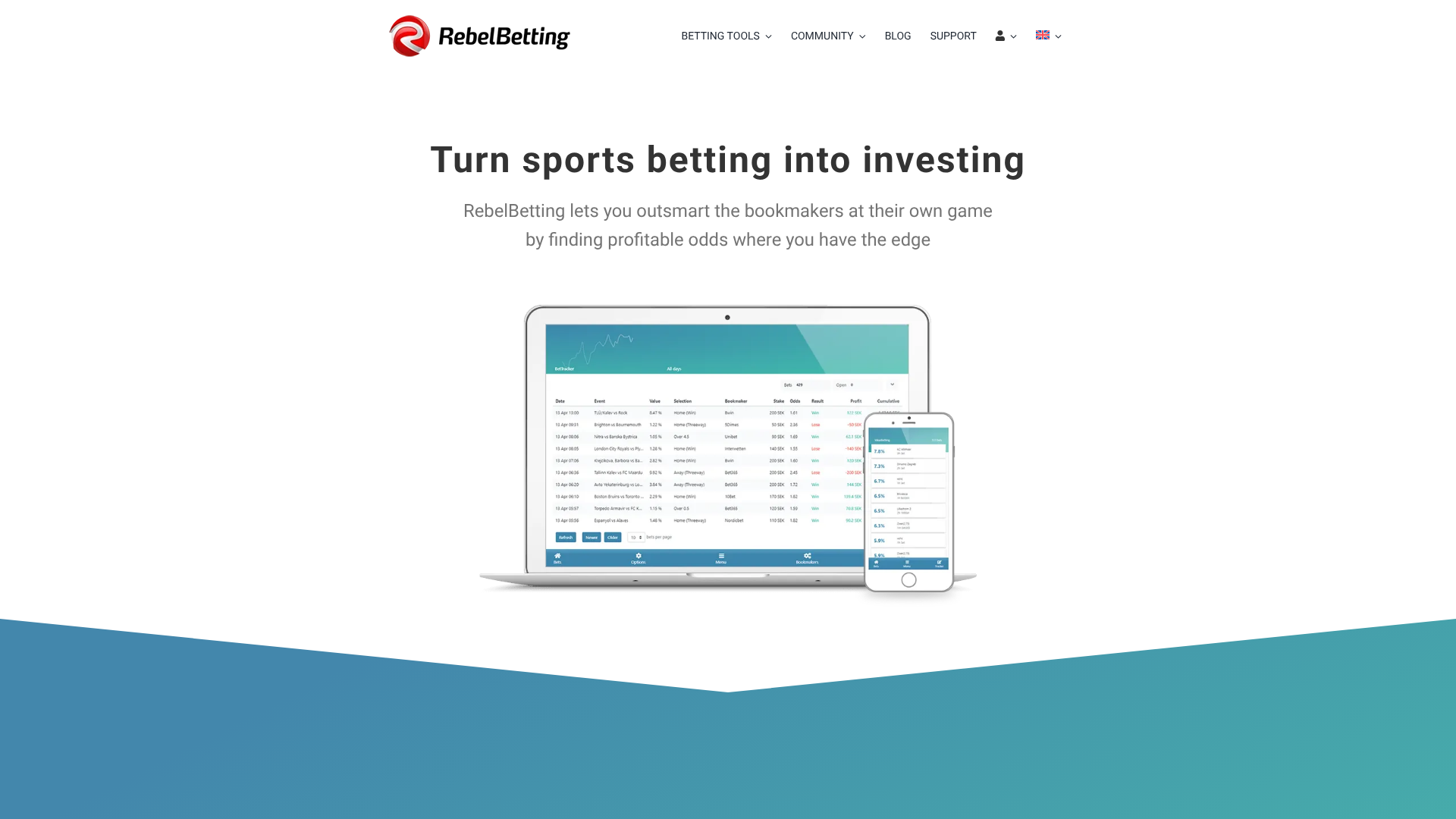
RebelBetting is one of the oldest and most respected names in the value betting and arbitrage space, with a strong focus on the European market. Their Value Betting service is designed for simplicity and efficiency, making it easy for users to find and place profitable bets.
RebelBetting is known for its reliability and user-friendly interface. It includes a built-in "Bet Tracker" to automatically log your wagers and track your profit over time. They also offer a profit guarantee for new users, which shows their confidence in the product's effectiveness. It's a fantastic option for those who want a dedicated, streamlined value betting experience.
Pros
- Very user-friendly and easy to get started with.
- Established reputation for reliability and excellent customer support.
- Profit guarantee provides a safety net for new subscribers.
Cons
- Focus is more on European bookmakers, though US books are included.
- It is a dedicated tool, so it lacks some of the extra features found in platforms like OddsJam.
Comparing Value Betting Software: What to Look For
Choosing the right value betting software is an investment in your betting career. While platforms like OddsJam and RebelBetting are top-tier, the right choice depends on your specific needs. Here are the key factors to consider.
- Speed and Accuracy: The betting market moves fast. A tool's ability to provide real-time, accurate odds is the most critical feature. Delays of even a few seconds can mean the difference between catching a value bet and missing it.
- Bookmaker Coverage: The software is only useful if it covers the sportsbooks you have access to. Check which bookies are included and ensure they align with the ones available in your region.
- Market Coverage: Do you want to bet on major leagues like the NFL and NBA, or do you also want access to smaller markets like tennis, soccer, and player props? More markets generally mean more opportunities.
- User Interface (UI): The platform should be easy to navigate. You need to be able to quickly identify a bet, see the relevant information (like the EV percentage), and place the wager without confusion.
Pricing and Cost Comparison
Value betting software operates on a subscription model, typically billed monthly or annually. While the cost might seem high at first glance, it's important to view it as a business expense. These tools are designed to generate a return on investment (ROI) that far exceeds their cost.
Prices can range from around $100 to several hundred dollars per month, depending on the features and level of access. Most services offer different tiers. For the most up-to-date information, it's always best to visit their websites. Both OddsJam and RebelBetting offer different plans, so you can choose one that matches your bankroll and commitment level.
Many also offer free trials or discounted introductory periods.
The Pros and Cons of a Value Betting Strategy
Like any investment strategy, value betting has its own set of advantages and disadvantages. It's crucial to understand both before committing your time and money.
Pros
- Mathematically Proven Profitability: This is the biggest advantage. When executed correctly, value betting has a positive expected value, which means you are mathematically favored to make money over the long term.
- Discipline Over Emotion: It forces you to make analytical, data-driven decisions rather than betting with your heart. This discipline is a hallmark of all successful sports bettors.
- Scalable: As your bankroll grows, you can increase your unit size, and your profits will grow accordingly. It's a strategy that can work with a $1,000 bankroll or a $100,000 bankroll.
Cons
- Requires Patience and a Long-Term View: You will have losing days and weeks. This is called variance. Bettors who lack the discipline to stick with the strategy during downswings will fail.
- Risk of Account Limitations: Sportsbooks are businesses, and they don't like consistent winners. If you win too much, too often, a bookmaker might limit your maximum stake size or even close your account. This is a known risk and part of the game.
- Requires a Subscription Investment: To do it effectively, you need to pay for software. This upfront cost can be a barrier for those with a very small starting bankroll.
Frequently Asked Questions About Value Betting
Here are answers to some of the most common questions people have when first learning about value betting.
How does value betting work?
Value betting works by identifying discrepancies between a sportsbook's odds and the true probability of an event. You calculate the implied probability from the odds and compare it to your own assessed probability. If the odds are higher than they should be (offering a bigger payout for the risk involved), you've found a bet with positive expected value (+EV), which is profitable over the long term.
What is an example of a value bet?
Imagine the Los Angeles Lakers are playing the Boston Celtics. A sportsbook offers odds of +120 for the Lakers to win, which implies a 45.5% chance of winning (100 / (120 + 100)). However, based on your analysis or a sharp market line, you determine the Lakers actually have a 50% chance to win. Since your assessed probability (50%) is higher than the implied probability (45.5%), this is a classic example of a value bet.
Is value betting legal?
Yes, value betting is completely legal. You are simply using publicly available information (the odds) to make intelligent betting decisions. It is a strategy, not a form of cheating. However, while it is legal, sportsbooks are private companies and reserve the right to limit or refuse service to customers they deem unprofitable, which can sometimes happen to successful value bettors.
What is value betting for dummies?
In the simplest terms, value betting is like shopping for a great deal. If you know a new iPhone is worth $1000, and you find a store selling it for $800, you'd buy it instantly because you're getting great value. Value betting is the same: you're looking for odds (a price) that are better than what they're truly worth. You're buying a bet at a discount.
Is value betting profitable?
Yes, value betting is a proven profitable strategy over the long run. It is the fundamental principle used by virtually all professional sports bettors. The key is consistency and volume. A single value bet might lose, but by consistently placing hundreds or thousands of bets with a mathematical edge, you will come out ahead.
The profitability depends on the size of your edge (EV %), your stake size, and the number of bets you place.
How many value bets per day?
The number of available value bets can vary greatly depending on the day, the sports in season, and the software you use. On a busy Saturday with college football, NBA, and NHL games, a tool like OddsJam might identify hundreds of +EV opportunities. On a quiet Tuesday, there might only be a few dozen. A dedicated bettor can easily place anywhere from 10 to 50+ value bets per day.
Final Thoughts: Is Value Betting Right for You?
Value betting is not a casual hobby; it's a systematic approach to turning sports betting into a profitable venture. It requires discipline, a sufficient bankroll to handle variance, and an investment in the right tools. It strips away the emotional highs and lows of gambling and replaces them with the steady, calculated pursuit of a mathematical edge.
If you're tired of losing money based on gut feelings and want to adopt a strategy used by professionals, then learning the value betting basics is your next logical step. It’s a challenging but rewarding journey that can fundamentally change the way you view sports betting.
For those ready to take it seriously, leveraging a powerful tool is the most efficient path to success. Platforms like OddsJam and RebelBetting are designed to find these profitable opportunities for you, saving you countless hours and giving you the best chance to succeed.