









Positive Expected Value Betting: A Guide for Beginners to Bet Smarter
If you've ever placed a sports bet based on a gut feeling, a favorite team, or a hot tip from a friend, you know the rollercoaster of emotions that follows. Sometimes you win, but often, the losses pile up, leaving you wondering if there's a better way. There is. Making the switch to positive expected value betting is the single most important step you can take to transform your approach from simple gambling into a calculated, long-term investment strategy.
It's about trading hunches for mathematics and finding wagers where the odds are mathematically in your favor.
This guide breaks down everything you need to know about this powerful concept. We'll move past the confusing jargon and focus on the practical steps, strategies, and tools that can give you a sustainable edge over the sportsbooks. You'll learn how to identify these valuable opportunities and understand the mindset required to become a profitable bettor over the long run.
What You'll Learn
- The Core Concept: Positive Expected Value (+EV) betting involves placing wagers only when the probability of winning is higher than the odds offered by the sportsbook imply, creating a mathematical edge.
- It's a Long-Term Strategy: You won't win every bet. The goal of +EV betting is to ensure that over hundreds or thousands of bets, your wins will outweigh your losses, leading to consistent profit.
- Tools are Essential: Manually finding +EV opportunities is nearly impossible. Bettors rely on specialized software like OddsJam to scan millions of odds in real-time to identify profitable wagers.
- Discipline is Key: Success requires strict bankroll management and removing emotion from your decisions. You must trust the math, even during inevitable losing streaks.
What is Positive Expected Value Betting? A Simple Explanation
At its heart, positive expected value betting is a mathematical approach to identifying wagers that are profitable over time. It's not about predicting the future with 100% accuracy. Instead, it's about finding situations where a sportsbook has mispriced its odds, offering a payout that is greater than the true risk of the bet.
Think of it like being the casino, not the player. The casino knows it will lose individual hands of blackjack, but over thousands of hands, its small mathematical edge ensures it will always come out ahead. Positive EV betting applies this same principle to sports, allowing you to find a small but consistent edge against the bookmaker.
The Core Concept: Finding an Edge Over the Sportsbook
Every set of odds offered by a sportsbook has an "implied probability"—the likelihood of an outcome happening as suggested by the odds. For example, odds of +100 (or 2.0 in decimal) imply a 50% chance of that outcome occurring. A positive EV bet exists when you determine that the true probability of an outcome is higher than the sportsbook's implied probability.
Let's say a sportsbook offers +120 odds on the Kansas City Chiefs to win. This implies a probability of about 45.5%. However, if your analysis (or data from a sharp sportsbook) suggests the Chiefs' true probability of winning is actually 50%, you have found a positive expected value bet. You're getting paid as if it's a 45.5% chance, but the real chance is higher.
Over time, making bets like this will lead to profit.



Implied Probability vs. True Probability: The Math Behind the Magic
The entire system of value betting strategies hinges on this gap between implied and true probability. Sportsbooks are not perfect. They manage thousands of markets and sometimes make mistakes, are slow to react to news, or set lines to balance their own risk rather than reflect true probability. These inefficiencies create opportunities.
The challenge, of course, is determining the "true" probability. This is where the concept of a "sharp" sportsbook comes in. Sharp books, like Pinnacle, cater to professional bettors and are known for having the most accurate odds. Many +EV tools use the odds from these sharp books as a baseline for true probability, searching for less-informed "soft" books that have strayed from that line.
A Simple Coin Toss Analogy
Imagine someone offers you a bet on a standard coin flip. The true probability of heads is 50%, and tails is 50%. If they offer you even money (+100 odds) on heads, this is a neutral EV bet. Over 100 flips, you'd expect to win 50 and lose 50, breaking even.
But what if they offered you +110 odds on heads. This means for every $10 you bet, you win $11. The true probability is still 50%, but the payout is now skewed in your favor. Even though you'll still lose about half the flips, the extra money you win on your successful bets will make you profitable in the long run.
This is a perfect, simple example of a positive EV betting opportunity.
The Key Benefits of Adopting a +EV Betting Strategy

Embracing positive EV betting is more than just a new tactic; it's a fundamental shift in how you view sports wagering. It moves you away from the emotional, luck-based approach that benefits sportsbooks and toward a disciplined, analytical method that can build a profitable hobby or side income. The benefits are significant and can completely change your results.
Shifting from Gambling to Investing
The most profound benefit is the change in mindset. When you bet on your favorite team, you're gambling. When you place a wager because you've identified a mathematical edge where the payout is disproportionately high compared to the risk, you're investing. Each bet becomes a small, calculated investment with a positive expected return.
This approach removes the emotional highs and lows. A loss is no longer a personal failure but simply a statistical outcome within a larger, profitable system. You learn to focus on the process and the long-term results, not the outcome of any single game. This detachment is crucial for making rational decisions consistently.
Long-Term Profitability and Bankroll Growth
While no strategy can guarantee a win on any given bet, positive expected value betting is the only method proven to be profitable over the long term. It's the same principle used by professional sports bettors, hedge funds, and insurance companies. By consistently taking advantage of small mathematical edges, your bankroll is positioned for steady, compound growth.
This isn't a get-rich-quick scheme. The edge on most +EV bets is small, typically between 1% and 5%. However, when applied consistently over hundreds or thousands of bets, these small edges compound into significant profits. It's a marathon, not a sprint, and those who stick with the strategy are the ones who see their bankrolls grow year after year.
Developing Discipline and Removing Emotion
Following a +EV strategy forces you to become a more disciplined bettor. It requires strict bankroll management, such as using a flat-staking plan (betting the same percentage of your bankroll on every wager) to withstand variance. You learn to ignore your personal biases about teams or players and trust the data instead.
This discipline is a skill that benefits all areas of investing and decision-making. You stop chasing losses, avoid making impulsive "all-in" bets, and treat your betting activity like a business. By removing emotion, you protect your capital and allow your mathematical edge to work for you over time.
How to Calculate and Identify Positive EV Bets
Understanding the theory is one thing, but applying it requires a bit of math. The good news is that the formula for expected value is straightforward. Once you grasp it, you'll see every bet in a new light. The real challenge isn't the calculation itself, but finding the inputs needed to perform it accurately.
The Expected Value Formula Explained
The formula to calculate the expected value of a bet is:
(Probability of Winning * Amount Won per Bet) - (Probability of Losing * Amount Lost per Bet)
A positive result means the bet has a positive expected value (+EV), while a negative result means it has a negative expected value (-EV) and should be avoided.
Let's walk through an example. Suppose the New York Yankees are playing the Boston Red Sox. A sportsbook offers +150 odds on the Yankees to win. You plan to bet $100.
- Determine the potential win and loss. A $100 bet at +150 odds wins you $150. Your amount at risk is $100.
- Determine the probabilities. This is the tricky part. Let's say your analysis shows the Yankees have a 45% (0.45) true probability of winning. This means they have a 55% (0.55) probability of losing.
- Plug the numbers into the formula:
- EV = (0.45 * $150) – (0.55 * $100)
- EV = $67.50 – $55.00
- EV = +$12.50
This result means that for every $100 you wager on this bet, you can expect to make an average profit of $12.50 over the long run. It's a clear +EV opportunity.
The Challenge: Finding the "True" Probability
As you saw in the example, the entire calculation depends on having an accurate "true probability." If you had estimated the Yankees' win probability at 35% instead of 45%, the EV would have been negative. So, how do you find this crucial number?
This is where professionals and advanced tools separate themselves. They determine true probability by creating sophisticated statistical models, analyzing historical data, and, most commonly, by observing the odds at the world's sharpest sportsbooks. These books take massive bets from the smartest bettors, and their lines are considered the most accurate representation of an event's true probability.
Using Sharp Sportsbooks as a Benchmark
For most bettors, building a complex predictive model is not realistic. A much more accessible method is to use the odds from a sharp bookmaker (like Pinnacle) as your source of "true" probability. The logic is simple: if the sharpest book in the world implies a 50% probability, but a softer, recreational book (like DraftKings or FanDuel) offers odds that imply a 45% probability for the same outcome, you've found a value gap.
This process involves removing the "vig" or "juice" from the sharp book's odds to find the no-vig true probability. Then, you compare that true probability to the odds offered at other sportsbooks. When you find a line at a soft book that is better than the no-vig line at the sharp book, you've found a +EV bet. Doing this manually across dozens of sportsbooks and thousands of markets is incredibly time-consuming, which is why software is essential for serious +EV bettors.
Pro Tip: Always have accounts at multiple sportsbooks. Line shopping is the foundation of +EV betting. Having access to 5-10 different books allows you to always place your bet at the one offering the best possible price, maximizing your edge.
Top Tools and Software for Finding +EV Opportunities
While it's possible to find occasional +EV bets manually, it's like trying to find a needle in a haystack. The sports betting market is vast and moves incredibly fast. To consistently find and act on these fleeting opportunities, successful bettors use specialized software. These tools do the heavy lifting, scanning thousands of odds across dozens of sportsbooks every second to pinpoint profitable wagers.
Why Use a +EV Betting Tool?
The advantages of using a dedicated tool are immense. First is speed. A profitable line might only exist for a few minutes or even seconds before the sportsbook adjusts it. Software identifies these opportunities instantly, giving you time to place the bet.
Second is volume. A tool can analyze millions of odds per day, presenting you with a constant stream of potential bets that would be impossible to find on your own.
Finally, these tools provide accuracy. They automatically calculate the no-vig fair odds from the sharpest bookmakers and show you the exact percentage of your edge on a given bet. This removes guesswork and allows you to bet with confidence, knowing each wager is backed by a mathematical advantage.
Recommendation 1: OddsJam – The All-in-One Data Hub

OddsJam is arguably the most popular and comprehensive tool for bettors in the United States. It's a powerful odds comparison tool that scans nearly every legal sportsbook, identifying not only +EV opportunities but also arbitrage bets (where you can guarantee a profit) and middle opportunities.
Its Positive EV tool is the main attraction. It presents a simple, real-time feed of bets with a mathematical edge. For each bet, it shows you the sportsbook offering the line, the bet itself, the odds, and the calculated percentage of your edge. It does all the complex calculations for you, so all you have to do is click, go to the sportsbook, and place the wager.
Pros
- Covers a massive range of sportsbooks and markets, including player props.
- User-friendly interface is great for beginners.
- Provides multiple tools beyond just +EV, including arbitrage and a fantasy optimizer.
Cons
- The subscription cost can be a barrier for those with a small bankroll.
- The best opportunities can disappear quickly due to the tool's popularity.
Recommendation 2: RebelBetting – For Value & Arbitrage
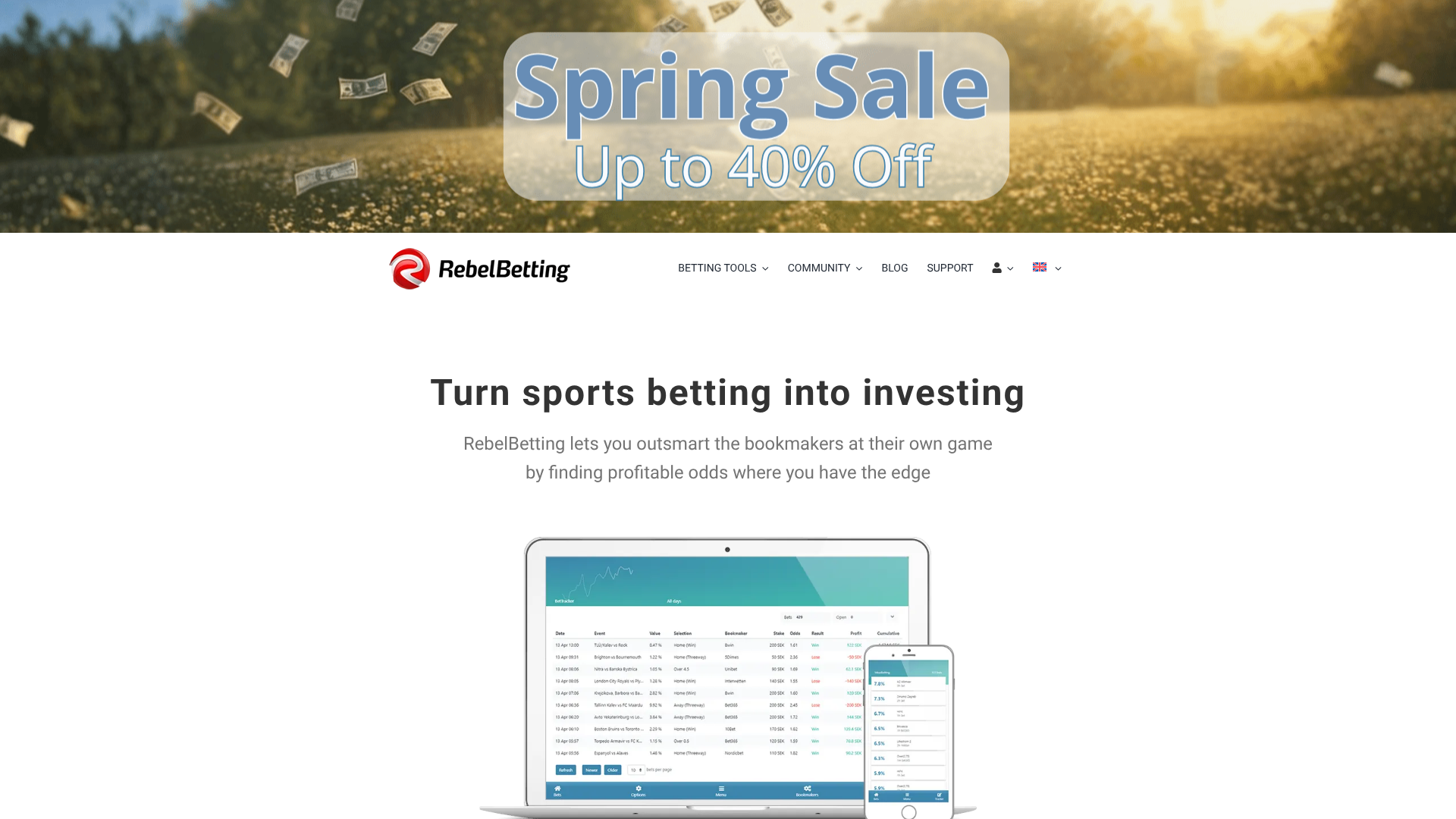
RebelBetting is a long-standing and highly respected name in the betting tools space, particularly popular in Europe but available worldwide. It offers dedicated products for both value betting and sure betting (arbitrage). Their Value Betting service is designed to find overpriced odds with a positive expected value, just like OddsJam.
RebelBetting is known for its reliability and the quality of the bets it identifies. It includes a built-in "bet tracker" to automatically log your wagers and track your profits, which is a huge help for maintaining accurate records. It helps you see your ROI over time and confirms that the strategy is working.
Pros
- Highly reliable and trusted service with a long track record.
- Integrated bet tracker simplifies bankroll management.
- Focuses on high-quality, high-edge bets.
Cons
- Supports fewer US-based sportsbooks compared to OddsJam.
- The interface can be less intuitive for absolute beginners.
Pricing and Cost: Is Investing in a Tool Worth It?
When you're starting with value betting strategies, the monthly subscription cost of a premium tool can seem daunting. It's a valid concern, and the decision to invest in software depends heavily on your bankroll size and commitment level. However, for anyone serious about making a consistent profit, a tool is not a luxury—it's a necessity.
Comparing Subscription Models
Most +EV tools operate on a monthly or annual subscription model. The price often varies based on the features included, such as the number of sportsbooks covered or access to more advanced tools like arbitrage finders. It's important to view this cost not as an expense, but as a business investment.
| Feature | OddsJam | RebelBetting |
|---|---|---|
| Primary Focus | Positive EV, Arbitrage, Props | Value Betting, Sure Betting |
| Best For | US-based bettors, prop bettors | Global bettors, dedicated value bettors |
| Pricing Model | Tiered monthly subscription | Tiered monthly subscription |
| Free Trial | Yes, typically offers a trial | Yes, typically offers a trial |
For the most up-to-date information, it's always best to visit their websites. You can check the latest pricing for OddsJam and RebelBetting directly.
Calculating Your Return on Investment (ROI)
The key question is: will the tool pay for itself? Let's do some simple math. Assume a tool costs $150 per month. If you have a $2,000 bankroll and you're betting 1% per wager ($20 bets), you need to generate $150 in profit to break even on your subscription.
If you're consistently finding bets with an average edge of 3%, your expected profit per $20 bet is $0.60 (20 * 0.03). This means you would need to place 250 bets per month ($150 / $0.60) just to cover the cost of the tool. This might sound like a lot, but a good tool can easily provide 10-20+ quality bets per day, making it very achievable.
Free vs. Paid Options
While there are some free odds comparison sites, they rarely offer the real-time speed and no-vig calculation necessary for effective +EV betting. Free tools are great for learning the basics of line shopping, but they lack the power to give you the edge needed for long-term profit. A paid subscription is an investment in the speed and accuracy required to beat the market.
Pro Tip: Start with a free trial. Nearly all major +EV services offer a trial period. Use this time to learn the software, place some bets (with small stakes), and prove to yourself that the concept works before committing to a monthly subscription.
The Pros and Cons of Positive EV Betting
Like any investment strategy, positive EV betting has a distinct set of advantages and challenges. Understanding both sides is crucial for setting realistic expectations and staying disciplined, especially when you encounter the inevitable ups and downs of variance.
The Advantages (The "Pros")
-
A Proven Mathematical Edge: This is the biggest advantage. Unlike almost any other form of gambling, +EV betting is not based on luck. It's a quantifiable, mathematical strategy that is proven to be profitable over the long term. You are systematically finding and exploiting inefficiencies in the market.
-
Removes Emotion and Guesswork: Your betting decisions are dictated by data, not by your feelings about a team or player. This objective approach prevents costly emotional mistakes, like chasing losses or betting too much on a "hunch."
-
Scalable and Consistent: The principles of +EV betting work regardless of your bankroll size. As your bankroll grows, you can increase your unit size, and your profits will scale accordingly. The flow of opportunities is relatively consistent, providing a steady stream of potential investments.
The Challenges and Risks (The "Cons")
-
Variance is Real (Losing Streaks Happen): This is the hardest part for new +EV bettors to accept. Even with a mathematical edge, you will have losing days, weeks, or even a losing month. A +EV bet with a 55% chance of winning will still lose 45% of the time. You must have the discipline and proper bankroll management to ride out these downswings without losing confidence in the process.
-
Risk of Sportsbook Limitations: Sportsbooks are not fond of consistent winners. If you win too much, too often, a sportsbook may limit the amount you can wager or even close your account. This is a known risk in the world of sharp betting. The strategy to combat this involves spreading your action across many different books and trying to "blend in" by occasionally placing smaller, recreational-style bets.
-
Can Be Time-Consuming: While tools make finding bets easy, the process of placing the wagers, tracking your results, and managing your bankroll across multiple sites still requires a time commitment. It's not a passive, set-it-and-forget-it strategy.
Frequently Asked Questions About Expected Value Betting
Here are answers to some of the most common questions newcomers have about positive EV betting.
What is positive expected value betting?
Positive expected value (+EV) betting is an investment-like strategy where you only place wagers that have a greater chance of winning than the odds offered by a sportsbook suggest. It involves calculating the "true probability" of an outcome and comparing it to the "implied probability" of the odds. When the true probability is higher, the bet has a positive expected value, meaning it will be profitable if made repeatedly over time.
Is +EV betting profitable?
Yes, +EV betting is profitable over the long term. It is the only mathematically proven way to beat sportsbooks consistently. However, profitability is not guaranteed in the short term. You will experience losing streaks due to natural statistical variance.
Success depends on placing a high volume of +EV bets and practicing strict bankroll management to endure the downswings. It is a marathon, not a sprint.
What is a good +EV percentage?
A good, sustainable +EV percentage for a bet is typically in the range of 2% to 6%. While you might occasionally see bets advertised with 10% or higher EV, these are often on obscure markets and the lines can be very volatile or even clear errors that a sportsbook might void. Consistently finding and betting on opportunities in the 2-6% range is the foundation of a solid, long-term strategy. Higher isn't always better, as it can sometimes indicate an error or a line that will move against you very quickly.
Is positive EV betting legal?
Yes, positive EV betting is completely legal. You are simply using publicly available information (the odds) to make intelligent betting decisions. It is no different from a stock trader using market data to find undervalued stocks. You are not cheating or manipulating any systems.
However, while it is legal, sportsbooks are private businesses and reserve the right to limit or refuse service to customers they identify as sharp bettors.
What is considered a good EV bet?
A good EV bet has several characteristics. First, it has a clear mathematical edge, ideally between 2-6%. Second, it's on a major, liquid market (like NFL, NBA, or major soccer leagues) where the lines are more stable and less likely to be voided. Third, it's at a sportsbook where you have an account and can place the bet quickly before the line changes.
The best EV bets are those that you can get down consistently as part of a high-volume strategy.
Final Thoughts: Making Positive EV Betting Work for You
Transitioning to a positive expected value betting approach is the most significant step you can take toward becoming a truly sharp bettor. It requires a complete mindset shift—from hoping for luck to relying on math, from emotional highs and lows to disciplined execution. It's not an easy path, and it demands patience, but it's the only sustainable way to achieve long-term profitability in sports betting.
Remember that variance is part of the game. You will have losing streaks, and you will question the process. This is where discipline and a firm belief in the underlying mathematics are your greatest assets. By managing your bankroll, trusting your strategy, and placing a high volume of +EV wagers, you put the odds in your favor.
For those serious about implementing this strategy effectively, using a dedicated tool is essential. The speed and accuracy they provide are impossible to replicate manually. If you're ready to take the next step, exploring a service like OddsJam or RebelBetting can provide the data and opportunities you need to start your journey as a value bettor.