









What is Arbitrage Betting? A Beginner's Guide to Guaranteed Profit (2026)
In the world of sports betting, the house almost always has an edge. But what if there was a mathematical strategy that could eliminate risk and guarantee a profit on every wager, no matter which team wins? This is the core promise of arbitrage betting, a technique that turns the tables on sportsbooks by exploiting small differences in their odds. Understanding what is arbitrage betting is the first step toward moving from speculative gambling to a more calculated, investment-like approach.
This isn't about luck, sports knowledge, or gut feelings. It's a systematic process of placing calculated bets on all possible outcomes of an event across different betting sites. When done correctly, the total payout is guaranteed to be more than your total stake, locking in a small but consistent profit. This guide will break down exactly how it works, the tools you need, and the real-world challenges you'll face.
What You'll Learn
- Arbitrage Betting Definition: Arbitrage is a risk-free betting strategy that involves placing wagers on every possible outcome of a sporting event across multiple sportsbooks to guarantee a profit.
- How It Works: The strategy capitalizes on discrepancies in odds offered by different bookmakers. By betting proportional amounts on each outcome, the total return always exceeds the total amount staked.
- Profit Margins are Small: Arbitrage opportunities, or "arbs," typically yield a small return, often between 1% and 5%. The strategy relies on volume and consistency rather than large single wins.
- Tools are Essential: Manually finding arbs is nearly impossible due to how quickly odds change. Specialized software like OddsJam or RebelBetting is crucial for identifying and acting on these opportunities in real-time.
- Risks and Challenges Exist: While the bets themselves are risk-free mathematically, practical risks include human error, rapid odds changes, and sportsbooks limiting or closing the accounts of successful arbitrage bettors.
Arbitrage Betting Explained: The Core Concept of a Guaranteed Profit
At its heart, arbitrage betting (often called "arbing" or a "surebet") is the practice of simultaneously placing bets on all possible outcomes of an event at odds that guarantee a profit, regardless of what happens in the game. It's an application of an old financial market principle—arbitrage—to the sports betting world. Financial traders do this by buying an asset in one market and immediately selling it at a higher price in another.
In sports betting, the "asset" is the odds on a particular outcome. Different sportsbooks are competing entities, each with its own team of oddsmakers, data models, and risk tolerances. This competition inevitably leads to slightly different opinions on the probability of an event, which manifests as different odds. An arbitrage opportunity exists when these differences become large enough to overcome the bookmaker's built-in margin (the "vig" or "juice").
Essentially, you are acting as the bookmaker, creating your own balanced book where you can't lose. You use one bookie's high odds for Team A and another bookie's high odds for Team B to create a profitable situation for yourself.
The Arbitrage Betting Definition: Beyond Simple Wagering
The formal arbitrage betting definition is a strategy that exploits price differentials in betting markets to lock in a profit. Unlike traditional betting, which is inherently speculative, arbing is purely mathematical. You aren't betting on who you think will win; you're betting on everyone to win, in a sense.
Think of it this way: a single sportsbook will never offer odds on a two-way market (like a tennis match) that add up to a profit for the bettor. Their odds are carefully calculated to ensure they make a commission. For example, they might offer -110 on both sides of a point spread, meaning you have to risk $110 to win $100. Arbitrage finds a loophole by combining the odds from two or more different sportsbooks that, when put together, create a positive expectation for the bettor.
How Arbitrage Betting Works: A Step-by-Step Breakdown
Understanding how arbitrage betting works is best done with a simple, concrete example. Let's imagine a tennis match between Player A and Player B. Because there are only two possible outcomes (Player A wins or Player B wins), it's a perfect scenario for an arb.



Here's the situation:
- Sportsbook 1 is offering odds of +110 (2.10 in decimal) for Player A to win.
- Sportsbook 2 is offering odds of -105 (1.95 in decimal) for Player B to win.
Individually, neither of these is an arb. But when combined, they create one. Let's say you have a total of $200 to wager.
- Calculate the Stakes: You need to determine how much to bet on each outcome to guarantee an equal profit. There are free arbitrage calculators online for this, but the principle is to weigh your stake toward the more likely outcome.
- Place the Bets: Using an arb calculator, you find the optimal stakes are:
- Bet $97.56 on Player A to win at +110 odds on Sportsbook 1.
- Bet $102.44 on Player B to win at -105 odds on Sportsbook 2.
- Analyze the Outcomes: Your total investment is $97.56 + $102.44 = $200.
- If Player A wins: Your bet on Sportsbook 1 pays out $204.88 ($97.56 * 2.10). You lose the $102.44 bet on Player B. Your net profit is $204.88 – $200 = $4.88.
- If Player B wins: Your bet on Sportsbook 2 pays out $200.00 (you win $97.56 on a $102.44 bet). You lose the $97.56 bet on Player A. Your net profit is $200.00 – $195.12 (the total risk) = $4.88.
As you can see, no matter who wins the match, you are guaranteed a profit of $4.88. This represents a 2.44% return on your investment ($4.88 / $200). While this might not seem like a lot, the power of arbitrage comes from repeating this process many times.
The Key Features and Benefits of Arbing
Arbitrage betting appeals to a specific type of bettor—one who is more interested in steady, predictable gains than the thrill of a longshot parlay. The benefits are rooted in mathematics and discipline, not chance.
Guaranteed, Risk-Free Returns
The most significant benefit is the elimination of risk. When an arbitrage bet is placed correctly, you cannot lose money. The mathematical certainty of a positive return is what sets it apart from every other form of sports betting. This transforms betting from a gamble into a form of short-term investment.
This security allows you to wager larger amounts with confidence, knowing your capital is not at risk. The focus shifts from hoping for a win to efficiently executing the process of placing the required bets.
Not Reliant on Luck or Sports Knowledge
Many people are drawn to sports betting because they love sports, but successful arbing requires zero knowledge of the teams, players, or even the rules of the game. Your decisions are based entirely on numerical data provided by the odds.
This is liberating for many. You don't need to spend hours researching player injuries, coaching strategies, or historical matchups. Your time is spent identifying odds discrepancies and executing bets quickly, making it a purely analytical and process-driven activity.
Scalability and Compounding Growth
While individual arb profits are small (typically 1-5%), the strategy is highly scalable. As your bankroll grows, the size of your stakes can increase, leading to larger absolute profits from the same percentage returns. A 2% return on a $100 total stake is $2, but a 2% return on a $1,000 total stake is $20.
Furthermore, the profits can be compounded. The money earned from today's arbs can be added to your bankroll to fund larger stakes for tomorrow's arbs. Over time, this compounding effect can lead to substantial bankroll growth, all while maintaining the risk-free nature of the strategy.


The Anatomy of an Arbitrage Opportunity: What to Look For
Arbitrage opportunities are fleeting moments when the market is inefficient. They can last for minutes or just a few seconds before sportsbooks adjust their lines. To be successful, you need to know what you're looking for and be prepared to act instantly.
Identifying Discrepancies in Odds
An arb exists when you can bet on all outcomes of an event and the implied probabilities of those odds add up to less than 100%. A bookmaker's odds for an event will always have an implied probability of over 100%—that's their margin. For example, two -110 odds each have an implied probability of 52.38%, totaling 104.76%.
To find an arb, you need to find odds at different bookmakers where the total implied probability is under 100%. For our tennis example (+110 and -105), the implied probabilities are 47.62% and 51.22%, respectively. The sum is 98.84%, which is less than 100%, indicating a profitable arbitrage opportunity of 1.16% (100 – 98.84).
Manually scanning dozens of sportsbooks for these opportunities is a monumental task. The odds are constantly changing, making it a race against the clock. This is why virtually all serious arbitrage bettors use specialized software to scan the market for them.
Calculating Your Stakes and Profit Margin
Once you've identified an arb, you must quickly calculate the correct amount to stake on each side to lock in the profit. Placing equal amounts on both sides rarely works unless the odds are identical (which is extremely rare). You need to place a larger stake on the outcome with the shorter odds (the favorite).
Free online arbitrage calculators are indispensable for this. You simply input the odds for each outcome and your total desired stake, and the calculator will tell you exactly how much to bet on each side and what your guaranteed profit will be. Making a mistake in this calculation is one of the few ways you can lose money, so accuracy is paramount.
Pro Tip: Always double-check your bet slip before confirming a wager. A simple typo, like betting $1000 instead of $100, can turn a guaranteed profit into a significant risk. Speed is important, but accuracy is essential.
The Importance of Speed and Execution
Arbitrage opportunities are fragile. A single sportsbook adjusting its odds can make an arb disappear in an instant. This often happens when one bookmaker is slow to react to market news (like a key player injury) or a large volume of bets coming in on one side.
When your software alerts you to an arb, you must be ready to act. This means having accounts funded and open in multiple browser tabs. The process looks like this: open the two sportsbooks, verify the odds are still available, use your calculator to determine stakes, and place both bets as quickly as possible. It's recommended to place the bet on the "soft" or unusual odd first, as it's the one most likely to change.
Top Arbitrage Betting Tools and Software
As mentioned, trying to find arbitrage opportunities manually in 2026 is like trying to mine for gold with a plastic shovel. The market moves too fast. Professional and semi-professional arbers rely on powerful software that scans thousands of odds from dozens of sportsbooks in real-time. These tools are the engine of any successful arbitrage strategy.
These platforms do the heavy lifting by constantly comparing odds across the market and alerting you the moment a profitable opportunity arises. They present the information clearly, often including a built-in calculator to show you the exact stakes and profit.
1. OddsJam

OddsJam is one of the most popular and comprehensive data tools for sports bettors in the North American market. While it offers a wide range of betting tools, its arbitrage screen is a core feature. It scans a massive number of US-based sportsbooks, including major players like DraftKings, FanDuel, and Caesars, to find discrepancies.
Pros
- Extensive Market Coverage: Covers a huge range of sports and sportsbooks, increasing the number of potential arbs.
- User-Friendly Interface: The arbitrage opportunities are presented in a clean, easy-to-understand table, showing the profit percentage and the books involved.
- All-in-One Platform: Beyond arbing, it offers tools for positive expected value (+EV) betting, low-hold bets, and more, providing value across different strategies.
Cons
- Subscription Cost: The service comes with a monthly fee that can be steep for beginners with a small bankroll.
- Focus on US Market: While excellent for bettors in the United States, its coverage may be less comprehensive for international sportsbooks.
2. RebelBetting
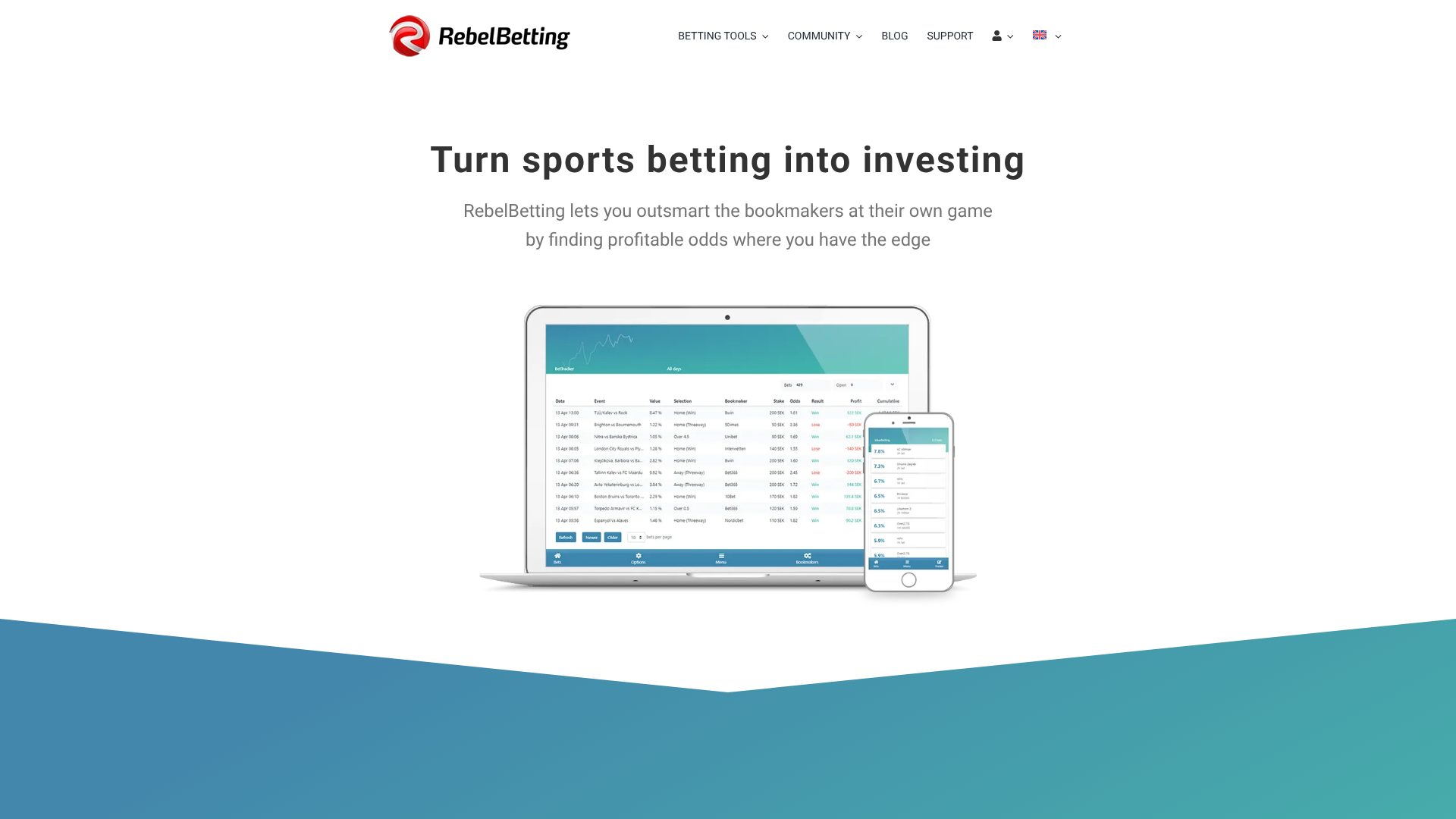
RebelBetting is a veteran in the arbitrage space, having been around for over a decade. It's a downloadable software known for its speed, reliability, and focus on the European betting market, though it has expanded its coverage over time. It's designed for serious bettors who want a dedicated, high-performance tool.
Pros
- Speed and Reliability: Known for being one of the fastest scanners on the market, which is critical for catching fleeting arbs.
- Profit Guarantee: They have historically offered a profit guarantee, promising that if you don't make a profit in your first month, you get another month free.
- Focus on Arbing: It's a specialized tool built from the ground up for arbitrage and value betting, without the extra features that might distract some users.
Cons
- Software-Based: Requires downloading and installing software on your computer, which may not be ideal for users who prefer web-based tools.
- Learning Curve: The interface can be more intimidating for absolute beginners compared to some newer, more streamlined web apps.
3. Arb Amigo

Arb Amigo is a newer player that aims to make arbitrage betting more accessible to beginners. It offers a clean, web-based interface and focuses on providing clear, actionable arbitrage opportunities without overwhelming the user with too much data. It's a great starting point for those new to the concept.
Pros
- Beginner-Friendly: The platform is designed to be intuitive and easy to navigate, lowering the barrier to entry.
- Affordable Pricing Tiers: Often has more accessible pricing plans, making it a good choice for those starting with a smaller bankroll.
- Web-Based: No software to download; you can access it from any browser, which adds flexibility.
Cons
- Fewer Features: May lack some of the advanced filtering and customization options found in more established platforms like OddsJam or RebelBetting.
- Smaller Bookmaker List: Its list of scanned bookmakers might not be as extensive, potentially leading to fewer opportunities.
Pricing and Cost Comparison of Arbing Software
Investing in arbitrage software is a necessary cost of doing business. The subscription fees for these services are an investment that should be easily covered by the profits you generate. When choosing a service, it's important to balance the cost with the features and market coverage it provides.
Here’s a general overview of what to expect:
| Feature | OddsJam | RebelBetting | Arb Amigo |
|---|---|---|---|
| Primary Market | North America | Europe / Global | Global / Beginner |
| Platform Type | Web-Based | Desktop Software | Web-Based |
| Typical Pricing | Higher-Tier | Mid to High-Tier | Lower to Mid-Tier |
| Free Trial | Often Available | Often Available | Often Available |
| Key Strength | All-in-one data hub | Speed and reliability | User-friendliness |
Pricing for these tools can range from around $50 to over $200 per month, depending on the plan and the features included. It's crucial to visit the official websites for the most current pricing information. For a beginner, it's wise to start with a free trial or a lower-cost plan to get comfortable with the process before committing to a more expensive subscription.
The key question to ask is: will the profits I generate exceed the cost of the software? If you are disciplined and have a sufficient starting bankroll (typically $500 or more), the answer is almost always yes. The software pays for itself by finding opportunities you would never be able to find on your own.
The Unspoken Reality: Pros and Cons of Arbitrage Betting
While mathematically sound, arbitrage betting is not a simple get-rich-quick scheme. It requires discipline, capital, and an understanding of the real-world challenges. A balanced view is essential before you dive in.
The Pros: Why Bettors Love Arbing
- Guaranteed Profit: This is the main draw. When executed correctly, you are guaranteed to make money.
- Low Risk: Your capital is never exposed to the uncertainty of a sporting outcome.
- Intellectual Challenge: For many, it's an engaging analytical exercise rather than a stressful gamble.
- Scalable: Your potential earnings grow as your bankroll grows.
- No Sports Knowledge Needed: Success is based on math and execution, not predicting winners.
The Cons: The Challenges You Will Face
- Account Limitations (Gubbing): This is the single biggest challenge for any arber. Sportsbooks do not like arbitrage bettors because they are guaranteed to win in the long run. If a bookmaker identifies you as an arber, they may limit your maximum stake amounts to very small numbers (e.g., $5) or close your account altogether. This is often referred to as being "gubbed" or "limited."
- Fast-Moving Odds: Opportunities can vanish in seconds. You might successfully place one side of the arb, only for the odds on the other side to change, leaving you with an exposed, risky bet.
- Human Error: In the rush to place bets, it's easy to make mistakes. You might bet on the wrong team, enter the wrong stake amount, or misread the odds. A single mistake can wipe out the profits from many successful arbs.
- Requires Capital: To make meaningful profits, you need a decent-sized bankroll spread across multiple sportsbooks. Starting with less than a few hundred dollars can be a slow and frustrating process.
- Time Commitment: While software finds the arbs, you still need to be available to place the bets. It's not a passive income strategy; it requires active participation.
Frequently Asked Questions About Arbitrage Betting
Here are answers to some of the most common questions newcomers have about arbitrage betting.
Is arbitrage betting illegal?
No, arbitrage betting is not illegal. It is a completely legal strategy that takes advantage of publicly available odds. You are simply placing bets with different legal entities (the sportsbooks) in a way that benefits you. There are no laws against being a smart shopper for the best odds.
However, it is important to distinguish between "illegal" and "against the terms of service." While not against the law, arbitrage betting is frowned upon by bookmakers and is often a violation of their terms and conditions. This is why they reserve the right to limit or close accounts of players they suspect of arbing.
Can you lose money in arbitrage betting?
Mathematically, a completed arbitrage bet cannot lose money. The profit is locked in. However, you can absolutely lose money due to practical, real-world errors. This is a critical distinction to understand.
Losses almost always stem from execution mistakes. The most common scenarios include: failing to place the second bet before the odds change, making a typo in your stake amount, or betting on the wrong market (e.g., betting on the first-half moneyline instead of the full-game moneyline). These errors leave you with a regular, speculative bet instead of a risk-free arb.
Which sport is best for arbitrage betting?
Arbitrage opportunities can be found in almost any sport, but some are better than others. The best sports for arbing are those with simple, two-way markets, as this reduces the complexity of placing the bets. This makes sports like tennis (Player A vs. Player B), basketball (moneyline or point spread), and American football (moneyline or point spread) very popular.
Soccer can also be good, but the three-way market (Team A wins, Team B wins, or Draw) adds a layer of complexity, as you need to find and place three separate bets. Markets like totals (Over/Under) in any sport are also excellent for finding arbs.
Can sportsbooks detect arbitrage?
Yes, sportsbooks have sophisticated methods for detecting arbitrage bettors. They look for patterns that are uncharacteristic of a typical recreational bettor. These patterns include consistently betting on obscure markets, wagering very specific, unrounded amounts (e.g., $87.34), and exclusively taking advantage of the best odds without placing other types of bets.
To avoid early detection, many arbers try to "disguise" their activity. This can involve rounding stake amounts to the nearest dollar, placing occasional smaller, recreational-looking parlay bets, and spreading their activity across as many different sportsbooks as possible.
How much money to start arbitrage betting?
While you can technically start with any amount, a realistic starting bankroll is generally considered to be at least $500 to $1,000. The reason for this is twofold. First, you need to have money deposited in multiple sportsbook accounts simultaneously to be able to act on opportunities as they appear.
Second, because the returns are a small percentage, a larger bankroll is needed to generate profits that are meaningful and can cover the cost of your arbitrage software. A 2% return on a $50 stake is only $1, which can be demoralizing. A 2% return on a $500 stake is $10, which starts to feel more worthwhile.
Final Thoughts: Is Arbitrage Betting Right for You?
Arbitrage betting offers a fascinating and mathematically sound way to profit from sports betting markets. It removes the element of chance and replaces it with a systematic approach to generating consistent, low-risk returns. For individuals who are analytical, disciplined, and patient, it can be a rewarding side hustle or even a full-time endeavor.
However, it's not a passive or effortless path to riches. Success requires a clear understanding of the risks involved—not from the bets themselves, but from the operational challenges of account limitations, human error, and the need for speed. It demands an initial investment in both a solid bankroll and powerful software to find the opportunities.
If you're looking for a way to engage with sports betting that relies on strategy instead of luck, arbitrage is an excellent avenue to explore. By starting with a solid educational foundation and using the right tools, you can turn the odds in your favor. For those ready to get started, exploring a tool like OddsJam or RebelBetting can provide the real-time data needed to turn theory into profit.