









How Does Arbitrage Betting Work? A Beginner's Guide to Guaranteed Profit
The idea of a guaranteed, risk-free profit in sports betting sounds too good to be true. For most strategies, it is. However, a mathematical approach called arbitrage betting makes it possible. Understanding how arbitrage betting works involves placing calculated wagers on all possible outcomes of an event across different bookmakers, ensuring you profit regardless of who wins or loses.
It's less about gambling and more about exploiting mathematical inefficiencies in the market.
This strategy isn't based on luck, sports knowledge, or gut feelings. It's a systematic process that leverages discrepancies in the odds offered by competing sportsbooks. While simple in concept, successful execution requires speed, precision, and the right tools to identify these fleeting opportunities before they disappear.
This guide will break down everything you need to know. We'll cover the fundamental mechanics, provide step-by-step examples, explore the necessary tools, and honestly assess the risks and rewards involved. By the end, you'll have a clear picture of whether this data-driven approach to sports betting is right for you.
What You'll Learn
- Core Concept: Arbitrage betting is a strategy that guarantees a profit by placing bets on all outcomes of an event at odds that lock in a positive return, typically between 1-5%.
- It's Not Illegal, But It's Frowned Upon: While completely legal, sportsbooks actively discourage arbitrage betting and may limit or close accounts of bettors they identify as arbers.
- Tools Are Essential: Finding arbitrage opportunities manually is nearly impossible due to how quickly odds change. Specialized software is required to scan hundreds of bookmakers in real-time.
- Bankroll and Speed Are Key: To make significant returns, you need a reasonably sized bankroll spread across multiple sportsbooks and the ability to place bets very quickly once an opportunity is found.
Arbitrage Betting Explained: The Core Concept of Risk-Free Profit
At its heart, arbitrage betting is the practice of simultaneously placing bets on every possible outcome of an event across different bookmakers. The goal is to find a set of odds where the total implied probability is less than 100%. This negative margin, known as the bookmaker's overround in reverse, creates a window for guaranteed profit.
Think of it like financial arbitrage. If you could buy a share of a company for $10 on the New York Stock Exchange and instantly sell it for $10.10 on the London Stock Exchange, you'd make a risk-free $0.10 profit. Arbitrage betting applies the same principle to sports odds. Bookmaker A might have one opinion on a tennis match, while Bookmaker B has a slightly different one.
This difference creates the price discrepancy you can exploit.
For example, in a tennis match between Player A and Player B, one bookmaker might offer high odds on Player A, while another offers high odds on Player B. By betting a calculated amount on Player A at the first bookmaker and another calculated amount on Player B at the second, the combined payouts will exceed your total stake, guaranteeing a profit no matter which player wins the match.



Why Do Arbitrage Opportunities Exist?
These opportunities, often called "arbs," appear for several reasons:
- Competition Among Bookmakers: Sportsbooks compete for customers by offering attractive odds. Sometimes, their odds differ enough to create an arb.
- Difference of Opinion: Bookmakers use different algorithms and oddsmakers to set their lines. A slight disagreement on a team's chances can create an opportunity.
- Time Lag in Odds Adjustment: When news breaks (like a player injury), some bookmakers react faster than others. The slow-to-update bookie's odds can create a temporary arb against the rest of the market.
- Balancing the Books: A bookmaker might adjust odds to balance their own liability if too much money is placed on one side of an event. This adjustment can create an arb with another bookmaker who hasn't taken similar action.
Understanding arbitrage betting means recognizing it's not a flaw in the system but a natural byproduct of a competitive market. These opportunities are usually small, often yielding a 1-5% return on investment, and they last for only a few minutes, making speed and technology critical.
How Does Arbitrage Betting Work? A Step-by-Step Example
Explaining the theory is one thing, but seeing it in action makes the concept click. Let's walk through a tangible example of an arbitrage bet from start to finish. This process highlights the precision required for this strategy.
Imagine a basketball game between the Los Angeles Lakers and the Boston Celtics. You have accounts funded at two different sportsbooks: Sportsbook A and Sportsbook B.
Step 1: Finding an Arbitrage Opportunity
Using an arbitrage scanner, you find a discrepancy in the moneyline odds for the game:
- Sportsbook A: Offers odds of +110 (2.10 decimal) for the Lakers to win.
- Sportsbook B: Offers odds of -105 (1.95 decimal) for the Celtics to win.
An arbitrage calculator confirms this is a profitable opportunity. The implied probabilities are 1/2.10 (47.62%) and 1.05/2.05 (51.22%). The total implied probability is 47.62% + 51.22% = 98.84%, which is less than 100%. This 1.16% difference is your guaranteed profit margin.
Step 2: Calculating the Stakes
Let's say you decide to stake a total of $200 on this game. You need to calculate how much to bet on each side to guarantee an equal profit regardless of the outcome. An arbitrage calculator will do this for you, but the formula is straightforward.
- Bet on Lakers (Sportsbook A): You would bet $95.69 at +110 odds.
- Bet on Celtics (Sportsbook B): You would bet $104.31 at -105 odds.
Your total stake is $95.69 + $104.31 = $200.00.
Step 3: Placing the Bets Simultaneously
This is the most critical and time-sensitive step. You must place both bets as quickly as possible, ideally within seconds of each other. If you place one bet and the odds on the other side change before you can place the second bet, your arb is ruined, and you're left with a regular, risky wager.
Most experienced arbers open both betting slips in separate browser tabs and confirm them almost at the same time. This minimizes the risk of an odds change.
Step 4: Confirming the Profit
Now, let's see what happens based on the game's outcome:
- If the Lakers win: Your bet at Sportsbook A wins. The payout is $95.69 * 2.10 = $200.95. After subtracting your total $200 stake, your profit is $0.95.
- If the Celtics win: Your bet at Sportsbook B wins. The payout is $104.31 * 1.9523 = $203.64. Your wager was $104.31 to win $99.33, so the total return is $203.64. After subtracting your total $200 stake, your profit is $3.64 (slight variance due to rounding in this example, but a calculator ensures it's equal). A proper calculator would have given you stakes for an exact equal profit.
Regardless of the outcome, you've locked in a small, guaranteed profit. While a dollar or two might not seem like much, the strategy relies on repeating this process many times a day to accumulate significant returns over time.
The Key Benefits: Why Pursue Arbitrage Betting?

While it requires diligence and the right setup, arbitrage betting offers several compelling advantages over traditional sports wagering. These benefits are what draw systematic, data-driven individuals to the strategy. It transforms betting from a game of chance into a form of short-term investment.
First and foremost is the guaranteed profit. When an arbitrage bet is executed correctly, you are mathematically certain to make money. This removes the stress and uncertainty associated with hoping your team wins. Your profit is locked in before the game even starts, turning the event itself into a formality.
Another significant benefit is its low-risk nature. The primary risks in arbitrage betting are related to execution—making a mistake while placing a bet or having odds change—rather than the outcome of the sport. Compared to traditional betting where you can easily lose your entire stake, a properly placed arb is financially secure.
Furthermore, this strategy is not reliant on luck or deep sports knowledge. You don't need to spend hours analyzing player stats, team form, or injury reports. Your success depends on your ability to identify mathematical discrepancies and act on them quickly. This makes it accessible to anyone with a good grasp of the process, regardless of their sports background.
Finally, arbitrage betting is a scalable strategy. While profits on individual arbs are small (usually 1-5% ROI), the process can be repeated dozens or even hundreds of times a month. As your bankroll grows, the size of your stakes can increase, leading to proportionally larger profits from the same percentage returns.
The Downsides and Risks: Understanding the Challenges
No strategy that generates profit is without its challenges, and it's crucial to approach arbitrage betting with a clear understanding of the potential hurdles. This isn't a simple get-rich-quick scheme; it's a grind that requires managing several significant risks.
The single biggest challenge is account limitations and closures, a practice known in the industry as "gubbing." Sportsbooks are private businesses, and they reserve the right to refuse service. They are not fans of arbitrage bettors because arbers are guaranteed to win in the long run. Bookmakers use sophisticated software to detect arbing patterns, such as betting unusual stake amounts (e.g., $95.69) or consistently betting on obscure markets.
If a bookmaker flags your account for arbitrage activity, they may limit your maximum stake amounts to trivial sums like $5, making it impossible to continue. In some cases, they may close your account altogether. Mitigating this risk is a core part of being a successful arber.
Next is execution risk. This covers a range of potential human errors. You might accidentally place the wrong stake amount, bet on the wrong market, or fail to place the second leg of the arb before the odds change. A single mistake can turn a guaranteed profit into a guaranteed loss or a high-risk gamble.
Speed is your enemy and your friend; you must be fast enough to catch the odds but precise enough to avoid errors.
Another factor to consider is the low profit margins. Most arbs offer a return of 1-5%. This means you need a substantial bankroll to generate meaningful income. If you're working with a few hundred dollars, your profits will be measured in cents and single dollars.
To make hundreds or thousands per month, you need a bankroll of several thousand dollars spread across many different bookmakers.
Finally, the strategy requires significant time and dedication. Finding and placing arbs is an active process. You need to be ready to act the moment an opportunity appears, which can happen at any time of day. It's more akin to day trading than passive investing, demanding your full attention when you're "working."
Pro Tip: To reduce the risk of being limited by bookmakers, try to "round" your stakes to the nearest dollar (e.g., bet $96 instead of $95.69). Also, place occasional small, recreational bets (like parlays) on major events to make your account activity appear more like that of a regular bettor.
How to Find Arbitrage Opportunities: Tools vs. Manual Searching

In the early days of online sports betting, it was possible for a dedicated individual to find arbitrage opportunities manually. You could open a few browser tabs with different bookmakers and compare odds on upcoming games. However, in 2026, the market is far too efficient and fast-moving for this approach to be viable.
Odds change in a matter of seconds. By the time you manually spot a potential arb, calculate the stakes, and attempt to place the bets, the opportunity will almost certainly have vanished. The market corrects itself too quickly. Attempting to do this manually is an exercise in frustration and is highly likely to lead to costly mistakes.
This is where technology becomes not just helpful, but essential. Arbitrage betting software, also known as arb finders or scanners, is the only practical way to succeed. These services use powerful computers to scan the odds from dozens or even hundreds of sportsbooks in real-time. When they detect a mathematical discrepancy that constitutes an arb, they instantly alert you.
These tools typically provide all the critical information you need on one screen:
- The event and market (e.g., LA Lakers vs. Boston Celtics, Moneyline).
- The bookmakers involved.
- The specific odds to bet on for each outcome.
- The guaranteed profit percentage.
- An integrated calculator to determine the exact stakes for your desired investment.
Without this technology, you are flying blind. The software does the heavy lifting of finding opportunities, allowing you to focus on the most important part: placing the bets quickly and accurately. Investing in a reliable arbitrage scanner is the first and most critical step for anyone serious about this strategy.
Top Arbitrage Betting Software Recommendations for 2026
Choosing the right arbitrage software is fundamental to your success. These platforms are your eyes and ears in the market, and a good one will pay for itself many times over. Here are a few of the top recommendations, each catering to slightly different needs and geographic locations.
1. OddsJam: Best for US-Based Bettors

OddsJam has quickly become a dominant force in the US sports betting market. Its primary strength is its comprehensive coverage of US-based sportsbooks, including major players like DraftKings, FanDuel, BetMGM, and Caesars. If you're betting in the United States, their real-time data feed is one of the fastest and most reliable available.
The platform is more than just an arbitrage finder; it also identifies Positive Expected Value (+EV) bets, which is another profitable betting strategy. The interface is clean and user-friendly, presenting arbs clearly with direct links to the sportsbooks to help you place bets faster. While it comes at a premium price, its speed and market coverage make it a top choice for serious US bettors.
Pros
- Extensive coverage of US sportsbooks.
- Extremely fast odds updates.
- Includes +EV betting tools in addition to arbitrage.
Cons
- Can be more expensive than some competitors.
- Primarily focused on the US market, less ideal for international users.
2. RebelBetting: Ideal for European Markets
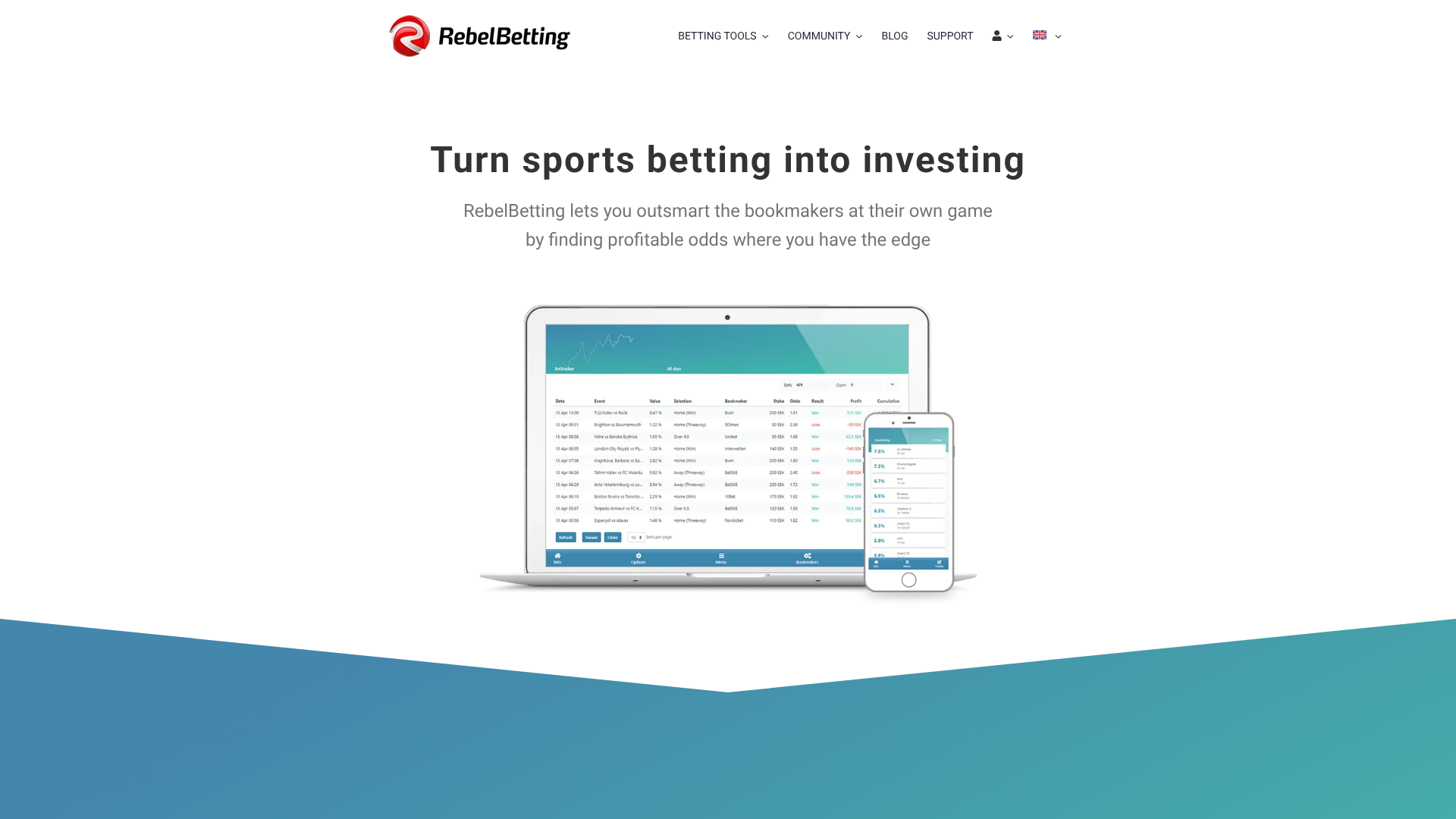
RebelBetting is one of the oldest and most respected names in the arbitrage community. Based in Sweden, they have been providing arbitrage (or "Sure Betting," as they call it) services for over a decade. Their software is known for its stability, reliability, and excellent coverage of European and international bookmakers.
Their platform is designed for efficiency, with features that help you log bets and track profits automatically. They also offer a value betting service for those looking to expand their strategies. RebelBetting is a great choice for bettors outside the US who want a proven, dependable tool from a company with a long track record of success.
Pros
- Long-standing, trusted reputation in the industry.
- Excellent coverage of European and international bookmakers.
- Robust software with helpful features for serious arbers.
Cons
- Subscription cost can be a barrier for beginners.
- Less focused on the newer US sportsbooks.
3. Arb Amigo: A Budget-Friendly Option

For those just starting with arbitrage betting or working with a smaller bankroll, Arb Amigo presents a more accessible entry point. It offers a reliable arbitrage scanning service at a lower price point than many of the premium competitors. While it may not have the same lightning-fast speed or the sheer number of bookmakers as OddsJam or RebelBetting, it provides more than enough to get started and generate consistent profits.
Arb Amigo covers a good mix of international bookmakers and presents opportunities in a clear, easy-to-understand format. It's an excellent choice for learning the ropes of arbitrage betting without committing to a high monthly subscription fee, making it a smart pick for beginners.
Pros
- More affordable pricing, great for beginners.
- Simple, straightforward user interface.
- Covers a solid range of international sportsbooks.
Cons
- Odds updates may be slightly slower than premium services.
- Fewer advanced features compared to top-tier competitors.
Pricing and Cost Comparison of Arbitrage Finders
Investing in an arbitrage finder is a necessary cost of doing business. The subscription fee is an operational expense that you must factor into your profit calculations. Pricing structures vary, but most services offer monthly, quarterly, or annual plans, with discounts for longer commitments. Here’s a general comparison of the recommended tools.
| Feature | OddsJam | RebelBetting | Arb Amigo |
|---|---|---|---|
| Best For | US Bettors | European & International Bettors | Beginners & Budget-Conscious Bettors |
| Key Features | Fastest US odds, +EV tools, clean UI | High reliability, auto-logging, long reputation | Lower cost, simple interface, good starting point |
| Pricing Model | Premium monthly subscription | Tiered monthly/annual subscriptions | Low-cost monthly subscription |
| Current Price | Visit OddsJam for latest pricing | Visit RebelBetting for latest pricing | Visit Arb Amigo for latest pricing |
When choosing a service, consider your location, your starting bankroll, and your level of commitment. For US-based bettors with a solid bankroll, the speed of OddsJam often justifies its premium price. For those in Europe or elsewhere, RebelBetting offers a time-tested and powerful solution.
If you're just starting out, it can be wise to begin with a more affordable option like Arb Amigo. You can use it to learn the process, build your bankroll, and confirm that the strategy works for you. Once your profits consistently exceed the subscription cost and you're ready to scale up, you can consider upgrading to a more advanced tool.
Frequently Asked Questions (FAQ)
This section addresses some of the most common questions people have when first learning about arbitrage betting. Understanding these points is key to managing expectations and risks.
Is betting arbitrage illegal?
No, arbitrage betting is not illegal. You are not breaking any laws by placing bets with different legal sportsbooks to lock in a profit. It is a legitimate strategy that takes advantage of a free market. However, it is explicitly against the terms and conditions of most sportsbooks.
They are private companies and have the right to limit or close your account if they suspect you are an arbitrage bettor, as you represent a guaranteed loss for them over the long term.
Is betting arbitrage profitable?
Yes, it is profitable when executed correctly and consistently. The profitability depends on several factors: the size of your bankroll, the number of sportsbooks you use, the speed and quality of your arbitrage software, and the amount of time you dedicate to it. Profits are made through a high volume of small, consistent wins rather than large, single payouts. It's a grind, not a lottery ticket, but it can generate a steady income stream.
Can you lose money in arbitrage?
Absolutely. While the strategy itself is risk-free in theory, the risk comes from human error during execution. You can lose money if you place the wrong stake, bet on the wrong line, or if the odds change after you've placed one side of the bet but before you can place the other. Another way to lose money is if a bookmaker cancels one of your bets (a palpable error), leaving you exposed on the other side.
Careful execution and discipline are essential to avoid these losses.
How much bankroll do you need to arbitrage a bet?
There's no magic number, but more is better. You can technically start with a few hundred dollars, but your profits will be very small. A more realistic starting bankroll is between $1,000 and $2,000. This amount needs to be spread across multiple (5-10) sportsbook accounts to take advantage of opportunities wherever they appear.
A larger bankroll allows you to place more arbs simultaneously and generate more meaningful returns.
How do you tell if a bet is an arbitrage opportunity?
The simplest way is to use an arbitrage scanner, which does the math for you. Manually, you can tell by converting the odds for all outcomes into their implied probabilities. If the sum of these probabilities is less than 100%, you have found an arbitrage opportunity. For a two-way market (like a tennis match), the formula is: (1 / Decimal Odds A) + (1 / Decimal Odds B) < 1.
If the result is less than 1, it's an arb.
Final Thoughts: Is Arbitrage Betting Right for You?
Now that we've explored the ins and outs of how arbitrage betting works, it's clear that this isn't a casual hobby but a systematic, data-driven strategy. It successfully removes luck from the equation, transforming sports betting into a process that resembles financial trading. The appeal of a guaranteed profit is strong, but it's earned through diligence, precision, and a clear-headed approach to managing risk.
This path is not for everyone. It requires an initial investment in both a software subscription and a sufficient bankroll. It also demands patience and a cool head, as you'll be dealing with the constant threat of account limitations and the pressure of placing bets quickly and accurately. It's a volume game where small, consistent gains add up over time.
If you are analytical, disciplined, and looking for a way to generate a side income that relies on math rather than chance, arbitrage betting is a compelling option. The key is to start with a realistic mindset, understanding that success comes from consistent execution, not a single big win. If you're serious about exploring this strategy, using a dedicated tool is non-negotiable. A service like OddsJam for US markets or RebelBetting for international ones can provide the technological edge you need to turn theory into profit.