









11 Best Sports Betting Strategies for Beginners (That Actually Work)
Turning a consistent profit from sports betting is challenging, but it's far from impossible. The key difference between bettors who win long-term and those who don't isn't luck; it's discipline and a clear plan. Adopting some of the best sports betting strategies shifts your approach from simple gambling to calculated investing, giving you a structured way to manage risk and identify valuable opportunities.
This guide breaks down the most effective betting tips, from foundational principles every beginner must master to advanced techniques used by professionals. We'll explore how to manage your money, find odds that are in your favor, and use powerful tools to gain an edge. By the end, you'll have a clear roadmap for making smarter, more informed wagers.
What You'll Learn
- Bankroll Management is Non-Negotiable: The single most important strategy is the 1% rule—never bet more than 1-2% of your total betting funds on a single wager to survive losing streaks.
- Value is Everything: The goal isn't just picking winners, but finding bets where the odds offered are better than the true probability of an outcome. This is known as Positive Expected Value (+EV) betting.
- Line Shopping is Free Money: Consistently getting the best possible odds across different sportsbooks is one of the easiest ways to increase your profitability over time.
- Specialization Beats Generalization: Focusing your expertise on specific sports, leagues, or even bet types allows you to develop a deeper knowledge base and identify opportunities the general public might miss.
- Tools Can Provide a Major Edge: Modern betting requires speed and data. Tools that scan odds, identify arbitrage opportunities, or analyze player props can automate time-consuming research and uncover profitable bets.
Foundational Principles: The Bedrock of Winning Sports Bets
Before diving into complex techniques, you must master the fundamentals. These core principles are the foundation upon which all successful betting careers are built. Ignoring them is the fastest way to deplete your bankroll, while embracing them provides the discipline needed for long-term success.
1. Master Bankroll Management (The 1% Rule)
This is the golden rule of betting and arguably the most critical strategy of all. Bankroll management is the practice of setting aside a specific amount of money for betting and only risking a small percentage of it on any single bet. Without it, even the most skilled bettor will eventually go broke due to the natural variance in sports.
The most common and effective method is the 1% Rule, where you wager only 1% to 2% of your total bankroll on each bet. If your bankroll is $1,000, each bet should be between $10 and $20. This approach protects you from devastating losses during a losing streak, which are inevitable for every bettor. It prevents emotional decision-making, like "chasing" losses with larger bets, which is a recipe for disaster.
Think of your bankroll as your business's capital. A smart business owner wouldn't risk 25% of their company's funds on a single venture, and you shouldn't either. Proper bankroll management ensures you stay in the game long enough for your skills and strategies to pay off.
2. Understand Value Betting (Positive EV)
Winning sports bets consistently isn't about picking the team you think will win; it's about identifying bets that have positive expected value (+EV). A bet has +EV when the probability of it winning is greater than the probability implied by the sportsbook's odds. In simpler terms, you're getting a price that is better than it should be.
To find value, you first need to understand implied probability. For American odds, the calculation is straightforward. For a favorite at -150 odds, the implied probability is 150 / (150 + 100) = 60%. For an underdog at +200 odds, it's 100 / (200 + 100) = 33.3%.



If your own analysis suggests the true probability of the underdog winning is 40%, then a bet at +200 odds is a +EV wager.
Finding these discrepancies is the core of professional betting. It requires research, data analysis, or the use of specialized tools. You won't win every +EV bet, but over hundreds or thousands of wagers, a consistent strategy of only betting on value will lead to long-term profitability.
3. Always Practice Line Shopping
Not line shopping is like willingly paying more for the same gallon of gas when a cheaper station is across the street. Every sportsbook offers slightly different odds on the same game. By having accounts at multiple books (e.g., DraftKings, FanDuel, Caesars) and always placing your bet at the one with the most favorable odds, you are directly increasing your potential profit.
A small difference from -110 to +100 might not seem like much on a single bet, but these differences compound significantly over time. Getting a better line can be the difference between winning and pushing, or pushing and losing. It's one of the simplest yet most effective betting tips to implement immediately.
Manually checking dozens of sportsbooks for every bet is tedious. This is where odds comparison tools become essential. Platforms like OddsJam automatically scan hundreds of sportsbooks in real-time to show you the best line available for any bet, saving you time and ensuring you never miss out on a better price.

4. Specialize, Don't Generalize
Trying to be an expert on every sport is impossible. The sportsbooks have teams of analysts and advanced algorithms setting lines for everything from the NFL to international table tennis. You can't outsmart them across the board, but you can develop a niche where you have a knowledge advantage.
Specialization involves focusing on one or two sports, or even specific leagues, conferences, or bet types within those sports. For example, instead of betting on all of college basketball, you might focus solely on the Big Ten conference. This allows you to develop a deep understanding of the teams, players, and coaching tendencies that linesmakers might overlook.
By narrowing your focus, your research becomes more efficient and your insights more valuable. You'll start to recognize patterns and situations that the general betting public misses, which is where you can find your edge and make more informed wagers.
Advanced Strategies for Finding an Edge
Once you have a firm grasp of the fundamentals, you can begin to explore more advanced strategies. These techniques require more effort and often rely on specialized tools, but they can offer unique opportunities for profit that aren't available to the average bettor.
5. Arbitrage Betting ("Sure Bets")
Arbitrage betting is one of the few ways to guarantee a profit in sports betting. It involves placing bets on all possible outcomes of an event across different sportsbooks whose odds have a significant discrepancy. When done correctly, you lock in a small profit regardless of which team wins.
For example, Sportsbook A might have the Kansas City Chiefs at +110, while Sportsbook B has their opponent, the Tampa Bay Buccaneers, at +105. By placing a carefully calculated amount on each side, you can ensure a profit of 1-3% no matter the result. The challenge is that these opportunities are rare and disappear quickly.
Executing an arbitrage strategy manually is nearly impossible. You need software that constantly scans the market for these discrepancies. Tools like Arb Amigo and RebelBetting are designed specifically for this purpose, alerting you to opportunities and even calculating the exact stakes for you.

| Feature | Arb Amigo | RebelBetting |
|---|---|---|
| Primary Focus | Arbitrage & Value Betting | Arbitrage & Value Betting |
| Sports Covered | Extensive, including esports | Extensive, including esports |
| Key Feature | Real-time alerts, user-friendly interface | High-speed alerts, integrated bet broker |
| Best For | Beginners and intermediate arbers | Serious and professional arbers |
Pro Tip: While arbitrage is risk-free in theory, be aware of practical risks. A sportsbook could void a bet due to a palpable error (obvious mistake in the line), or you might fail to place the second leg of the arb before the odds change. Always act quickly and double-check your wagers.
6. Hedging Your Bets
Hedging is a strategy used to reduce risk or lock in a guaranteed profit from an existing bet. It's most commonly used on the final leg of a multi-bet parlay or a futures bet that is close to winning. It involves placing a second bet on the opposite side of your original wager.
Imagine you have a $10 four-team parlay that pays $120, and the first three legs have already won. For the final game, you could let it ride for the full $120 payout, or you could hedge by betting on the opposing team. For example, if you bet $55 on the other team to win at +100 odds, you could guarantee a profit of around $55-$65 regardless of who wins the final game.
Hedging reduces your maximum potential payout but eliminates the risk of walking away with nothing. The decision to hedge depends on your risk tolerance and the size of the potential payout. It's a powerful tool for managing risk in high-stakes situations.
7. Fade the Public
"Fading the public" is a contrarian betting strategy that involves betting against the team that is receiving the majority of public bets. The logic is that the general betting public is often uninformed, betting with their heart instead of their head, and tends to favor popular teams, home teams, and favorites.
Sportsbooks are aware of these tendencies and often shade their lines to account for the expected influx of public money. This can create value on the other side of the bet. If 85% of the public is betting on the Dallas Cowboys, the line on their opponent might be inflated, offering better value than it should.
To effectively fade the public, you need access to data on betting percentages, which shows what percentage of bets and money are on each side of a game. This strategy isn't about blindly betting against the popular team; it's about identifying situations where public bias has moved a line and created value on the contrarian side.

8. Middle Betting (Middling)
Middling is an advanced strategy that's similar to arbitrage but involves trying to win both sides of a bet. It's possible when a point spread or total moves after you've placed your initial wager. You exploit the gap, or "middle," between the two numbers.
For example, you bet on the Green Bay Packers at -2.5 early in the week. Later, due to news or heavy betting, the line moves to Packers -4.5. You could then place a second bet on their opponent at +4.5. If the Packers win by exactly 3 or 4 points, you win both of your bets.
If they win by any other margin, one bet will win and the other will lose, resulting in a small loss (the juice).
Middling opportunities are rare and require you to be quick to act on line movements. While the chance of hitting the middle is small, the potential payout is huge. It's a high-risk, high-reward strategy best suited for experienced bettors who closely monitor line movements.
Data-Driven and Prop Betting Strategies
The modern sports betting landscape is dominated by data. The most successful bettors use analytics to find their edge. These strategies focus on less efficient markets, like player props, and use data to make highly informed decisions.
9. Focus on Player Props
Player proposition (prop) bets are wagers on an individual player's statistical performance, such as passing yards for a quarterback or points scored by a basketball player. These markets are often considered "softer" than main lines (spreads and totals) because they receive less betting volume, and sportsbooks may not dedicate as much time to perfecting these lines.
This creates opportunities for knowledgeable bettors. If you have a deep understanding of player matchups, usage rates, and game scripts, you can often find significant value in prop markets. Research is key, and this is where specialized tools can make a massive difference.
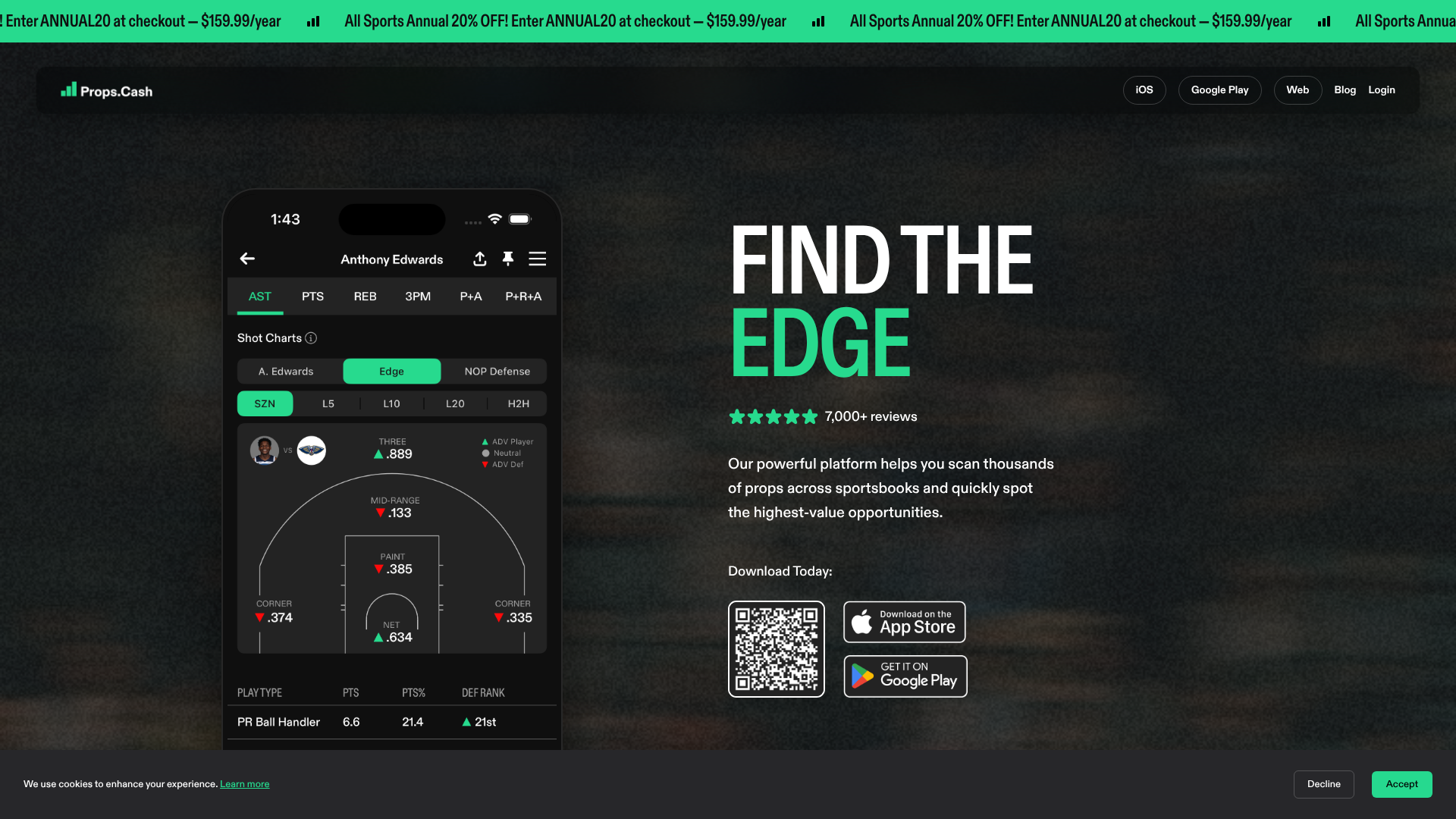
Platforms like Props.Cash are built specifically for prop bet research. They provide detailed historical data, matchup analysis, and defensive rankings, consolidating hours of research into a simple, easy-to-use interface. This allows you to quickly identify trends and make data-backed prop bets.
10. Use Data Models and Analytics
Quantitative betting, or "quant" betting, involves using statistical models and algorithms to predict game outcomes and identify profitable betting opportunities. While building complex models from scratch was once reserved for data scientists, new tools are making this approach more accessible.
These models can analyze thousands of data points—from historical performance and weather conditions to player efficiency ratings—to generate their own lines for a game. If the model's line differs significantly from the sportsbook's line, it signals a potential value bet.
For those interested in a data-driven approach without needing to code, platforms like Rithmm offer a solution. Rithmm uses AI to help you build and customize your own analytical models for sports betting, allowing you to leverage the power of data without being a programming expert.

11. Capitalize on Live Betting Inefficiencies
Live betting, or in-game wagering, allows you to place bets while a game is in progress. The odds are constantly updated based on what's happening on the field. This fast-paced environment can create inefficiencies that savvy bettors can exploit.
Algorithms that set live lines can sometimes overreact to specific events, like an early turnover or a lucky touchdown. A team that was a 7-point favorite pre-game might suddenly be available at -3 after giving up an early score. If your analysis suggests the early score was an anomaly, you can get the favorite at a much better price than was available before the game.
Successful live betting requires you to watch the games closely and act quickly. It's about combining your understanding of the sport with an ability to assess whether a live line is an overreaction or a legitimate adjustment.
How to Choose the Right Betting Strategy for You
Not every strategy is suitable for every bettor. The best approach for you depends on several factors, including your goals, risk tolerance, time commitment, and the size of your bankroll.
-
For Beginners: Start with the fundamentals. Your entire focus should be on mastering bankroll management, learning to identify value, and diligently line shopping. These are the non-negotiable skills for survival and long-term growth.
-
For Those with Limited Time: If you can't dedicate hours to research, strategies that can be supported by tools are ideal. Using an odds comparison tool like OddsJam for line shopping or a prop research tool like Props.Cash can make you vastly more efficient.
-
For the Risk-Averse: Arbitrage betting is the only strategy that offers guaranteed, risk-free returns. While the profits are small (typically 1-5% per bet), it's a steady way to build a bankroll. Tools like RebelBetting are essential for this approach.
-
For the Analytical Bettor: If you enjoy data and statistics, diving into player props, building models with a tool like Rithmm, or developing a contrarian approach by fading the public will align well with your skills.
Ultimately, the best path is to start with the basics and gradually incorporate more advanced techniques as your knowledge and confidence grow. Never jump into a complex strategy without fully understanding the principles behind it.
Frequently Asked Questions (FAQ)
What is the most successful betting strategy?
For long-term, sustainable profit, value betting (+EV) is widely considered the most successful strategy. It focuses on the mathematical edge of finding odds that are mispriced relative to their true probability. While it doesn't guarantee wins on every bet, it ensures profitability over a large sample size. For guaranteed but smaller returns on each wager, arbitrage betting is the most successful, as it locks in a profit regardless of the outcome.
What is the 80/20 rule in betting?
The 80/20 rule, or Pareto Principle, suggests that roughly 80% of your results come from 20% of your efforts. In betting, this can mean that 80% of your profits might come from 20% of your bets, often those within your area of specialization. It reinforces the importance of focusing on your niche—the sports or bet types you know best—rather than spreading your efforts too thin across markets where you don't have an edge.
What is the 1/3, 2/4 strategy?
The 1/3, 2/4 strategy is a specific staking plan, more commonly associated with casino games like baccarat than sports betting. It's a form of progressive betting system where you increase your stake after a win. While some bettors try to adapt such systems to sports, most professionals advise against them. A flat-staking model, like the 1% rule, is a much safer and more effective way to manage a sports betting bankroll as it doesn't require you to increase your risk after a win.
What is the golden rule of betting?
The undisputed golden rule of betting is to never bet more than you can afford to lose. This principle is the cornerstone of responsible gambling and effective bankroll management. It means treating your betting funds as separate from your essential living expenses. Following this rule protects your financial well-being and helps you make logical, strategic decisions instead of emotional ones driven by financial pressure.
Final Thoughts
Becoming a successful sports bettor is a marathon, not a sprint. There is no single magic formula for winning every bet, but by consistently applying the best sports betting strategies, you can significantly tilt the odds in your favor. It all starts with the disciplined foundation of bankroll management, line shopping, and a commitment to finding value.
From there, you can explore more advanced techniques like arbitrage, prop betting, or data modeling to further refine your edge. The key is to be patient, stay disciplined, and never stop learning. Using modern tools can accelerate your progress, automating tedious research and uncovering opportunities you might otherwise miss.
If you're serious about improving, consider how tools can help. For finding the best odds and +EV opportunities, OddsJam is an invaluable resource. For those interested in risk-free profits, exploring arbitrage with a platform like RebelBetting could be the right path. Choose the strategy that fits your style and commit to it for the long haul.