









Value Betting Prediction Explained: A Beginner's Guide to Profitable Wagering
Successful sports betting isn't about luck or gut feelings; it's about finding a mathematical edge. A solid value betting prediction strategy transforms gambling into a form of investing by identifying wagers where the odds offered by a bookmaker are higher than the true probability of an outcome. Instead of just picking winners, you're systematically finding and exploiting pricing errors in the betting market. This guide breaks down exactly how this powerful strategy works, from the basic math to the tools that can automate the entire process for you.
This isn't a get-rich-quick scheme. It's a disciplined, long-term approach that requires patience and a solid understanding of the core principles. By the end of this article, you'll understand how to spot value, why it's the foundation of professional betting, and how you can start applying these concepts to your own wagers.
What You'll Learn
- The Core Concept: Value betting is about placing bets on odds that are mispriced in your favor, giving you a positive expected value (+EV) over time.
- It's a Numbers Game: Success relies on understanding basic probability and the concept of expected value, not on predicting winners with perfect accuracy.
- Tools are Essential: Manually finding value bets is nearly impossible. Specialized software is required to scan thousands of odds in real-time to find profitable opportunities.
- Long-Term Strategy: Value betting is not about winning every bet. It's about maintaining a statistical edge that guarantees profit over a large volume of wagers, despite inevitable losses and downswings.
- Discipline is Key: This strategy demands strict bankroll management and the emotional discipline to stick with the process, even during losing streaks.
What is Value Betting Prediction?
A value betting prediction is the identification of a betting opportunity where the probability of a given outcome is greater than the implied probability reflected in the bookmaker's odds. In simpler terms, you're finding a bet where the potential payout is disproportionately high compared to the actual risk. It's the betting equivalent of finding an item on sale for less than it's worth.
Think of it like a coin toss. A fair coin has a 50% chance of landing on heads and a 50% chance of landing on tails. The true odds for heads are 2.00 (or +100 in American odds). Now, imagine someone offers you odds of 2.10 (+110) for it to land on heads.
This is a value bet. Even though you might lose the next flip, if you made that same bet a thousand times, you would be guaranteed to make a profit because the payout you receive is better than what the true probability dictates.
This is the essence of value betting. You aren't trying to predict the future with 100% certainty. Instead, you're looking for these small pricing inefficiencies. The core formula that governs this is for calculating Expected Value (EV):
Value = (True Probability * Decimal Odds) – 1
If the result of this calculation is greater than zero, you have found a value bet, also known as a positive expected value (+EV) bet. The challenge, of course, is determining the "true probability" of an event. This is where data, sophisticated models, and specialized tools come into play.



The Key Benefits of Using Value Bet Forecasts

Adopting a strategy based on value bet forecasts fundamentally changes your approach to sports betting. It shifts the focus from hoping for wins to executing a plan with a proven mathematical advantage. Here are the primary benefits of this disciplined method.
Long-Term Profitability Over Short-Term Luck
The single biggest advantage is the potential for consistent, long-term profit. Recreational bettors ride the emotional rollercoaster of wins and losses, often ending up with a depleted bankroll. Value bettors understand that individual outcomes are irrelevant. What matters is that over hundreds or thousands of bets, their mathematical edge will materialize as profit.
This approach removes the element of luck and replaces it with statistical certainty.
A Disciplined, Mathematical Approach
Value betting forces you to be disciplined. You no longer bet based on team loyalty, gut feelings, or what a TV pundit says. Every wager is based on a single criterion: does it have positive expected value. This removes emotional decision-making, which is the downfall of most gamblers.
It provides a clear framework for why you are placing a bet, turning a hobby into a structured investment strategy.
Gaining an Edge Over the Bookmaker
Bookmakers build a profit margin, known as the "vig" or "juice," into their odds. This means that on a perfectly balanced market, they are guaranteed to make money. A prediction for value betting is one of the few strategies that can consistently overcome this built-in house edge. By finding odds that are incorrectly priced, you are effectively turning the bookmaker's margin against them and creating your own advantage.
Improved Bankroll Management
Because value betting is a volume-based game, it necessitates smart bankroll management. Professionals often use a staking method like the Kelly Criterion, which calculates the optimal bet size based on the size of the value and the size of your bankroll. This ensures you don't risk too much on any single bet, protecting you from the inevitable variance and downswings that are part of the process.

How Value Betting Predictions Are Calculated
Identifying value isn't magic; it's a data-driven process that relies on speed and accuracy. While the concept is simple, the execution requires powerful technology to analyze the vast and constantly changing sports betting market. Here’s a look at the mechanics behind modern value bet forecasts.
The Role of Statistical Models and Data
At the heart of any value betting system is a method for determining the "true" probability of an event. This is often done by creating sophisticated statistical models that analyze historical data, team performance metrics, player injuries, weather conditions, and dozens of other variables. The model's output is a probability percentage for each outcome of a game (e.g., Team A has a 65% chance to win).
Comparing Odds Across Multiple Sportsbooks
The most common and effective way to find value is by comparing odds from dozens of different sportsbooks against each other. The betting market is generally efficient, but individual bookmakers can be slow to react to new information or may set their lines differently to balance their own books. A value betting tool scans all these odds in real-time. When it finds a bookmaker whose odds are significantly higher than the market average, it flags it as a potential value bet.
The Concept of a "Sharp" Pinnacle Line
Many value betting services use the odds from "sharp" bookmakers, like Pinnacle, as a baseline for true probability. Sharp bookmakers accept very high betting limits and welcome professional bettors. Because of this, their odds are believed to be the most accurate reflection of the market. By removing the vig from the Pinnacle line, a tool can calculate a close approximation of the true probability.
Any other bookmaker offering odds significantly better than this sharp line is likely offering value.
Pro Tip: Don't get discouraged by small value percentages. Many professional value bettors consistently profit from edges as small as 2-4%. The key is volume. Placing hundreds of these small-edge bets is what builds a bankroll over time.
How AI is Enhancing Prediction Accuracy
Artificial intelligence is taking this process a step further. AI-powered platforms can analyze more complex data sets and identify patterns that traditional statistical models might miss. For example, a tool like Rithmm allows users to build their own predictive models using AI without needing to code. This technology can personalize betting value tips by tailoring forecasts to a user's specific strategies and risk tolerance, offering a more advanced way to find an edge.
For a visual explanation of how a tool can automate this process, check out this video:
How to Choose the Right Value Betting Tool
Since manually finding value bets is impractical, subscribing to a service is a necessity. However, not all tools are created equal. Choosing the right one depends on your budget, experience level, and betting style. Here are the key factors to consider when evaluating your options.
Key Features to Look For
- Speed: The betting market moves fast. A valuable opportunity might only exist for a few minutes. Your tool must deliver real-time alerts so you can place the bet before the odds change.
- Bookmaker Coverage: The more sportsbooks the service scans, the more opportunities it will find. Ensure the tool covers the bookmakers that are available in your region.
- Sports and Market Coverage: Do you want to bet on major leagues like the NFL and NBA, or do you prefer niche sports? Check that the service covers the markets you're interested in, including moneylines, spreads, totals, and props.
- Customizable Filters: A good tool will allow you to filter opportunities by sport, market, value percentage, and bookmaker. This helps you focus only on the bets that fit your specific strategy.
- Integrated Bet Tracker: A bet tracker is crucial for analyzing your performance. The best services offer an integrated tracker that automatically logs your bets and calculates your profit, loss, and ROI.
Free vs. Paid Services: What's the Difference?
While some sites offer free value bets, they are often delayed or limited in scope. Paid subscription services provide the real-time speed and comprehensive market coverage necessary for serious value betting. The subscription fee should be viewed as an investment; if the tool consistently provides profitable opportunities, it will pay for itself many times over.
User Interface and Ease of Use
The platform should be intuitive and easy to navigate. You need to be able to find the information you need and place your bets quickly. Many services offer free trials, which are a great way to test the user experience before committing to a subscription.
Top Value Betting Prediction Tools and Services
Several excellent tools on the market can help you implement a value betting strategy. Each has its own strengths, catering to different types of bettors. Here are some of the top recommendations.
For All-in-One Value & Arbitrage: RebelBetting
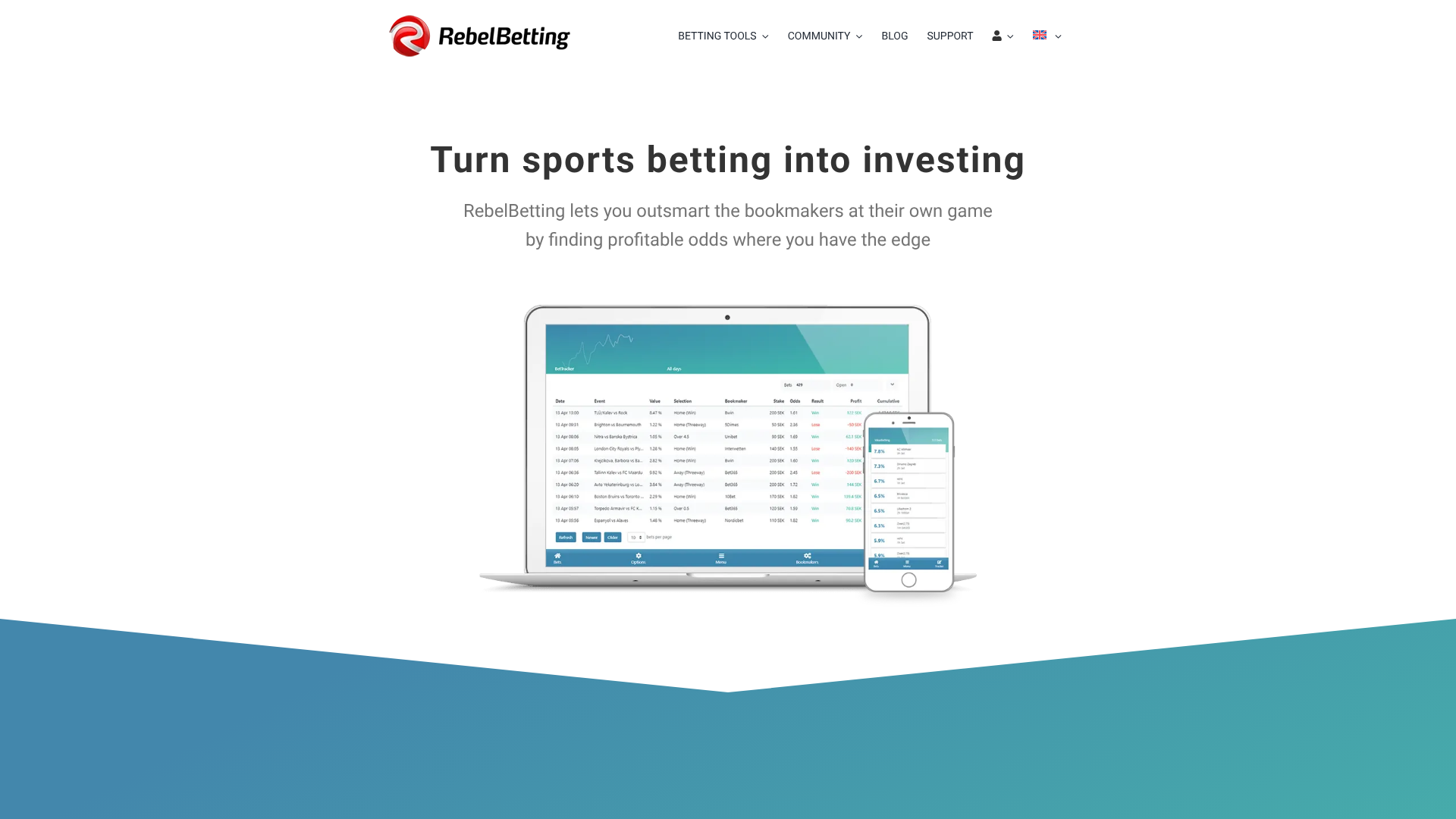
RebelBetting is one of the most established and respected names in the industry. It offers dedicated products for both value betting and arbitrage betting. Their software is known for its speed, reliability, and user-friendly interface, making it a great choice for both beginners and experienced bettors.
Pros
- High Speed and Reliability: Delivers fast alerts, which is critical for catching valuable odds.
- Profit Guarantee: They offer a profit guarantee, which shows confidence in their product.
- Excellent Educational Resources: Their site is full of guides and tutorials to help you get started.
Cons
- Higher Price Point: It's a premium service with a subscription cost that reflects its quality.
- Software-Based: Requires downloading software to your desktop, which may not be ideal for everyone.
For Real-Time Odds Comparison: OddsJam

OddsJam is a powerful, browser-based tool that offers a suite of features for profitable bettors, including a Positive EV tool. It scans millions of odds per second across a huge range of sportsbooks and markets. Its speed and comprehensive data make it a favorite among serious American sports bettors.
Pros
- Extensive Bookmaker Coverage: Covers nearly every legal sportsbook in the United States.
- All-in-One Platform: Includes tools for arbitrage, low-holds, and fantasy research in addition to value betting.
- Browser-Based: No software download is required, making it accessible from any device.
Cons
- Can Be Overwhelming for Beginners: The sheer amount of data and tools can have a steep learning curve.
- Subscription Cost: Full access to all tools comes at a premium price.
For AI-Powered Personal Picks: Rithmm

Rithmm takes a different approach. Instead of just identifying market inefficiencies, it uses AI to help you build your own predictive sports betting models. You can customize models based on stats you find important, and the AI will generate picks with a quantified edge. It's ideal for the bettor who wants more control and a deeper analytical approach.
Pros
- Highly Customizable: Allows you to build and test your own betting theories.
- AI-Driven Edge: Provides a unique way to find value that isn't just based on market comparisons.
- Focus on Core Markets: Excellent for building models for major sports like NFL, NBA, and MLB.
Cons
- Requires More User Input: Not a simple plug-and-play solution; you need to engage with the modeling process.
- Less Focus on Niche Sports: The modeling capabilities are centered on the most popular leagues.
Pricing and Cost Comparison of Value Betting Services
The cost of value betting software can range from around $50 to over $200 per month, depending on the features, speed, and market coverage offered. While this may seem expensive, it's essential to frame it as a business expense. The goal is for the profits generated from the tool's tips to far exceed its cost.
Here’s a general breakdown of what to expect from different pricing tiers:
| Tier | Typical Monthly Cost | Key Features | Best For |
|---|---|---|---|
| Entry-Level | $50 – $100 | Limited bookmakers, slower refresh rates, basic filters | Beginners wanting to learn the ropes without a large investment. |
| Mid-Tier | $100 – $200 | Faster alerts, wider bookmaker/sport coverage, some advanced tools | Serious bettors who are ready to increase their volume and profits. |
| Professional | $200+ | Real-time speed, complete market coverage, integrated tracking, arbitrage tools | Full-time bettors or those managing a very large bankroll. |
Most top-tier services like RebelBetting and OddsJam fall into the mid-to-professional tiers. They often offer free trials or discounted introductory periods, which you should absolutely use to determine if the service is a good fit for you. Always visit the official websites for the most current pricing information, as plans and promotions change frequently.
The Pros and Cons of a Value Betting Strategy
Like any investment strategy, value betting has significant upsides but also comes with its own set of challenges and risks. A balanced understanding is crucial before you commit your time and money.
Advantages
- Proven Mathematical Edge: Unlike most betting systems, value betting is based on a sound mathematical principle that is proven to be profitable over the long run.
- Removes Emotion: By focusing solely on data and value, you eliminate costly emotional mistakes and biases from your decision-making process.
- Scalable: As your bankroll grows, you can increase your stake sizes, and your profits can grow accordingly. It's a strategy that works for both small and large bankrolls.
Disadvantages
- Requires Patience and Volume: Profits don't appear overnight. You need to place hundreds of bets to see your edge materialize, which requires significant time and patience.
- Variance and Downswings: You will experience losing streaks. This is a statistical certainty. You must have the discipline and proper bankroll management to weather these periods without losing confidence in the strategy.
- Risk of Account Limitations: Bookmakers do not like consistent winners. If you win too much, too often, they may limit your stake sizes or even close your account. This is a constant challenge for successful value bettors.
- Subscription Costs: The necessary tools come with a monthly fee, which is an upfront cost you must cover regardless of your short-term results.
Frequently Asked Questions (FAQ)
Here are answers to some of the most common questions people have about value betting.
How profitable is value betting?
The profitability of value betting depends on several factors, including the volume of bets you place, the average value percentage you find, your stake size, and your bankroll. Most experienced value bettors aim for a return on investment (ROI) of between 3% and 8%. While that might not sound like much, when applied over thousands of bets, it can lead to substantial and consistent profits that outperform traditional financial markets.
Does expected value betting work?
Yes, absolutely. The principle of expected value is a fundamental concept in probability theory and statistics. As long as you can accurately assess the true probability of an outcome and find odds that offer a positive expected value, you are mathematically guaranteed to make a profit over the long term. The entire sports betting industry is built on this principle, with bookmakers ensuring they have a negative EV for bettors on average.
What is the value betting strategy?
The value betting strategy is a systematic method of only placing wagers that have a positive expected value (+EV). This involves using software to scan odds across numerous bookmakers to find discrepancies between the offered odds and the true probability of an event. The strategy focuses on long-term profit through a high volume of mathematically advantageous bets rather than trying to predict individual game winners.
Is value betting risky?
Value betting carries risks, just like any form of investment. The primary risk is variance, which means you can experience significant downswings and losing streaks even with a mathematical edge. There is also the risk of bookmakers limiting your accounts if you are too successful. However, when executed with proper bankroll management, the risk of losing your entire bankroll is very low compared to traditional gambling.
Can AI make daily predictions?
Yes, AI is becoming increasingly effective at making daily sports predictions. AI models can process vast amounts of historical data and complex variables to generate probabilities for game outcomes. Platforms like Rithmm empower users to leverage AI for daily predictions, creating personalized betting models that can identify value that other bettors might miss.
What is the best sport for value betting?
Value can be found in almost any sport, but the best opportunities are often in less popular markets or leagues where bookmakers may have less data and expertise. Major leagues like the NFL and NBA have very efficient markets, making value harder to find. Many professionals find great success in sports like tennis, soccer, and even esports, as well as in prop bet markets (e.g., player points or rebounds) where lines are often softer.
How to find good value bets?
The most reliable way to find good value bets is to use a specialized odds comparison tool or value betting software. These services automate the process of scanning dozens of bookmakers and comparing their odds to a sharp baseline to instantly flag +EV opportunities. Manually trying to do this is too slow and inefficient to be effective in today's fast-moving markets.
Final Thoughts
Mastering the art of value betting prediction is the single most important step you can take to transition from a casual gambler to a serious, profitable sports bettor. It requires a shift in mindset—from trying to pick winners to hunting for mispriced odds. It's a game of numbers, discipline, and long-term vision, not luck or intuition.
While the concept is straightforward, the execution requires the right tools. Services like OddsJam and RebelBetting provide the technology needed to scan the market and find these profitable opportunities in real-time. For those who want to take a more hands-on, analytical approach, AI platforms like Rithmm offer a new frontier in building a personalized edge.
Ultimately, success in value betting comes down to consistently applying a proven strategy. Embrace the math, manage your bankroll wisely, and have the patience to see your edge pay off. It's the most reliable path to beating the books and achieving long-term success in sports betting.