









How Does Arbitrage Betting Work? A Beginner's Guide to Guaranteed Profit
Arbitrage betting sounds complex, but it's a straightforward strategy that uses math to guarantee a profit. Instead of gambling on an outcome, you're exploiting price differences between sportsbooks. This guide explains exactly how does arbitrage betting work, breaking down the process so you can understand how to secure risk-free returns, regardless of which team wins.
At its core, arbitrage is about placing calculated bets on all possible outcomes of an event across different betting sites. When the odds are just right, the combined payouts are greater than your total stake. It’s less about sports knowledge and more about speed, precision, and having the right tools to spot these fleeting opportunities.
What You'll Learn
- The Core Concept: Arbitrage betting is a mathematical strategy that guarantees profit by exploiting discrepancies in odds across different sportsbooks.
- How It Works: It involves placing proportional bets on all outcomes of an event, ensuring your total payout exceeds your total wager, no matter the result.
- Key Risks: While mathematically sound, risks include rapid odds changes, bet cancellations, and sportsbooks limiting or closing your accounts.
- Essential Tools: Success in arbing almost always requires specialized software to find and act on opportunities quickly before they disappear.
- Legality vs. Terms of Service: Arbitrage betting is not illegal, but it is against the terms and conditions of most sportsbooks, which can lead to account restrictions.
What is Arbitrage Betting? A Deeper Dive
Think of arbitrage betting like retail arbitrage. You might find a popular electronic device on sale for $80 at one store while another store across town sells it for $120. If you could buy it at the first store and immediately sell it at the second, you'd lock in a $40 profit. You aren't guessing if the price will go up; you're acting on a current price difference.
Sports betting arbitrage, often called "arbing" or a "sure bet," applies this same principle to the odds offered by sportsbooks. Different bookmakers have different opinions on the probability of an event's outcome, leading them to set slightly different odds. An arbitrage opportunity, or "arb," exists when you can bet on all outcomes of an event across multiple bookies and guarantee a profit.
This isn't gambling in the traditional sense. You are no longer betting on who will win the game. Instead, you are betting on a mathematical certainty. The profit margins on each arb are typically small, usually ranging from 1% to 5%, but they are consistent and, when executed correctly, risk-free.
How Does Arbitrage Betting Work? The Step-by-Step Process
Understanding arbitrage betting theory is one thing, but putting it into practice requires a systematic approach. The process is time-sensitive and demands precision. Here’s a breakdown of the steps involved in executing a successful arbitrage bet.
Step 1: Finding an Arbitrage Opportunity
The first and most challenging step is finding an arb. These opportunities arise when the total implied probability of all outcomes, according to the odds from different bookmakers, is less than 100%. Since bookmakers build their own profit margin (the "vig" or "juice") into the odds, the implied probability for a single bookmaker is always over 100%.
For example, in a two-way market like a tennis match, Bookmaker A might have Player 1 at +110 and Player 2 at -120. An arb occurs when you find another bookmaker, Bookmaker B, offering odds on Player 2 at +115. The discrepancy between Bookmaker A's odds on Player 1 and Bookmaker B's odds on Player 2 creates the profit window. Manually searching for these is nearly impossible, which is why most arbers use specialized software.



Step 2: Calculating the Correct Stakes
Once you find an opportunity, you can't just bet the same amount on each outcome. You must calculate the precise stake for each bet to guarantee an equal profit regardless of the result. This is where an arbitrage calculator is essential.
Let's use a simple example. Imagine a basketball game moneyline:
- Bookmaker A: Team A to win at +150 (Decimal odds: 2.50)
- Bookmaker B: Team B to win at -130 (Decimal odds: 1.77)
If you have a total stake of $100, an arb calculator would tell you to place:
- $41.65 on Team A at +150. If they win, your return is $104.13 ($41.65 * 2.50).
- $58.35 on Team B at -130. If they win, your return is $103.28 ($58.35 * 1.77).
No matter who wins, your return is over $103, guaranteeing a profit of more than 3% on your $100 stake. Trying to do this math manually under pressure is a recipe for error.
Step 3: Placing the Bets Quickly and Accurately
Arbitrage opportunities are fleeting. Odds can change in seconds as bookmakers adjust to market activity or correct their lines. You must have accounts funded and ready to go at multiple sportsbooks. Once you've calculated your stakes, you need to place both bets as quickly as possible, ideally within a minute.
Always place the bet on the "soft" odds (the one that is an outlier and likely to change first) before placing the bet on the "sharp" odds. This minimizes the risk of one half of your arb disappearing before you can complete the trade. Double-check your bet slips for accuracy before confirming.

The Risks and Downsides: What Beginners Must Know
While the math behind arbitrage betting is sound, executing it in the real world comes with practical risks. Ignoring these can turn a "sure bet" into a costly mistake. Understanding these challenges is crucial for anyone considering this strategy.
Account Limitations and Closures
This is the single biggest threat to any arbitrage bettor. Sportsbooks are private businesses, and they exist to make money from recreational gamblers, not to give it away to sharp, analytical bettors. They actively look for arbing patterns and will not hesitate to limit your maximum stake sizes or close your account entirely.
Bookmakers can identify arbers by looking for specific behaviors, such as consistently betting unusual amounts (like $58.35), only betting on odds that provide maximum value, or betting on obscure markets where arbs are more common. Once you are flagged as a sharp bettor, your ability to place meaningful wagers will be severely restricted.
Execution Risk
Execution risk occurs when you successfully place one side of the arb, but the odds change before you can place the other. This leaves you with an exposed, regular bet that is no longer hedged. For example, you bet on Team A, and before you can bet on Team B at the other bookmaker, their odds drop, and the arbitrage opportunity vanishes.
This can happen due to the high speed of modern betting markets. To mitigate this, always have your accounts logged in and funded, and use arbitrage software that provides real-time odds updates. Speed is your best defense against execution risk.
Bet Cancellation (Palpable Errors)
Sometimes, a bookmaker will offer odds that are so out of line with the rest of the market that they are considered a "palpable error" or "palp." In these cases, the sportsbook reserves the right, per their terms and conditions, to void or cancel your bet, even after it has been accepted. If they cancel one side of your arb, you are left exposed on the other side.
This is a frustrating but unavoidable part of arbing. A common rule of thumb is to be wary of arbs that offer returns over 10%. While tempting, these are often the result of a clear error that is likely to be voided, leaving you with a significant risk.
Pro Tip: To avoid looking like an arbitrage bettor, round your stakes to the nearest dollar or five dollars (e.g., bet $58 instead of $58.35). You should also place occasional small, recreational "mug bets" on popular events like the Super Bowl or World Series to make your account activity appear more normal.
Choosing the Right Arbitrage Betting Tools
Trying to find arbitrage opportunities manually is like trying to find a specific grain of sand on a beach. There are thousands of events and dozens of sportsbooks, all with constantly changing odds. To succeed, you need technology on your side. Arbitrage betting software, often called "arb finders" or "scanners," is an essential investment.
These tools scan the odds from numerous bookmakers in real-time and alert you the moment an arbitrage opportunity appears. They do the heavy lifting of finding arbs and often include built-in calculators to tell you exactly how much to stake on each side. When choosing a tool, consider these factors:
- Speed: How quickly does the software update its odds? The faster, the better, as arbs can disappear in seconds.
- Bookmaker Coverage: Does the service cover the sportsbooks you have access to in your region? More bookmakers mean more potential opportunities.
- Accuracy: The tool must provide reliable, accurate odds data. Inaccurate data can lead to costly errors.
- Filters and Customization: A good tool will let you filter by sport, market, profit percentage, and bookmakers to help you find the arbs that fit your strategy.
- User Interface: The platform should be easy to navigate so you can act quickly when an opportunity arises.
Top Arbitrage Betting Software Recommendations for 2026
Several excellent tools are available to help you find and execute arbitrage bets. Each has its strengths, so the best choice depends on your location, budget, and experience level. Here are a few of the top recommendations.
1. OddsJam

OddsJam is a leading platform in the United States, known for its incredible speed and comprehensive coverage of US-based sportsbooks. It's designed not just for arbitrage but for all forms of profitable sports betting, including positive expected value (+EV) betting.
Its interface is clean and intuitive, making it a great choice for beginners. The platform's arbitrage tool highlights opportunities clearly, showing the profit percentage and linking directly to the sportsbooks involved. The speed at which it refreshes odds is a significant advantage, allowing users to catch arbs before they disappear.
Pros
- Extremely fast odds updates, crucial for time-sensitive arbs.
- Excellent coverage of US sportsbooks like DraftKings, FanDuel, and Caesars.
- User-friendly interface that is easy for beginners to navigate.
Cons
- Primarily focused on the US market, so less ideal for international users.
- Subscription cost can be high for casual bettors.
2. RebelBetting
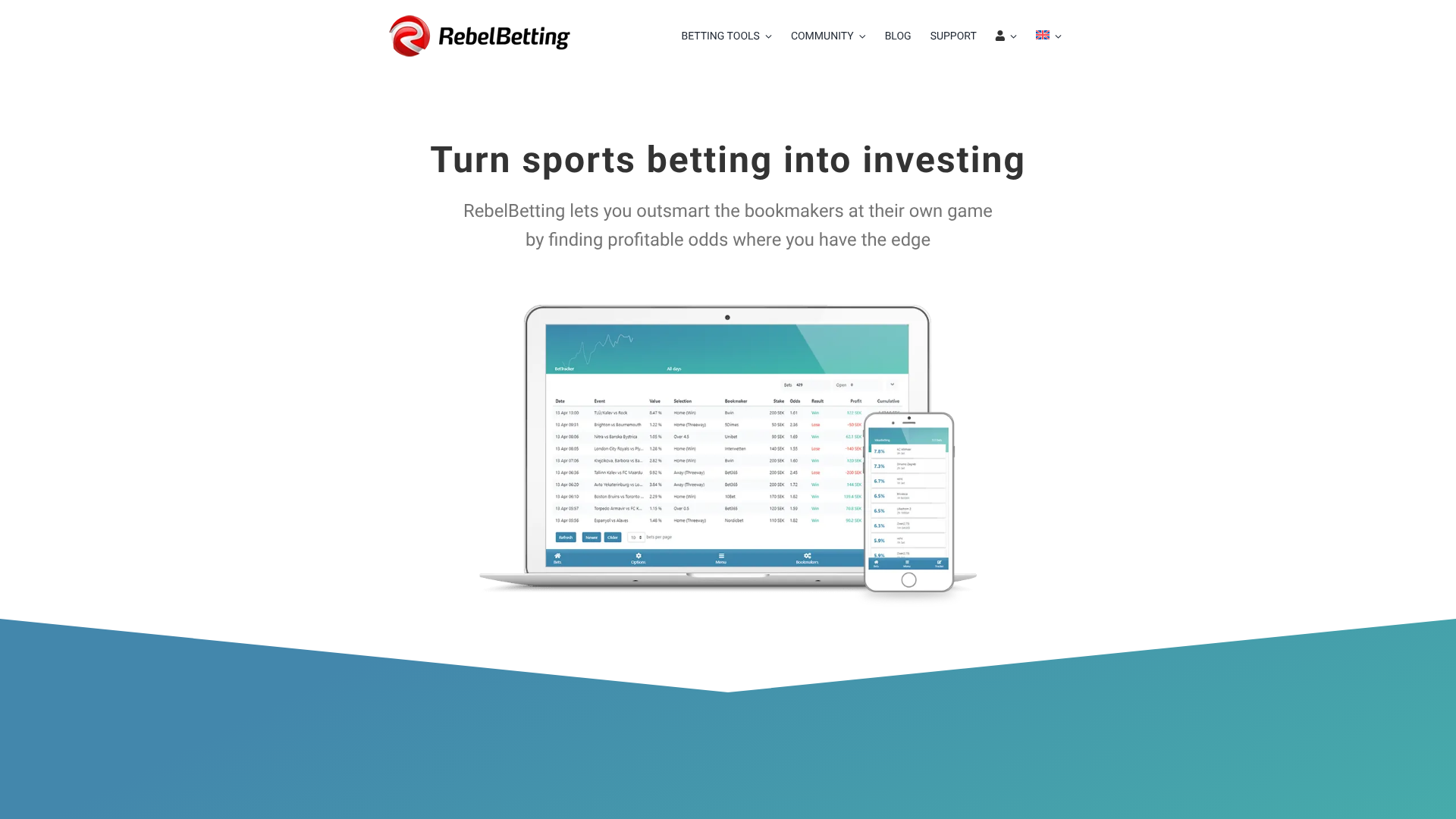
RebelBetting is one of the oldest and most respected names in the arbitrage betting space. Based in Europe, it offers extensive coverage of both European and international bookmakers. It's known for its reliability, stability, and dedication purely to arbitrage and value betting.
The software is robust and provides users with a steady stream of sure bets. RebelBetting also offers a feature that can help you avoid detection by bookmakers by suggesting how to round your bets. It's a professional-grade tool trusted by serious arbers for over a decade.
Pros
- Long-standing reputation for reliability and accuracy.
- Excellent coverage of European and international bookmakers.
- Features designed to help users prolong the life of their sportsbook accounts.
Cons
- The subscription fee is a significant investment.
- The software can have a steeper learning curve compared to newer platforms.
3. Arb Amigo

Arb Amigo is another strong contender that provides a user-friendly platform for finding arbitrage opportunities. It aims to simplify the process, making it accessible to those who are new to the concept of arbing. The platform scans a wide range of bookmakers and presents the data in a clear, actionable format.
It offers different subscription tiers, which can make it a more budget-friendly option for those just starting. Arb Amigo focuses on delivering reliable arb alerts without overwhelming the user with overly complex features, striking a good balance between functionality and simplicity.
Pros
- Clean and simple interface suitable for beginners.
- Often more affordable than some of its larger competitors.
- Covers a solid range of sports and bookmakers.
Cons
- May not have the same update speed or breadth of bookmaker coverage as premium services.
- Fewer advanced features for experienced, high-volume arbers.
Pricing and Cost Comparison
Investing in arbitrage software is a necessary cost of doing business. The subscription fees can seem high, but a quality tool will pay for itself through the profitable opportunities it finds. Here’s a general comparison of the pricing structures for these tools.
| Feature | OddsJam | RebelBetting | Arb Amigo |
|---|---|---|---|
| Best For | US Bettors, Speed | European Bettors, Reliability | Beginners, Budget-Conscious |
| Key Feature | Real-time US odds | Account longevity tools | Simplicity and ease of use |
| Pricing Model | Monthly Subscription | Monthly/Annual Subscription | Tiered Monthly Subscription |
| Current Price | Visit OddsJam for plans | Visit RebelBetting for plans | Visit Arb Amigo for plans |
Pros and Cons of Arbitrage Betting
Like any strategy, arbitrage betting has distinct advantages and disadvantages. It's important to weigh them both before deciding if it's the right approach for you.

Pros
- Guaranteed Profit: When executed correctly, the mathematical nature of arbing ensures you make a profit regardless of the outcome.
- Low Risk: The strategy eliminates the risk associated with traditional gambling. Your profit is locked in before the event even starts.
- Not Reliant on Sports Knowledge: You don't need to be a sports expert. Success depends on math, speed, and execution, not on predicting winners.
Cons
- Small Margins: Profits on individual arbs are small, typically 1-5%. It requires a high volume of bets to generate significant income.
- Requires Speed and Capital: You need to act fast and have a sufficient bankroll spread across multiple sportsbooks to capitalize on opportunities.
- Risk of Account Limitations: This is the biggest long-term challenge. Sportsbooks will eventually limit or close your accounts if they identify you as an arber.
- High Initial Learning Curve: While the concept is simple, mastering the execution and managing the risks takes time and practice.
Frequently Asked Questions about Arbitrage Betting
Here are answers to some of the most common questions people have when first learning about arbitrage betting.
Is betting arbitrage illegal?
No, arbitrage betting is not illegal. There are no laws against placing bets at different sportsbooks to take advantage of their offered odds. It is a legal strategy that uses publicly available information.
However, it is almost universally against the terms and conditions of every sportsbook. They consider it an abuse of their services. While you won't face legal trouble, you will almost certainly face consequences from the bookmakers, such as having your stake sizes limited or your account closed.
Is arbitrage betting really profitable?
Yes, it is profitable. The math guarantees a profit on every correctly executed trade. The profitability for an individual, however, depends on several factors: the size of their bankroll, the number of sportsbook accounts they have, the speed of their software, and their ability to execute bets quickly without making errors.
It is not a get-rich-quick scheme. It's a volume-based strategy that requires discipline and consistency. Many people make a steady side income from it, while dedicated professionals can earn a full-time living.
How do bookies know you are arbing?
Bookmakers use sophisticated software and risk management teams to identify patterns associated with arbitrage betting. They look for several red flags, including:
-
Unusual Stake Sizes: Consistently betting odd amounts like $112.78 to perfectly balance an arb. * Betting on Obscure Markets: Arbs are often found in less popular markets (e.g., player props, international leagues) where odds are less efficient. * Always Taking the Best Odds: Recreational bettors spread their action, while arbers exclusively take odds that offer mathematical value.
-
Lack of Brand Loyalty: Arbers jump between dozens of bookies, showing no loyalty to any single one.
How do arbitrage bettors get caught?
Bettors get caught when their betting patterns trigger the red flags mentioned above. Over time, the bookmaker's algorithm will flag an account for review. A risk manager will then look at the account's history and, if it fits the profile of an arber, will apply limitations.
As one user on a Reddit discussion about building an arbing bot noted, the key is speed and automation, but this also creates very clear, non-human patterns that bookies can easily detect. The goal for a long-term arber is to blend in as much as possible to prolong the life of their accounts.
Final Thoughts: Is Arbitrage Betting Right for You?
Understanding how arbitrage betting works reveals it as a unique and analytical approach to sports betting. It transforms gambling into a form of trading, where profits are generated through mathematical certainty rather than luck. It's an excellent strategy for individuals who are disciplined, detail-oriented, and comfortable with using technology to gain an edge.
However, it's not for everyone. If you're looking for the thrill of a big win or enjoy the recreational aspect of betting on your favorite team, arbing might feel more like a job than a hobby. It requires patience, a significant starting bankroll, and the acceptance that your sportsbook accounts will have a limited lifespan.
If you're ready to move from guessing to calculating, using a tool is the first step. Platforms like OddsJam for US bettors or RebelBetting for a global audience provide the technology needed to turn theory into profit. By starting small, learning the process, and managing your risks, you can make arbitrage a consistent and profitable part of your financial strategy.