









Betting Strategies for Sports: A Beginner's Guide to Smarter Wagering
Moving beyond casual bets and developing effective betting strategies for sports is the first step toward becoming a more disciplined and potentially profitable bettor. For many, sports betting is a shot in the dark, driven by gut feelings or loyalty to a favorite team. This approach rarely leads to long-term success. The key difference between casual bettors and sharp, successful ones lies in their methodical approach, grounded in strategy, data analysis, and unwavering discipline.
This guide is designed for beginners who want to understand the fundamental principles that underpin successful sports wagering. We will break down the core concepts, from managing your money and understanding odds to analyzing data and controlling the psychological pitfalls that trap so many. The goal isn't to promise guaranteed wins—that's impossible—but to equip you with the knowledge to make smarter, more informed decisions.
What You'll Learn
- Bankroll Management is Non-Negotiable: Learn why protecting your capital with a strict bankroll strategy is the single most important skill for long-term survival and success in sports betting.
- The Power of Shopping for the Best Line: Discover how small differences in odds and lines across various sportsbooks can significantly impact your profitability over time.
- Data Over Emotion Wins: Understand the importance of using statistics, trends, and objective analysis to make informed bets, rather than relying on gut feelings or team loyalty.
- Discipline is Your Greatest Asset: Explore the psychological side of betting and learn how to avoid common mental traps like chasing losses and confirmation bias.
- Mastering the Basics is Key: Get a clear breakdown of the most common bet types and how to read betting odds, providing a solid foundation for all your future wagers.
The Foundation: Understanding Odds and Bet Types
Before you can implement any strategy, you need to speak the language of sports betting. This starts with understanding the odds and the basic types of wagers you can place. Misinterpreting this information is a common mistake that can lead to costly errors.
How to Read Sports Betting Odds
Odds tell you two crucial things: the implied probability of an outcome and how much money you'll win if your bet is successful. The most common format in the United States is American odds, which you'll see displayed with a plus (+) or minus (-) sign.
- Minus Sign (-): Indicates the favorite. The number shows how much you need to risk to win $100. For example, odds of -150 mean you must bet $150 to win $100 (for a total payout of $250).
- Plus Sign (+): Indicates the underdog. The number shows how much you will win for every $100 you risk. For example, odds of +130 mean a $100 bet will win you $130 (for a total payout of $230).
Understanding this relationship is fundamental. The sportsbook's goal is to balance the action on both sides, and the odds reflect their assessment of the matchup, adjusted for public betting patterns.
Common Types of Sports Bets
While there are dozens of exotic wagers, most betting revolves around a few core types. Mastering these is essential for any beginner.
- Moneyline: The simplest bet of all. You're just picking which team will win the game outright. Odds are the only factor determining your payout. If the Kansas City Chiefs are -200 on the moneyline, you bet $200 to win $100.
- Point Spread: This bet is about the margin of victory. The favorite is given a handicap (e.g., -7.5 points) they must win by, while the underdog gets a head start (e.g., +7.5 points). To win a bet on the favorite, they must win by 8 points or more. A bet on the underdog wins if they win the game outright or lose by 7 points or fewer.
- Totals (Over/Under): The sportsbook sets a total number of points, goals, or runs expected in a game. You bet on whether the final combined score will be over or under that number. It doesn't matter who wins, only how much they score.
- Parlays: A high-risk, high-reward wager where you combine two or more bets into a single ticket. For the parlay to win, every single one of your individual bets (or "legs") must be correct. If even one leg loses, the entire parlay is a loss.
- Prop Bets: These are wagers on specific events within a game that don't necessarily relate to the final outcome. Examples include a quarterback throwing for over or under 2.5 touchdowns, or a specific player scoring the first basket in an NBA game.
The Golden Rule: Mastering Bankroll Management
If you take only one piece of advice from this guide, let it be this: effective bankroll management is the most critical component of any successful sports betting strategy. Without it, even the most skilled handicapper will eventually go broke. Your bankroll is the total amount of money you have set aside specifically for betting—money you can afford to lose.
Bankroll management is not about picking winners; it's about preserving your capital so you can withstand the inevitable losing streaks. The core principle is to use a consistent staking plan, often called a "unit" system. A unit is a percentage of your total bankroll, typically between 1% and 5%.



For example, if your total bankroll is $1,000, a 1% unit size would be $10. This means that for a standard bet, you would risk $10. By sticking to a small, fixed percentage, you ensure that a string of losses won't wipe out your entire bankroll. A 10-game losing streak would only deplete 10% of your starting capital, leaving you with plenty of funds to continue betting and recover.
There are several common staking methods:
- Flat-Betting Model: You bet the exact same amount (e.g., 1 unit) on every single wager, regardless of your confidence level or the odds. This is the simplest and most recommended method for beginners because it completely removes emotion from bet sizing.
- Percentage Model: Your unit size is always a fixed percentage (e.g., 1%) of your current bankroll. If your bankroll grows to $1,100, your unit size becomes $11. If it shrinks to $900, your unit size becomes $9. This method helps maximize gains during winning streaks and minimize losses during downturns.
- Confidence Model: You vary your bet size based on your confidence in the wager, such as 1 unit for a standard play, 2 units for a strong play, and 3 units for a top play. This requires extreme discipline and honesty, as it's easy to overestimate your confidence after a few wins.
As a beginner, start with a 1% unit size using the flat-betting model. This disciplined approach protects you from making emotional decisions, like betting bigger to chase losses—the fastest way to drain your account.


Finding Your Edge: The Power of Data and Analysis
Successful sports betting is less about luck and more about finding an analytical edge. This means moving beyond surface-level information like team records and media narratives. Professional bettors use deep statistical analysis to identify value and make informed decisions. While you don't need to be a data scientist, adopting a more analytical mindset is a crucial step.
Start by specializing. Instead of betting on every sport, focus on one or two leagues you know well. This allows you to develop a deeper understanding of the teams, players, and underlying dynamics. For example, instead of betting on all of college football, you might specialize in the SEC conference.
Next, learn to look beyond the box score. Consider advanced metrics that provide a clearer picture of a team's performance. In basketball, this could be offensive and defensive efficiency ratings instead of just points per game. In baseball, it might be metrics like xFIP for pitchers or wOBA for hitters.
These stats often strip out luck and provide a more accurate assessment of true talent.
Here are some key areas to analyze:
- Recent Performance and Trends: Is a team on a hot streak, or have they been struggling? Look at their performance against the spread (ATS), not just their win-loss record.
- Injuries and Lineup Changes: The absence of a key player can dramatically alter a game's outcome. Always check injury reports right up until game time.
- Situational Factors: Consider factors like travel schedules, rest days, and motivational angles. Is a team playing its third road game in four nights? Is another team in a "must-win" situation to make the playoffs?
- Matchup Analysis: How does one team's strength line up against another's weakness? A team with a dominant rushing attack might have a significant advantage against a team with a weak run defense.
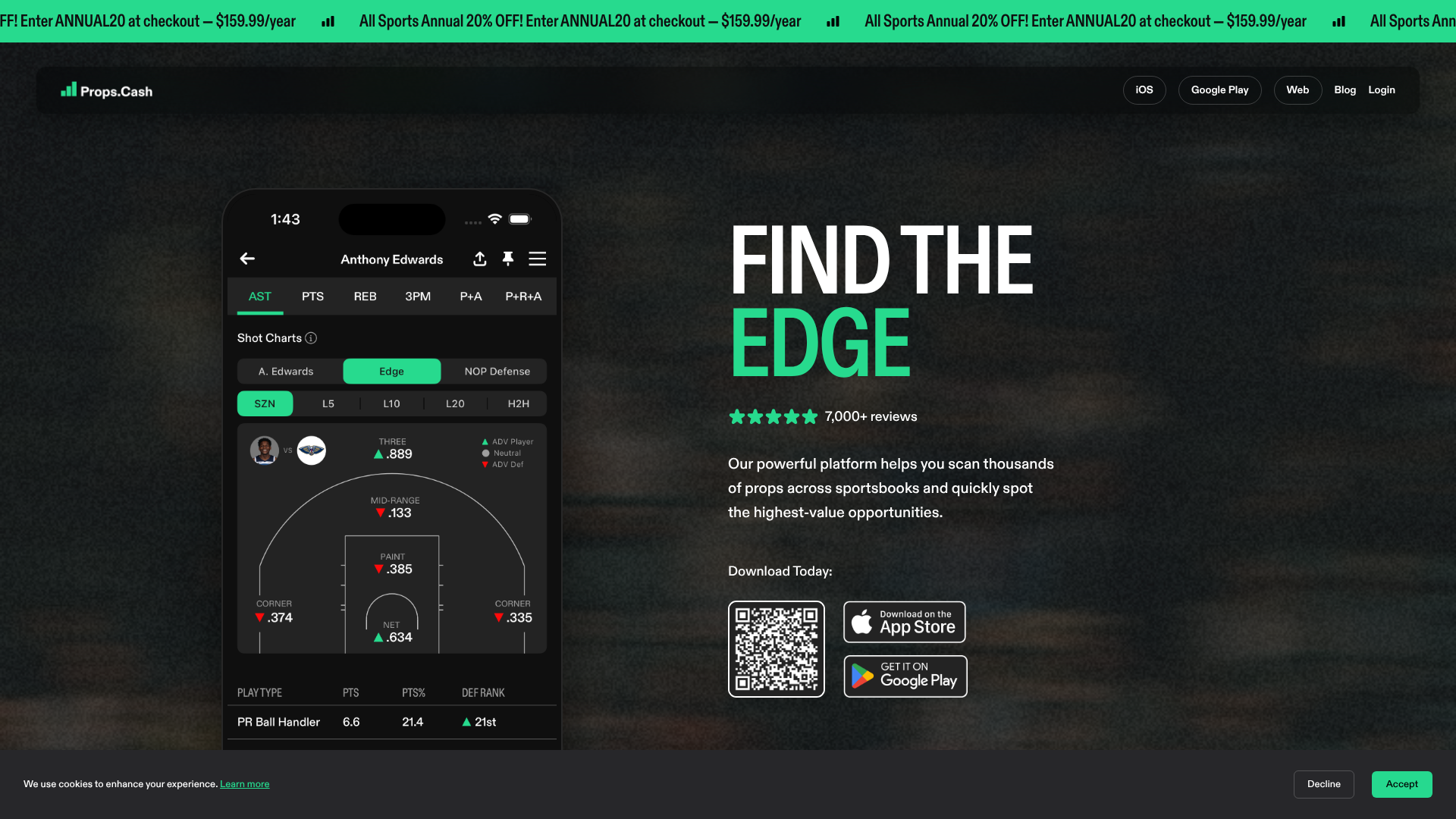
For those who want to dive deep into player props, tools like Props.Cash can be incredibly useful. They aggregate player statistics, historical performance against specific opponents, and other relevant data to help you research prop bets more efficiently. This saves time and helps you spot trends you might otherwise miss.
How to Get the Best Price: The Art of Line Shopping
Line shopping is one of the simplest yet most effective sports betting tips you can implement immediately. It's the practice of comparing the odds and lines for the same bet across multiple sportsbooks to ensure you get the best possible price. Failing to do so is like willingly paying more for the exact same product at a different store—it's a direct hit to your bottom line.
Sportsbooks often have slightly different odds because they are trying to manage their own risk and balance the money they've taken on each side of a game. One book might have the Green Bay Packers at -7, while another has them at -6.5. That half-point difference might seem small, but over hundreds of bets, it can be the difference between a winning and losing season. The same applies to the "juice" or "vig"—the commission a sportsbook charges.
Finding a line at -105 instead of the standard -110 saves you money on every bet you place.
To effectively shop for lines, you must have accounts at multiple online sportsbooks. It's recommended to have funds in at least three to five different legal books. This allows you to quickly place a wager at whichever book is offering the most favorable terms for your chosen bet.
Manually checking every sportsbook for every bet can be time-consuming. This is where odds comparison tools become invaluable. Platforms like OddsJam automate the entire process. They scan dozens of sportsbooks in real-time and display the best available odds for every game and every type of bet on a single screen.
This not only saves a massive amount of time but also ensures you never miss an opportunity to get the best price.
Pro Tip: Line shopping is a core principle of value betting. By consistently getting better numbers than the market average, you are systematically increasing your expected value (+EV) on every wager you make. It's a foundational habit of every sharp bettor.
Building Your System: Developing a Consistent Betting Strategy
Consistency is the hallmark of a disciplined bettor. A successful strategy isn't about finding a magic formula that wins every time; it's about creating a repeatable process for identifying, analyzing, and placing bets. This system should be based on logic and data, not emotion or impulse.
Your first step is to define your approach. What will be your primary method for finding bets? Some common betting tactics for sports include:
- Statistical Modeling: Using data to create your own power ratings or predictive models to identify discrepancies between your projections and the sportsbook's lines.
- Trend-Based Betting: Identifying historical trends and patterns that have proven profitable over time (e.g., a specific team's record on the road as an underdog).
- Situational Handicapping: Focusing on the context of the game, such as motivation, travel, or let-down spots after a big win.
- Fading the Public: Betting against the team that is receiving the overwhelming majority of public bets. The theory is that heavy public money can inflate lines, creating value on the other side.
Once you've chosen an approach, the next critical step is to track every single bet you make. Use a spreadsheet or a dedicated app to record the date, sport, teams, bet type, stake size, odds, and the result. This data is invaluable. Over time, it will reveal your strengths and weaknesses.
You might discover you're highly profitable betting on NBA totals but lose consistently on NFL point spreads. This allows you to refine your strategy, focusing on what works and eliminating what doesn't.
As one user on X.com noted, the difference is approach. If you treat betting like a system with "Data over emotions, Risk management over excitement, Long-term edge over short-term wins," you give yourself a chance to succeed. Your system should be a living document. Continuously review your results, question your assumptions, and be willing to adapt your strategy based on what the data tells you.
Advanced Sports Wager Strategies
Once you've mastered the fundamentals, you can begin to explore more advanced sports wager strategies. These methods require more knowledge and often specialized tools, but they are based on mathematical principles designed to secure a long-term edge. For beginners, it's important to understand these concepts even if you don't implement them right away.
Value Betting (+EV)
Value betting is the cornerstone of professional sports betting. A bet has positive expected value (+EV) when the probability of it winning is greater than the probability implied by the sportsbook's odds. For example, if you believe a team has a 55% chance of winning, but the odds offered imply only a 50% chance, that is a value bet. Over the long run, consistently placing +EV bets will lead to profit, even if many individual bets lose.
Identifying value requires you to be better at predicting outcomes than the market. This can be achieved through sophisticated statistical models or deep domain expertise. Tools that use AI to create predictive models, like Rithmm, aim to help bettors find these +EV opportunities by generating their own data-driven projections and comparing them to market odds.

Arbitrage Betting ("Arbing")
Arbitrage betting is a risk-free strategy that involves placing bets on all possible outcomes of an event across different sportsbooks. Due to discrepancies in odds between bookmakers, a situation can arise where you can guarantee a small profit regardless of the result. For example, you might bet on the Over at one sportsbook and the Under at another, with odds that ensure you win more than you lose no matter what.
Arbitrage opportunities are rare and disappear quickly. They require speed, precision, and accounts at many sportsbooks. Specialized software like RebelBetting or Arb Amigo is designed to scan the market continuously and alert users to these fleeting opportunities. While it guarantees a profit, the returns are typically small (1-3%), and sportsbooks may limit or close the accounts of bettors they suspect of arbing.
The Mental Game: Psychological Factors in Sports Betting
Your mindset is just as important as your analytical skills. Many promising bettors fail not because their analysis is flawed, but because they can't control their emotions. Understanding and overcoming common psychological biases is essential for long-term success.
One of the biggest traps is emotional betting. This often involves betting on your favorite team to win or against a rival you dislike. Your personal feelings cloud your judgment and prevent you from making an objective assessment of the game. A core rule of disciplined betting is to never bet on games where you have a strong emotional attachment.
Another major pitfall is chasing losses. After a losing bet, the temptation to immediately place a larger bet to win your money back is strong. This is a recipe for disaster. It leads to impulsive, poorly researched wagers and can quickly decimate your bankroll.
A disciplined bettor accepts that losses are part of the process and sticks to their pre-defined unit size and strategy, no matter the previous result.
Other common biases include:
- Confirmation Bias: The tendency to only seek out information that confirms your existing belief about a game, while ignoring data that contradicts it.
- Recency Bias: Giving too much weight to recent events. A team isn't necessarily the best in the league just because they won their last three games, nor are they the worst because they lost them.
- Gambler's Fallacy: The mistaken belief that if something happens more frequently than normal during a given period, it will happen less frequently in the future. For example, believing a team is "due" for a win after a long losing streak.
To combat these biases, you must rely on your system. Trust your data and your process. Stick to your bankroll management rules without exception. Success in sports betting is a marathon, not a sprint, and maintaining emotional control is the key to finishing the race.
Betting on the Fly: An Introduction to In-Play Wagering
In-play or live betting has become one of the most popular forms of sports wagering. It allows you to place bets on a game after it has already started, with odds that update in real-time based on the action on the field or court. This dynamic environment presents unique opportunities but also comes with significant risks.
The primary advantage of live betting is the ability to react to the flow of the game. You can see how teams are performing before committing your money. For example, if a heavy pre-game favorite comes out flat and falls behind early, you might be able to get much better odds on them to come back and win than you could have before the game started.
Live betting is also an excellent tool for hedging or middling opportunities. If your pre-game bet is looking good, you might be able to place a live bet on the other side to lock in a guaranteed profit. If you bet on the underdog +10.5 before the game and they are leading by 14 in the fourth quarter, you could place a live bet on the favorite at a new, smaller spread to create a "middle" where you could potentially win both bets.
However, in-play betting requires extreme discipline. The fast-paced nature of constantly changing odds can lead to impulsive decisions. It's easy to get caught up in the excitement and place bets without proper analysis. To succeed with in-play betting strategies, you must have a clear plan before the game begins.
Identify potential scenarios you might want to bet on and the price points you'd be willing to accept. Without a pre-game plan, you're just gambling on momentum, which is a losing proposition long-term.
Pro Tip: Use the first quarter or first period of a game as an information-gathering session. Don't place any live bets. Instead, watch how the teams match up and see if your pre-game analysis holds true. This patient approach can help you spot valuable live betting opportunities later in the game.
Staying on the Right Side of the Law: Legal Considerations
Navigating the legal landscape of sports betting is a crucial final step in developing a responsible strategy. The legality of sports wagering in the United States has changed dramatically in recent years, with many states moving to legalize and regulate the industry. However, the laws can vary significantly from one state to another.
It is absolutely essential to only place wagers with legal, licensed, and regulated sportsbooks. These operators are required to adhere to strict standards set by state gaming commissions, which ensures fair play, the security of your funds, and responsible gaming practices. Betting with offshore or illegal bookmakers carries significant risks. They offer no consumer protections, and you have no recourse if they refuse to pay out your winnings or disappear with your money.
Before you start, confirm the legal status of sports betting in your state. You must be physically located within the borders of a state with legal sports betting to place a wager. Legal sportsbooks use geolocation technology to verify your location. You will also need to meet the minimum age requirement, which is typically 21 years old in most states.
Finally, always practice responsible gaming. Sports betting should be a form of entertainment, not a way to make money or solve financial problems. Set strict limits on your time and money, and never bet more than you can afford to lose. If you ever feel that your betting is becoming a problem, legal sportsbooks are required to provide resources to help, such as options to set deposit limits, spending limits, or self-exclude from the platform.
Organizations like the National Council on Problem Gambling also offer free, confidential help.
Frequently Asked Questions (FAQ)
What is the most successful betting system?
There is no single "most successful" betting system that guarantees wins. However, strategies based on mathematical principles like value betting (+EV) and arbitrage are used by professional bettors because they are designed to create a long-term advantage. The true success of any system, however, relies more on the bettor's discipline, consistent execution, and strict bankroll management than on the system itself. For beginners, the most successful approach is to focus on the fundamentals: line shopping, basic data analysis, and never risking more than 1-2% of your bankroll on a single bet.
Can you make a living off betting?
While it is technically possible for a very small percentage of individuals, making a living from sports betting is extremely difficult and not a realistic goal for the vast majority of people. It requires a significant starting bankroll, an advanced understanding of statistics and modeling, immense discipline, and the ability to handle long losing streaks emotionally. It should be treated as a full-time job involving countless hours of research. For over 99% of participants, sports betting should be viewed as a form of entertainment with a budget, not a viable career path.
Does doubling your bet work?
This strategy, known as the Martingale system, involves doubling your bet after every loss. The theory is that you will eventually win and recoup all previous losses plus your original stake. In practice, this system is incredibly dangerous and almost always leads to ruin. You can quickly hit a long losing streak that requires an astronomically large bet, exceeding either your bankroll or the sportsbook's table limits.
It is a flawed strategy that fails to account for real-world constraints and is strongly advised against.
What does +3000 odds to win mean?
In American odds, a plus sign (+) indicates how much profit you will make on a $100 wager. So, odds of +3000 mean that if you bet $100 and win, you will receive $3,000 in profit, for a total payout of $3,100 (your original $100 stake plus the $3,000 win). These odds are typically associated with longshot bets, such as a team with a very low probability of winning a championship.
What is the 80/20 rule in betting?
The 80/20 rule, or Pareto Principle, can be applied to sports betting in several ways. It suggests that roughly 80% of your profits will come from 20% of your bets. This highlights the importance of identifying your most profitable areas and focusing your efforts there. For example, you might find that 80% of your success comes from betting on a specific sport, league, or bet type.
The principle encourages bettors to specialize and dedicate their research time to the 20% of areas where they have the biggest edge.
Final Thoughts
Developing effective betting strategies for sports is a journey that transforms wagering from a game of chance into a structured discipline. The core principles are not complex, but they demand consistency and patience. By prioritizing bankroll management above all else, you give yourself the foundation to withstand the natural ups and downs of sports betting.
From there, success is built on a commitment to making informed decisions. This means diligently shopping for the best lines, dedicating time to research and data analysis, and building a repeatable system for identifying wagers. Just as importantly, it requires mastering the mental game—recognizing and avoiding the emotional biases that lead to poor choices.
Remember that there are no shortcuts or guaranteed profits. The goal is to make smarter, more calculated decisions over the long term. Start with the basics, track your performance, and slowly refine your approach. By treating sports betting with the seriousness of an investment, you can enhance your enjoyment of the games and give yourself the best possible chance for success.