









Arbitrage Betting Software: A 2026 Buyer's Guide for Beginners
Arbitrage betting offers a rare opportunity in the world of sports wagering: a guaranteed, risk-free profit. This is achieved by placing proportional bets on every possible outcome of an event across different bookmakers. The challenge isn't the concept, but the execution. Finding these opportunities manually is nearly impossible, which is where arbitrage betting software becomes essential.
These powerful tools scan millions of odds across hundreds of sportsbooks in real-time, flagging mathematical certainties for profit and turning a complex theory into an actionable strategy.
This guide is designed for beginners looking to understand and choose the right tools for the job. We'll break down how the software works, what features matter most, and review the top options available today. Whether you're looking to generate a side income or explore advanced betting strategies, understanding these platforms is your first step toward success.
What You'll Learn
- What Arbitrage Betting Is: A clear explanation of how arbitrage betting works by exploiting price discrepancies between different sportsbooks to guarantee a profit.
- Why Software is Essential: Manual arbitrage is impractical due to the speed at which odds change. Software automates the discovery process, making it feasible.
- Key Features to Compare: The most important features to look for in betting arbitrage tools include speed, bookmaker coverage, an integrated calculator, and robust filtering options.
- Top Software Choices: We review leading options like OddsJam for US bettors, RebelBetting for European markets, and Arb Amigo for its user-friendly interface.
- Common Risks and Mistakes: Arbitrage is legal, but bookmakers can limit accounts. We cover how to avoid common pitfalls like placing obvious bets or chasing unrealistic profits.
How Arbitrage Betting Works: The Core Concept

Arbitrage betting, often called "arbing" or creating a "surebet," is a strategy that capitalizes on discrepancies in odds offered by different bookmakers for the same sporting event. By betting on all possible outcomes across these bookmakers, you can lock in a profit regardless of who wins. Think of it like stock market arbitrage, but for sports.
Let's use a simple tennis match example between Player A and Player B. Two different sportsbooks are offering odds on the winner:
- Bookmaker 1: Offers odds of 2.05 for Player A to win.
- Bookmaker 2: Offers odds of 2.10 for Player B to win.
This scenario presents an arbitrage opportunity. If you place a calculated stake on each player at these respective bookmakers, you guarantee a profit. For instance, if you bet a total of $100, you would stake:
- $50.60 on Player A at Bookmaker 1 (odds 2.05)
- $49.40 on Player B at Bookmaker 2 (odds 2.10)
Now, let's see the outcome. If Player A wins, your return is $50.60 x 2.05 = $103.73. If Player B wins, your return is $49.40 x 2.10 = $103.74. In either case, your return is greater than your total stake of $100.



You've made a guaranteed profit of approximately $3.73, which is a 3.73% return on your investment. While this amount seems small, repeating this process consistently with larger stakes can generate significant returns over time.
The Critical Role of Arbitrage Betting Software
While the concept of arbitrage is simple, finding these opportunities manually is a Herculean task. Odds on popular sporting events change every few seconds, driven by betting volume, news, and bookmaker adjustments. An arbitrage opportunity might only exist for a few minutes, or even seconds, before the odds shift and the profit window closes.
This is why arbitrage betting software is not just a convenience—it's a necessity. These platforms are built to perform three critical functions at a speed no human can match:
- Scanning: The software constantly scrapes odds from dozens, sometimes hundreds, of online bookmakers simultaneously. It processes millions of data points across various sports and markets, from simple moneyline bets to complex Asian handicaps.
- Calculating: As soon as the software finds a discrepancy, its algorithms instantly calculate if an arbitrage opportunity exists. It determines the potential profit percentage and provides the exact stakes you need to place on each outcome to guarantee that return.
- Alerting: The platform alerts you in real-time, typically through a dashboard, email, or push notification. This allows you to act immediately before the odds change.
Without these automated betting arbitrage tools, you would spend hours manually comparing odds with no guarantee of finding a single profitable bet. The speed and efficiency of the software are what make a sustainable arbitrage strategy possible. It transforms arbing from a theoretical possibility into a practical, repeatable process for generating income.

Key Features to Look for in Betting Arbitrage Tools
Not all arbitrage platforms are created equal. When you're evaluating different arbitrage betting apps and software, certain features are crucial for success, efficiency, and protecting your bankroll. Here’s a breakdown of what to look for in a top-tier service.
Speed and Refresh Rate
Speed is the single most important factor in arbitrage betting. The faster the software can find an arb and alert you, the higher your chances of placing the bet before the odds change. Look for software that boasts a low latency and a high refresh rate. Some of the best services update their odds every few seconds, giving you a significant advantage.
Bookmaker Coverage
An arbitrage opportunity requires odds from at least two different bookmakers. Therefore, the more bookmakers a service covers, the more potential arbs it can find. Check the list of supported bookmakers and ensure it includes the ones you have accounts with or plan to use. If you're in a specific region like the US or UK, verify that the software covers the sportsbooks legally available to you.
Sport and Market Coverage
While major sports like football, basketball, and tennis generate the most arbs, having coverage across niche sports can also be valuable. More importantly, check the market coverage. Does the software only scan moneyline (win/loss) bets, or does it also cover totals (over/under), spreads, and player props? Broader market coverage translates to more opportunities.
Integrated Bet Calculators
Any good arbitrage service will have a built-in calculator. When an arb appears, the calculator should automatically show you the guaranteed profit percentage and tell you exactly how much to stake on each side of the bet based on your total desired investment. This eliminates manual math errors and saves precious seconds when placing bets.
Filters and Customization
Your screen can quickly become cluttered with dozens of low-profit arbs. Effective filtering is essential. You should be able to filter opportunities by profit percentage, specific bookmakers, sports, and markets. This customization allows you to focus only on the arbs that meet your specific criteria, making your workflow much more efficient.
User Interface and Experience (UI/UX)
The software should be easy to navigate, especially under pressure. A clean, intuitive interface that clearly displays the event, participating bookmakers, odds, and required stakes is vital. Some platforms even offer direct links that take you to the betting slip on the bookmaker's site, further speeding up the process.
Top Arbitrage Betting Software Options for 2026
Choosing the right sports betting software is a crucial step. The market has several strong contenders, each with unique strengths tailored to different types of users and geographic locations. Here are some of the top options to consider.
1. OddsJam

Best For: US and Canadian Bettors
OddsJam has established itself as a leader in the North American market. Its primary strength is its extensive coverage of US-facing sportsbooks, including major players like DraftKings, FanDuel, BetMGM, and Caesars. It was built from the ground up for the legal US betting landscape.
The platform is incredibly fast, identifying arbitrage and value betting opportunities in near real-time. Its user interface is clean and provides all the necessary information at a glance, including an integrated calculator that simplifies the staking process. Beyond arbitrage, OddsJam offers tools for positive expected value (+EV) betting, which is a strategy focused on finding bets with long-term profitability.
Pros
- Excellent coverage of US, Canadian, and Australian sportsbooks.
- Extremely fast odds updates, crucial for catching fleeting arbs.
- Offers multiple tools beyond arbitrage, including +EV and low-hold finders.
Cons
- Subscription can be more expensive than some competitors.
- Primarily focused on North American markets, so less ideal for European users.
2. RebelBetting
Best For: European Bettors and Reliability
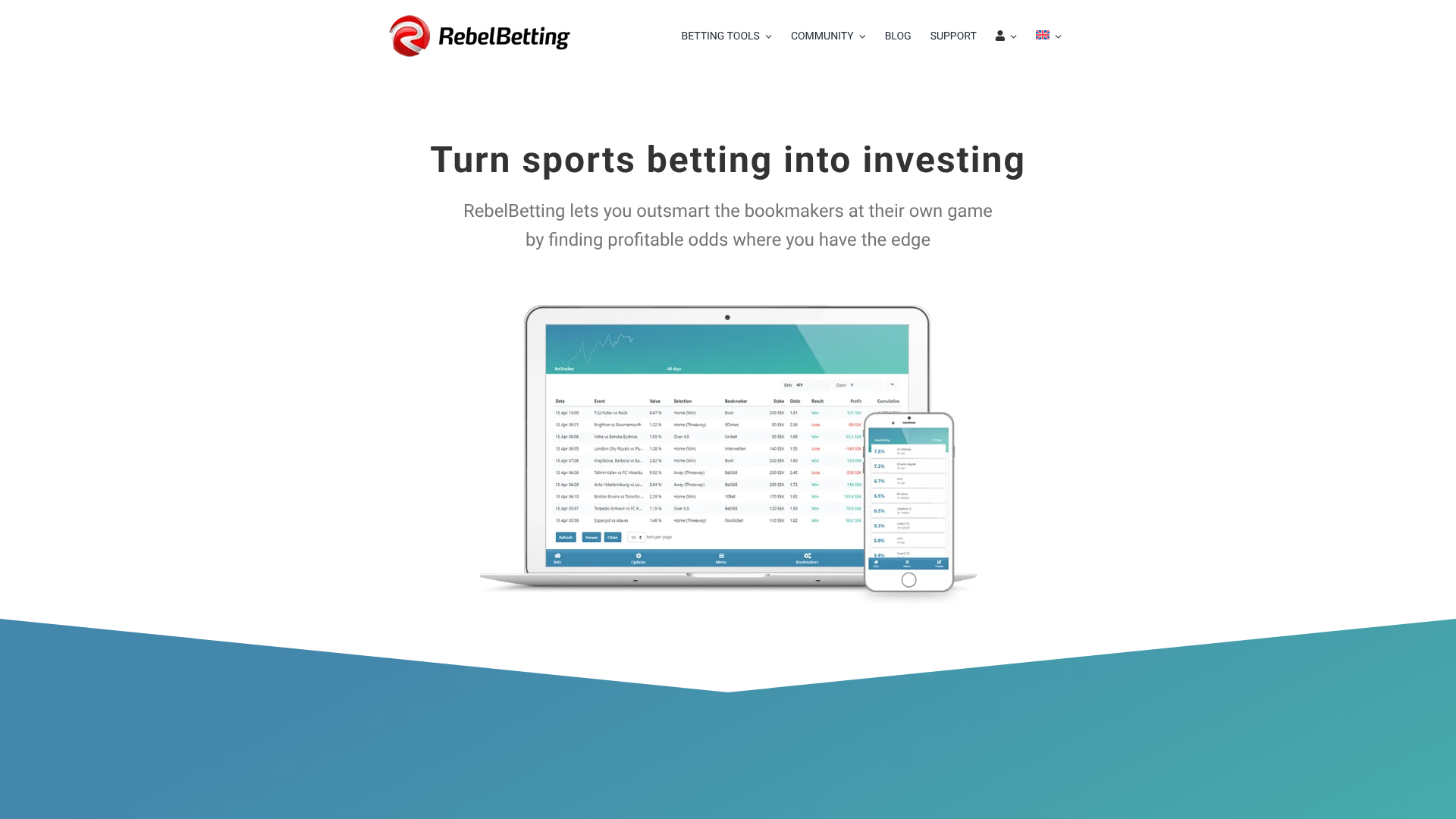
RebelBetting is one of the oldest and most respected names in the arbitrage community. Based in Sweden, it has a long track record of reliability and offers extensive coverage of European and international bookmakers. It's known for its stable software and dependable alerts.
One of its standout features is the BetBrowser, which automatically navigates to the correct betting page and can even pre-fill the betting slip for you, dramatically reducing the time it takes to place a bet. This feature helps minimize the risk of odds changing before you can lock in both sides of the arb. They offer separate products for sure betting (arbitrage) and value betting.
Pros
- Long-standing reputation for reliability and accuracy.
- Excellent coverage of European bookmakers.
- BetBrowser feature significantly speeds up the betting process.
Cons
- The software is Windows-only, which can be a limitation for Mac users.
- Subscription costs are in the mid-to-high range.
3. Arb Amigo

Best For: Beginners and Ease of Use
Arb Amigo is a newer player that focuses on simplicity and accessibility, making it a great choice for those just starting with arbitrage betting. The interface is clean and straightforward, avoiding the overwhelming complexity of some other platforms. It provides clear instructions and an easy-to-use calculator.
It covers a solid range of international bookmakers and sports, offering a good balance of features for its price point. Arb Amigo is designed to help users find and place arbs quickly without a steep learning curve, making it an excellent entry point into the world of surebetting.
Pros
- Very user-friendly interface, perfect for beginners.
- Competitive pricing makes it an accessible option.
- Good coverage of major international sports and bookmakers.
Cons
- May not have the same depth of bookmaker coverage as more established competitors.
- Fewer advanced features compared to services like OddsJam or RebelBetting.
Comparison of Top Arbitrage Tools
| Feature | OddsJam | RebelBetting | Arb Amigo |
|---|---|---|---|
| Best For | US/Canadian Bettors | European Bettors | Beginners |
| Bookmaker Coverage | US-focused, extensive | Europe-focused, deep | Broad, international |
| Speed | Excellent | Very Good | Good |
| Key Feature | +EV tools included | BetBrowser automation | Simplicity |
| Platform | Web-based | Windows Desktop | Web-based |
| Pricing | Visit site for details | Visit site for details | Visit site for details |
How to Set Up and Use Your First Arbitrage Betting App
Getting started with arbitrage betting involves more than just subscribing to a service. It requires a methodical setup to ensure you can act quickly and efficiently. Here’s a step-by-step guide to get you up and running.
Step 1: Choose Your Software
Based on your location, budget, and experience level, select the arbitrage betting software that best fits your needs. Use the comparison above as a starting point. Most services offer a free trial or a money-back guarantee, so you can test the platform before committing fully.
Step 2: Sign Up for Multiple Sportsbooks
Arbitrage betting is impossible without accounts at different bookmakers. To start, sign up for at least 5-10 sportsbooks covered by your chosen software. The more accounts you have, the more opportunities you'll be able to act on. Be sure to take advantage of any sign-up bonuses, as this can provide a nice boost to your initial bankroll.
Step 3: Fund Your Accounts
Once your accounts are verified, you need to deposit funds. Distribute your total bankroll across your various sportsbook accounts. You don't need to put an equal amount in each one, but ensure you have enough capital in several accounts to place bets when an opportunity arises. Many beginners start with a total bankroll of $500 to $1,000.
Step 4: Configure Your Software Filters
Log in to your arbitrage software and set up your filters. To begin, you might want to filter for:
- Profit Margin: Start with arbs between 1% and 4%. Anything higher is often a palpable error (palp) that a bookmaker will void.
- Bookmakers: Select only the sportsbooks where you have funded accounts.
- Sports: Stick to major sports you understand, like basketball or soccer, as the betting rules are more standardized.
Step 5: Place Your First Arb
When an arb that meets your criteria appears, act quickly but carefully. Use the integrated calculator to determine your stakes. Open the two bookmaker websites in separate tabs. Place the first bet, and immediately after it's confirmed, place the second bet.
Always double-check the odds and stakes on the bet slip before confirming. Congratulations, you've locked in your first profit.
Common Mistakes to Avoid (And How to Fix Them)
While arbitrage betting is low-risk from a mathematical standpoint, operational mistakes can cost you money or get your accounts flagged. Here are some of the most common errors beginners make and how to steer clear of them.
-
Chasing High-Profit Arbs: If you see an arb promising a 15% return, it's almost certainly a palpable error, or "palp." This means the bookmaker made an obvious mistake in setting the odds. They will likely void the bet, leaving you exposed on the other side of the arb. Fix: Stick to arbs in the 1-5% range. These are far more likely to be honored.
-
Betting Too Slowly: The biggest risk in arbing is placing one side of the bet, only for the odds on the other side to change before you can place the second bet. This leaves you with a regular bet exposed to potential loss. Fix: Be prepared. Have your bookmaker tabs open and be logged in. Use tools like RebelBetting's BetBrowser to speed up the process.
-
Using Obvious Stake Amounts: Bookmakers look for patterns to identify arbitrage bettors. Placing bets with highly specific amounts like $128.47 is a huge red flag. Fix: Round your stakes to the nearest dollar or fifty cents (e.g., $128.50 or $128). This makes your bets look more natural and helps you blend in.
-
Ignoring Different Betting Rules: A tennis match retirement rule, for example, can differ between bookmakers. One might void the bet if a player retires, while another settles it as a loss. This can turn a surebet into a loss. Fix: Familiarize yourself with the key rules of the sports you're betting on, especially for markets like tennis and baseball.
Pro Tip: To prolong the life of your sportsbook accounts, mix in some regular, small "mug bets" on popular events. Placing a simple $10 bet on a major NFL or Premier League game makes your account activity look more like that of a recreational bettor, reducing the chances of being limited.
Is Arbitrage Betting Legal and Safe?
This is one of the most frequently asked questions, and the answer has two parts. First, regarding legality: yes, arbitrage betting is completely legal. There are no laws in the United States, the UK, or most other major jurisdictions that prohibit you from placing bets at different bookmakers to lock in a profit. You are simply using publicly available information (odds) to your advantage.
However, the second part of the answer relates to safety from the bookmaker's perspective. While legal, bookmakers do not like arbitrage bettors. Their business model relies on balancing their books and maintaining a profit margin (the "vig" or "juice"). Arbitrage bettors disrupt this model by guaranteeing themselves a profit, which comes directly from the bookmakers' pockets. As private businesses, sportsbooks have the right to refuse service to customers they deem unprofitable.
If a bookmaker identifies you as an arbitrage bettor, they won't take legal action, but they will likely take steps to limit your activity. This is known as being "gubbed" or "limited." They might:
- Restrict your stake sizes: Limiting you to placing bets of only a few dollars.
- Remove promotional offers: Excluding you from bonuses and free bets.
- Close your account: In extreme cases, they may close your account and return your balance.
Bookmakers use sophisticated software to detect arbing patterns, such as consistently betting on obscure markets, placing unrounded bet amounts, and only betting when odds provide a mathematical edge. This is why it's crucial to use strategies like stake rounding and placing occasional mug bets to prolong the health of your accounts.
Case Studies: A Successful Arbitrage Betting Strategy in Action
To understand how this works in practice, let's look at a hypothetical case study of a beginner, Alex, who decides to start arbitrage betting.
The Setup:
Alex starts with a total bankroll of $1,500. He subscribes to an arbitrage service and opens accounts at eight different sportsbooks, distributing his bankroll among them. He decides to focus on major soccer and tennis markets to avoid suspicion and sticks to a conservative strategy.
Month 1: The Learning Curve
In the first week, Alex focuses on learning the software and placing small arbs in the 1-2% profit range. His total stake per arb is usually around $100. He makes a few small mistakes, like being too slow on one bet, but because his stakes are small, the financial impact is minimal. By the end of the month, he has successfully completed over 50 arbs and increased his bankroll by about 4%, or $60, after accounting for a couple of minor errors.
Month 2: Increasing Efficiency
Feeling more confident, Alex increases his average total stake to $250 per arb. He uses his software's filters to hide arbs below 1.5%, focusing his attention on more valuable opportunities. He gets much faster at placing bets and learns to round his stakes effectively. He continues to place one or two small "mug bets" each weekend.
This month, he successfully places 70 arbs, and his average return holds steady. His bankroll grows by another 6%, adding $93 to his total.
Month 3: Scaling Up
By the third month, Alex is proficient. He increases his stake size again to an average of $400 per arb. One of his eight sportsbook accounts gets limited, but because he has a diverse set of accounts, his ability to find and place arbs is only slightly affected. He opens a new account at another bookmaker to replace it.
He targets a consistent 2-3% return on his investments. At the end of the month, his bankroll has grown by another 8%, or $135.
Outcome:
After three months of disciplined effort, Alex has grown his initial $1,500 bankroll by nearly $290, a total return of over 19%. This case study illustrates that arbitrage betting is not a get-rich-quick scheme but a methodical process. Success depends on patience, discipline, and the consistent application of a sound strategy powered by reliable arbitrage betting software.
The Future of Arbitrage Betting Technology
The world of sports betting is constantly evolving, and the technology behind it is advancing at a rapid pace. The future of arbitrage betting will likely be shaped by automation, artificial intelligence, and greater market integration.
One of the most significant trends is the move toward automation. As one user on a Reddit automation forum mentioned, it's possible to build a bot using Python to execute trades automatically. While fully automated betting bots are complex and carry risks, we can expect commercial software to incorporate more semi-automated features. For example, tools that can place both bets across two bookmakers with a single click could become more common, further reducing the risk of odds changing mid-arb.
Artificial intelligence (AI) will also play a larger role. AI algorithms can predict odds movements more accurately, potentially identifying arbitrage opportunities before they even fully appear. This could also help bettors avoid palpable errors by flagging odds that are too far out of line with the rest of the market. Some modern sports betting software, like Rithmm, already uses AI to generate predictive models for finding value, a concept closely related to arbitrage.
Finally, we can expect to see even broader integration. As more regions legalize sports betting, arbitrage software will expand its coverage to include more local and niche bookmakers. This will create more opportunities, though it will also require bettors to manage an even larger portfolio of sportsbook accounts. The core principles of arbitrage will remain the same, but the tools we use will become faster, smarter, and more efficient.
Frequently Asked Questions about Arbitrage Betting Software
Can you automate arbitrage betting?
Yes, to an extent. While fully automated bots that place bets without human intervention exist, they are complex, risky, and often violate bookmaker terms of service. Most commercially available software is semi-automated, meaning it automates the finding and calculation process, but the user must still manually confirm and place the bets. Features like RebelBetting's BetBrowser are a step toward greater automation by streamlining the placement process.
Is arbitrage betting actually profitable?
Absolutely. When executed correctly, arbitrage betting is mathematically guaranteed to be profitable. The profit on each individual arb is small, typically 1-5% of your stake. The overall profitability comes from consistently placing many of these bets over time.
Success requires a sufficient bankroll, discipline, speed, and the use of reliable software. It's a volume-based strategy, not a single jackpot win.
How do bookies know you are arbing?
Bookmakers use sophisticated algorithms to detect patterns associated with arbitrage betting. These red flags include consistently betting on obscure markets or sports, always taking the best odds available across the industry, placing bets with unusual, unrounded stakes (e.g., $97.63), and having a long-term profit rate that is unnaturally high for a recreational player. They also monitor for users who only bet when there is a clear mathematical edge and rarely place bets on popular events with a high bookmaker margin.
What is the best platform for arbitrage?
The "best" platform depends on your location and needs. For bettors in the United States and Canada, OddsJam is widely considered the top choice due to its extensive coverage of North American sportsbooks. For those in Europe or international markets, RebelBetting is a highly reliable and long-standing option. For beginners seeking a simple, user-friendly experience, Arb Amigo is an excellent starting point.
Final Thoughts: Choosing the Right Tool for You
Arbitrage betting represents a unique and methodical way to profit from sports betting, removing the element of chance and replacing it with mathematical certainty. However, success is almost entirely dependent on the quality of your tools. The speed, accuracy, and breadth of your arbitrage betting software will directly impact your ability to find and execute profitable trades.
For beginners, the key is to start with a reliable, user-friendly platform and a conservative strategy. Don't be tempted by unrealistic profits; focus on learning the process and consistently executing small, guaranteed wins. As you gain experience, you can scale your stakes and refine your approach.
If you're ready to start, consider exploring the options we've discussed. Arb Amigo offers a gentle learning curve for newcomers, while platforms like OddsJam and RebelBetting provide the power and depth needed for more serious bettors. By choosing the right tool and committing to a disciplined process, you can turn sports betting from a gamble into a calculated investment.