









NBA Basketball Betting Strategies: A 10-Step Guide for Beginners
Betting on the NBA is more than just picking the winner of a game; it’s a complex challenge that blends statistical analysis, situational awareness, and disciplined financial management. While luck plays a role on any given night, long-term success depends on having a structured approach. Developing effective NBA basketball betting strategies is the single most important factor that separates casual bettors from those who consistently find an edge against the sportsbooks.
This guide breaks down the essential components of a winning strategy, from understanding the basics of odds to using advanced analytics. We will cover the core principles you need to move beyond simple guesswork and start making informed, data-driven wagers. Whether you're new to sports betting or looking to refine your approach, these tactics will provide a solid foundation for your NBA wagering journey.
What You'll Learn
- Bankroll Management is Non-Negotiable: The most critical strategy is protecting your capital. We'll cover how to set a budget, use a unit system, and avoid the common pitfall of chasing losses.
- Data Beats Gut Feelings: Successful betting relies on analyzing key statistics like pace, offensive/defensive efficiency, and player performance metrics, not just team reputations.
- Finding Value is the Ultimate Goal: The key to long-term profit isn't just picking winners, but finding bets where the odds offered are better than the actual probability of the outcome.
- Situational Factors Create Opportunities: The grueling NBA schedule, player injuries, and home-court advantage create unique betting angles that informed bettors can capitalize on.
1. Understanding NBA Betting Odds
Before placing any bet, you must understand what the odds represent. Odds tell you two things: the implied probability of an outcome and how much you will be paid if your bet wins. The three most common formats are American, Decimal, and Fractional.
American Odds (e.g., -110, +150)
This is the most common format in the United States. The numbers are based on winning or wagering $100.
- Negative Numbers (-): A negative number indicates the favorite. The number shows how much you must risk to win $100. For example, odds of -150 mean you need to bet $150 to win $100 (for a total return of $250).
- Positive Numbers (+): A positive number indicates the underdog. The number shows how much you will win for every $100 you risk. For example, odds of +200 mean a $100 bet will win you $200 (for a total return of $300).
Decimal Odds (e.g., 1.91, 2.50)
Popular in Europe and Canada, decimal odds represent the total amount returned on a winning bet for every $1 wagered, including your original stake. To calculate your potential return, you simply multiply your stake by the decimal odd. A $100 bet at 1.91 odds returns $191 ($91 profit + $100 stake).
Fractional Odds (e.g., 5/1, 1/2)
Common in the UK, fractional odds show the potential profit relative to your stake. The first number is the amount you can win, and the second is the amount you stake. For example, odds of 5/1 (read as "five-to-one") mean you win $5 for every $1 you bet.
Most online sportsbooks allow you to switch between these formats, so you can use whichever you find most comfortable. The key is to internalize what they mean so you can quickly assess the value of a potential wager.
2. Types of NBA Bets: Spread, Moneyline, and Totals
Once you understand odds, you can explore the most common types of NBA bets. Mastering these three markets is fundamental to any basketball betting strategy.



Point Spread
The point spread is designed to level the playing field between two teams of different strengths. The sportsbook sets a margin of victory (the spread) that the favored team must win by for a bet on them to cash.
- The Favorite: Will have a negative number (e.g., -7.5). This means they must win the game by 8 points or more.
- The Underdog: Will have a positive number (e.g., +7.5). This means they can either win the game outright or lose by 7 points or fewer.
For example, if the Los Angeles Lakers are -4.5 against the Boston Celtics, a bet on the Lakers only wins if they win by 5 or more points. A bet on the Celtics wins if they win the game or lose by 4 or fewer points. The standard odds for a spread bet are -110, meaning you risk $110 to win $100.
Moneyline
The moneyline is the simplest bet type: you are just picking which team will win the game outright, regardless of the margin of victory. The odds reflect each team's perceived chances of winning.
Using the same example, the Lakers might be -180 on the moneyline, while the Celtics are +160. A bet on the favored Lakers requires a $180 wager to win $100. A bet on the underdog Celtics would win $160 on a $100 wager. Moneyline bets on heavy favorites offer small returns, while underdog bets can be very profitable if they hit.
Totals (Over/Under)
Totals betting, or Over/Under, doesn't involve picking a winner. Instead, you're wagering on the total combined score of both teams in the game. The sportsbook sets a line (e.g., 225.5 points), and you bet on whether the final score will be over or under that number.
If you bet the Over 225.5 and the final score is 115-112 (a total of 227), your bet wins. If the final score is 110-105 (a total of 215), the Under wins. This type of bet is popular for bettors who have a strong read on a game's pace and the offensive/defensive capabilities of the teams involved.
3. Bankroll Management: The Cornerstone of Success
No NBA wagering tactic will lead to long-term success without disciplined bankroll management. This is the practice of managing your betting funds to withstand losing streaks and grow your capital over time. It's arguably the most important skill a bettor can develop.
First, you must set aside a specific amount of money that you are willing to lose. This is your bankroll. It should be discretionary income, not money needed for essential expenses. Once your bankroll is established, the next step is to define your betting unit.
A "unit" is a consistent percentage of your bankroll that you risk on each bet. A conservative and highly recommended approach is to make one unit equal to 1-2% of your total bankroll. For example, with a $1,000 bankroll, one unit would be $10 (1%). This means your standard bet on any single game is $10.
This flat-betting approach has several advantages:
- It Removes Emotion: By sticking to a pre-determined unit size, you avoid the temptation to bet more after a big win or chase losses after a bad beat.
- It Protects Your Capital: A 1% unit size means you would need to lose 100 consecutive bets to wipe out your bankroll, which is statistically improbable. This protects you from variance and cold streaks.
- It Promotes Discipline: It forces you to focus on the quality of your bets, not the quantity or size. Your goal is to find value, and a consistent stake allows you to measure your performance accurately over time.
Never deviate from your unit system. The moment you start making large, emotional bets to recover losses, you've abandoned strategy and started gambling recklessly. Treat your bankroll like a business investment.

4. Analyzing Team Performance and Statistics
To find an edge in NBA betting, you need to look beyond simple win-loss records and points per game. The best basketball betting strategies are built on a deeper understanding of advanced statistics that reveal a team's true strengths and weaknesses.
Here are some of the most important metrics to analyze:
-
Pace: This measures the number of possessions a team has per 48 minutes. A fast-paced team (like the Sacramento Kings in recent years) generates more possessions, leading to more scoring opportunities for both teams. Pace is a crucial factor for Over/Under betting. A game between two fast-paced teams is more likely to go Over the total, while a matchup of two slow, methodical teams is more likely to go Under.
-
Offensive and Defensive Efficiency (Rating): These are perhaps the most important stats. They measure points scored (Offensive Rating) and points allowed (Defensive Rating) per 100 possessions. By normalizing for pace, these ratings give a much clearer picture of how efficient a team is on both ends of the floor. A team might have a high points-per-game average simply because they play at a breakneck pace, but their offensive rating might reveal they are actually inefficient.
-
Effective Field Goal Percentage (eFG%): This metric adjusts standard field goal percentage to account for the fact that a three-point shot is worth more than a two-point shot. It gives a more accurate measure of a team's shooting ability. Teams that rank highly in eFG% on offense and low in eFG% allowed on defense are often strong bets.
-
Turnover Percentage (TOV%): This is the percentage of a team's possessions that end in a turnover. Teams that protect the ball well (low TOV%) limit easy transition points for their opponents, while sloppy teams give away valuable possessions.
By incorporating these metrics into your analysis, you can identify mismatches that the general public might overlook. A team with a mediocre record might have underlying stats that suggest they are better than their record indicates, making them a potential value bet.
5. The Impact of Player Injuries on Betting Outcomes
In a star-driven league like the NBA, no single factor can swing a betting line more than a key player's injury. A team's entire offensive and defensive structure can change with one player out of the lineup. This is why monitoring injury reports is a non-negotiable part of any daily betting routine.
When a star player like Nikola Jokic or Stephen Curry is ruled out, the impact on the point spread is immediate and significant, often moving the line by several points. However, the value often lies in understanding the ripple effects of injuries to less-heralded players.
Consider the absence of a key defensive role player. A team's top perimeter defender being out could mean a star opposing guard is in for a huge night. This creates opportunities not just on the spread or moneyline, but also in the player props market. You might bet the Over on that star guard's points total.
To capitalize on injury news, you must:
- Check Injury Reports Late: Official injury news often comes out just a few hours before tip-off. Be prepared to act quickly, as sportsbooks will adjust lines as soon as the news breaks.
- Understand Player Roles: Don't just look at who is out; analyze who will step in to fill their minutes and usage. Does the backup have a similar skillset? Will the team's offensive focus shift to another player?
- Use Specialized Tools: Analyzing these ripple effects can be complex. Tools like Props.Cash are designed for this. They provide detailed data on how a player's statistical output changes when a teammate is out of the lineup, helping you quickly identify valuable player prop opportunities.
By staying on top of injury news and understanding its deeper implications, you can find significant edges before the market fully adjusts.

Pro Tip: Pay close attention to players listed as "Questionable." If a star player is questionable and the betting line hasn't moved much, you may find value by anticipating they will sit out. If they are officially ruled out, the line will move sharply, and you will have secured a better number.
6. Home Court Advantage and Schedule Analysis
Home court advantage in the NBA is a real phenomenon, but its impact can vary significantly from team to team. While the general rule of thumb is that home court is worth about 2-3 points to the spread, a more nuanced approach is required.
Some teams have a much stronger advantage due to passionate fanbases, unique arena characteristics, or even altitude (like in Denver or Salt Lake City). Conversely, a struggling team playing in a half-empty arena may have a negligible home-court edge. Always analyze a team's home vs. away performance splits to get a more accurate picture.
Even more impactful than home court is schedule analysis. The 82-game NBA season is a grind, and situational spots related to fatigue and travel create some of the most profitable betting angles.
Key schedule spots to look for:
- Back-to-Backs (B2B): Teams playing on the second night of a back-to-back, especially on the road, are often fatigued. Their defensive intensity may wane, and their jump shots may fall short. Betting against these teams, or on the Over if their defense suffers, can be a solid strategy.
- Three Games in Four Nights: This is another classic fatigue spot. By the fourth night, a team's legs are often gone. This is particularly true at the end of a long road trip.
- The "Letdown Spot": A team coming off a huge, emotional win against a rival or a top contender may come out flat in their next game against a weaker opponent. They may not be as mentally focused, creating an opportunity to bet on the underdog.
- The "Lookahead Spot": Conversely, a team might be caught looking ahead to a big upcoming game and overlook their current, weaker opponent. This can also lead to value on the underdog.
By cross-referencing team strength with these situational factors, you can identify spots where a good team is likely to underperform or a bad team is likely to be more competitive than the spread suggests.
7. Advanced NBA Wagering Tactics
Once you've mastered the fundamentals, you can begin to incorporate more advanced NBA betting tips into your process. These tactics are used by professional bettors to find subtle edges in the market.
Betting Against the Public: The Contrarian Approach
Sportsbooks aim to get balanced action on both sides of a bet. However, the general betting public often gravitates toward popular teams, star players, and favorites. When a large percentage of bets (e.g., 75% or more) are on one side, it creates a liability for the sportsbook.
To mitigate this risk, they may shade the line, making the popular side a slightly worse value. This creates an opportunity for contrarian bettors to "fade the public" by betting on the other side. A classic example is when a popular team like the Lakers is -7, but 85% of the public is betting on them. A sharp bettor might see value in taking the underdog at +7, knowing the line is likely inflated due to public perception.
Identifying Value in the Market
This is the single most important concept in sports betting. A value bet is a wager where you believe the probability of an outcome is greater than the probability implied by the odds. You aren't just trying to pick winners; you're trying to find mispriced odds.
For example, you might analyze a game and determine that a team has a 50% chance of winning. If the sportsbook is offering them at +120 odds (which implies a 45.5% probability), that is a positive expected value (+EV) bet. Over the long run, making bets with positive EV is the only way to be profitable.
Finding these opportunities requires significant research and a keen understanding of the market. The most efficient way to find value is by line shopping—comparing the odds at multiple sportsbooks. One book might have a team at -110, while another has them at +105. Consistently getting the best price is crucial.
Tools like OddsJam are built for this purpose, scanning dozens of sportsbooks in real-time to highlight +EV opportunities and arbitrage situations.
Leveraging Advanced Analytics and Models
Top-tier bettors often build their own statistical models to project game outcomes. These models can range from simple spreadsheets using the advanced stats mentioned earlier to complex algorithms that incorporate dozens of variables. The goal is to create a more accurate prediction of a game's outcome than the sportsbook's line.
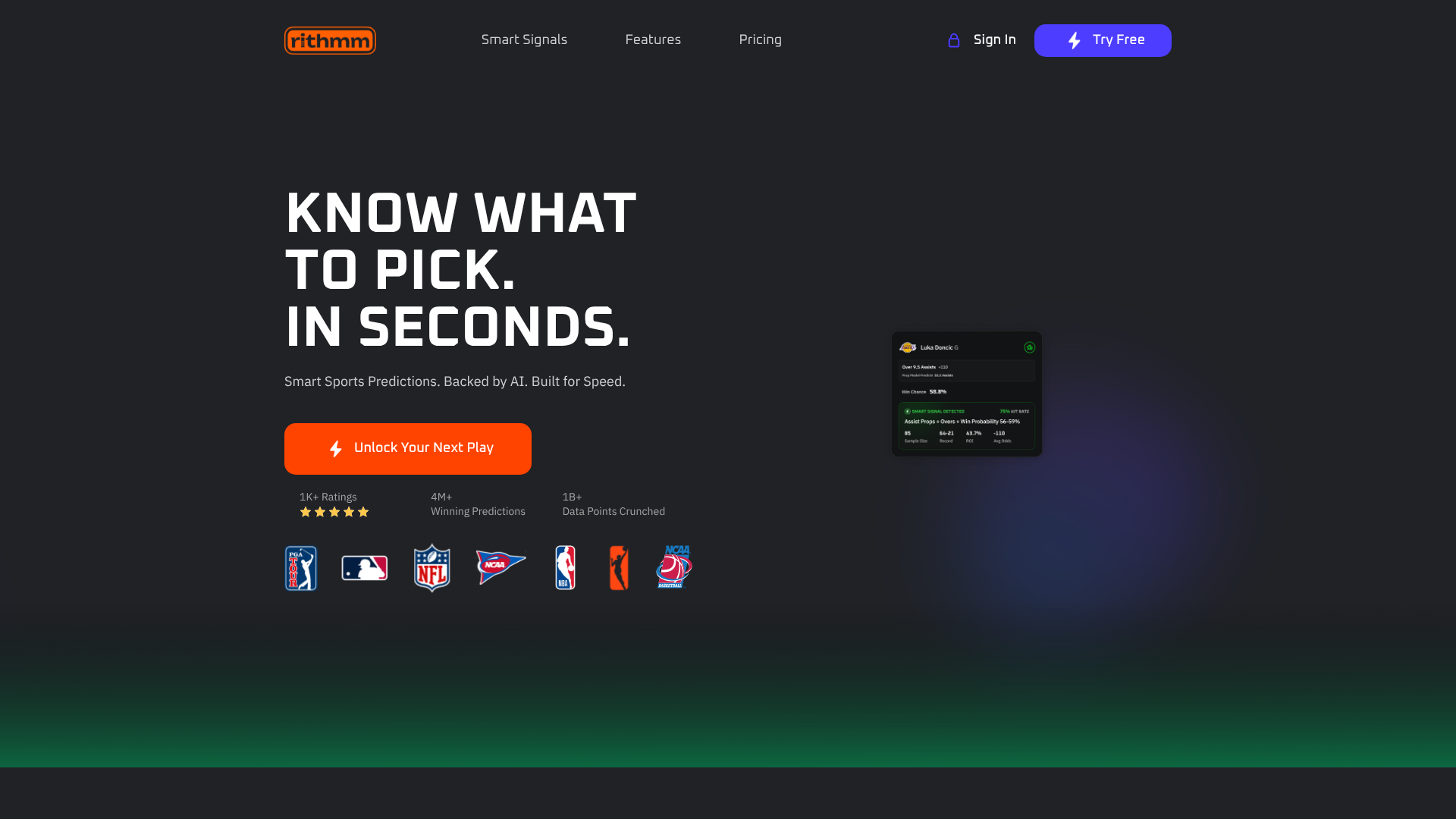
While building a model from scratch is difficult, new tools are making this level of analysis more accessible. AI-powered platforms like Rithmm allow users to build and backtest their own analytical models without needing to code. By customizing which stats you believe are most important, you can generate your own projections and compare them to the betting market to find value.
8. In-Game Action: Mastering Live Betting Strategies
Live betting, or wagering on a game after it has started, offers a dynamic and exciting way to find value. The odds and lines are constantly updating in real-time based on the action on the court. This creates unique opportunities for observant bettors.
One of the best live betting strategies is to look for overreactions in the market. For example, a heavy favorite might get off to a slow start and fall behind by 10 points in the first quarter. Their live moneyline odds might drop from -400 to -150, and their point spread might shift from -9.5 to -3.5.
If your pre-game analysis suggested this team was the much stronger side, this is a perfect opportunity to bet on them at a much better price than what was available before the game. Basketball is a game of runs, and early deficits are often overcome. You can capitalize on the market's short-term panic.
Another key strategy is to identify unsustainable trends. A team might be shooting 70% from three-point range in the first half. This is statistically unlikely to continue. This could be a good time to bet the live Under on their team total or the game total, anticipating a regression to the mean in the second half.
Live betting requires you to be watching the game and acting quickly. It's not for the faint of heart, but it can be extremely profitable if you can keep a level head and identify when the live odds are out of sync with the game's likely long-term outcome.
FAQ: Common Betting Strategy Questions
What is the 80/20 rule in betting?
The 80/20 rule, also known as the Pareto Principle, suggests that roughly 80% of your results will come from 20% of your efforts. In betting, this means you should focus your time and energy on the strategies and markets where you have the biggest edge. Instead of trying to bet on every game or every sport, specialize.
If you find you are most successful betting on NBA player props or first-half totals, dedicate the majority of your research and bankroll to those specific areas. By concentrating on your most profitable 20%, you can maximize your returns and avoid wasting resources on bets where you don't have a clear advantage.
What is the best option to bet on basketball?
There is no single "best" option, as it depends entirely on your knowledge, skills, and strategy. For bettors who excel at analyzing team matchups, pace, and overall game flow, point spreads and totals are often the best fit. These markets require a holistic understanding of how the two teams will perform against each other.
For bettors who are experts on individual players, the player props market is an excellent choice. If you have deep knowledge of a player's tendencies, their role in the offense, and their matchups, you can find significant value in betting on their points, rebounds, assists, or other statistical categories. The key is to align your betting choices with your area of expertise.
What are betting systems like the 1/3/2/6 strategy?
Systems like the 1/3/2/6 or the Martingale (doubling your bet after every loss) are progressive staking plans. They dictate how much you should bet based on the outcome of your previous wager. The 1/3/2/6 system, for example, involves a four-bet cycle where you increase your stake after each win (1 unit, then 3, then 2, then 6) and revert to 1 unit after a loss or completion of the cycle.
While these systems can seem appealing, they are generally not recommended for serious sports betting. They do not improve your ability to pick winners and can be dangerous for your bankroll. A large losing streak with a negative progression system like the Martingale can wipe out your funds very quickly. A flat-betting, unit-based approach is a much safer and more disciplined strategy for long-term success.
Final Thoughts
Becoming a successful NBA bettor is a marathon, not a sprint. It requires a commitment to research, a disciplined mindset, and a consistent strategy. There are no shortcuts or guaranteed wins, but by implementing the principles outlined in this guide, you can dramatically improve your chances of success.
Always remember that bankroll management is the foundation of everything. From there, focus on deep statistical analysis, stay vigilant with injury news, and learn to identify situational advantages. Most importantly, hunt for value in every bet you make. By consistently finding wagers where the odds are in your favor, you put yourself on the path to long-term profitability.
If you're looking to take your analysis to the next level, consider exploring tools that can streamline your process. Platforms like OddsJam for line shopping and Props.Cash for player prop research can provide the data and efficiency needed to find a consistent edge in the fast-moving NBA market.